
Official statement
Other statements from this video 1 ▾
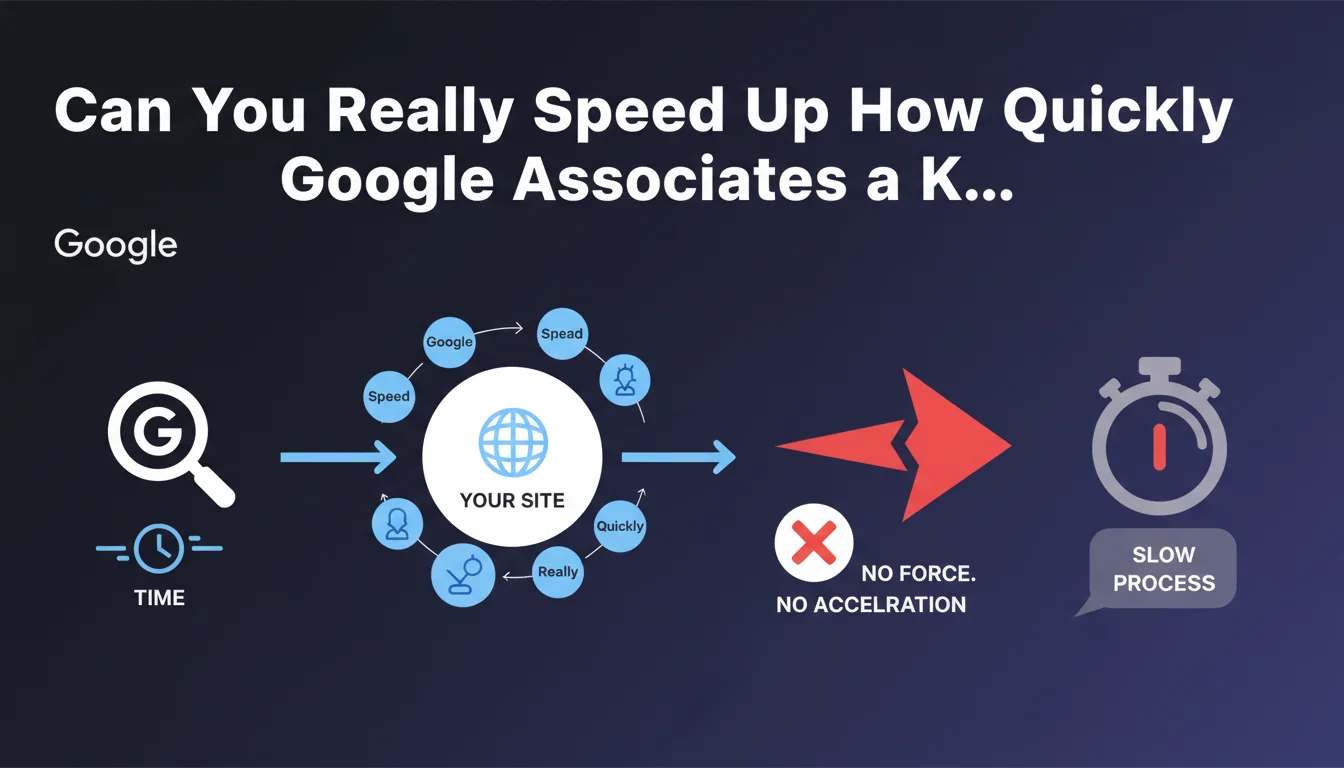
Google claims that the association of a search term with a website is a time-dependent process that cannot be forced or directly accelerated. This statement legitimizes semantic indexing delays, but remains vague about indirect levers that influence this recognition speed.
What you need to understand
What does this concept of association really mean?
When Google talks about associating a term with a site, it refers to the process by which its algorithms establish a semantic link between a specific query and your domain. It's not just indexing a page that contains the word — it's recognizing your site as a legitimate authority on that topic.
In practical terms? A site can be indexed for "running shoes" but not be considered relevant for that query for weeks or even months. Google must accumulate trust signals: clicks, session duration, contextual backlinks, content freshness.
Why does Google insist on the impossibility of forcing this process?
This statement is probably aimed at tempering expectations about immediate results. Too many sites think that adding optimized content is enough to rank instantly. Google is reminding us that its infrastructure needs time to crawl, analyze, compare, and validate relevance.
But let's be honest — saying you can "force nothing" is an oversimplification. Sites that publish viral content, obtain massive backlinks in a short time, or generate explosive social traffic do accelerate their semantic recognition. Google doesn't say it explicitly, but it's observable.
What are the underlying mechanisms behind this time factor?
Several systems come into play: the crawl budget which limits how frequently bots visit your site, semantic reindexing cycles that update thematic associations, and anti-spam filters that intentionally slow down suspicious new content.
Add to this the signal propagation delays: a powerful backlink doesn't transfer its juice instantly, behavioral data takes time to accumulate, and ranking algorithms run in waves, not continuously.
- Semantic association goes beyond simply indexing the keyword
- Google aggregates trust signals over an extended period
- Crawl budget and update cycles create structural delays
- Backlinks and social signals can indirectly accelerate the process
- New sites often experience a sandbox effect that slows association
SEO Expert opinion
Is this statement consistent with what we observe in the field?
Partly. Established sites with strong thematic authority do associate new terms faster than new domains. But the idea that you can "do nothing to speed it up" is debatable.
Techniques like link velocity boost (rapid acquisition of quality backlinks), strategic republication of viral content, or aggressive internal linking optimization show measurable gains in association speed. Google doesn't want to encourage these practices — hence this cautious statement — but they work. [To verify]: the exact share played by domain age versus the freshness of signals.
What nuances should we add to this claim?
First point: Google deliberately conflates natural speed and direct manipulation. Yes, you can't "force" the algorithm to associate you with a term via an API or magic button. But you can create conditions for it to happen faster.
Second point: this statement ignores branded queries. If you launch a product with a massive media campaign, Google associates you with the product name almost instantly. Association is "slow" only for competitive generic terms.
In which cases does this rule not really apply?
News sites are treated differently: their freshness takes priority, and association can happen in hours for breaking news events. Google acknowledges that a media site covering a hot topic must rank quickly.
Domains with strong global authority (DR 80+) also benefit from a shorter association window. Publishing content on a site like The New York Times or Wikipedia triggers near-instant recognition. The delay mainly affects small sites and new niches.
Practical impact and recommendations
What should you do concretely to optimize this delay?
First action: ensure that your crawl budget is optimized. Remove unnecessary pages, block parasitic URLs in robots.txt, and actively submit new pages via Search Console. The faster Google crawls, the faster association happens.
Second action: build contextual backlinks right from publication. A link from a thematically close site with the right anchor text accelerates semantic recognition. You don't need to wait months to start building links.
Third action: generate initial traffic through other channels (social media, email, forums). Google uses behavioral signals to validate relevance — show it that your content actually interests people.
What mistakes should you avoid that slow down association?
Don't publish orphaned content. A page without internal linking takes much longer to be crawled and associated. Link each new piece of content from your strong pages on day one.
Avoid making semantic changes too frequently. If you constantly pivot on a keyword (changing title, H1, focus keyword every week), you slow Google down as it must continuously reanalyze. Choose your target and stick with it for at least 2-3 months.
Don't wait passively either. Some SEOs interpret this statement as "we can't do anything." Wrong — you just can't cheat. But an active strategy of content, links, and social signals remains decisive.
How can you verify that the process is moving forward normally?
Monitor Search Console: the Performance tab shows which queries generate impressions. If after 4-6 weeks you don't appear anywhere for your target keywords, that's suspicious.
Use tools like Ahrefs or SEMrush to track your positioning on specific queries. A curve that doesn't move at all after 2 months could indicate a problem (duplicate content, penalty, cannibalization).
Also test branded queries that include your target term (e.g., "[your brand] + [keyword]"). If even this combination doesn't rank you, it means Google hasn't associated you with the term yet — or worse, there's a technical block.
- Optimize crawl budget and actively submit new URLs
- Build contextual backlinks right from content publication
- Generate initial traffic through social media and other channels
- Ensure solid internal linking from the start
- Maintain semantic consistency without constantly pivoting
- Monitor impressions in Search Console after 4-6 weeks
- Use tracking tools to detect blockers
❓ Frequently Asked Questions
Combien de temps faut-il en moyenne pour qu'un site soit associé à un nouveau mot-clé ?
Les backlinks accélèrent-ils vraiment l'association sémantique ?
Peut-on forcer Google à crawler plus vite une page spécifique ?
Un site d'autorité élevée contourne-t-il ce délai d'association ?
Que faire si après 3 mois aucune association ne s'est créée ?
🎥 From the same video 1
Other SEO insights extracted from this same Google Search Central video · published on 04/09/2025
🎥 Watch the full video on YouTube →
💬 Comments (0)
Be the first to comment.