
Official statement
Other statements from this video 13 ▾
- □ Does robots.txt really prevent your pages from being indexed by Google?
- □ Is the meta tag 'none' really the same as using noindex + nofollow together?
- □ Is robots.txt really ineffective at preventing your pages from being indexed by Google?
- □ Can you block indexation of entire directories using server modules instead of robots.txt?
- □ Is indexing your login pages actually hurting your user experience?
- □ Should you really use rel=canonical over noindex for aging content?
- □ Does the noarchive meta tag really prevent Google from caching your pages?
- □ Should you really use max-snippet and max-image-preview to control how your content appears in search results?
- □ Should you use individual nofollow attributes or a meta robots nofollow tag to control PageRank distribution?
- □ Why Is Google So Reluctant to Develop New Meta Robots Directives?
- □ Is the X-Robots-Tag header really the only way to keep PDFs out of Google's index?
- □ Why does robots.txt actually block images and videos but not web pages?
- □ How does Google really transform your PDFs into searchable content?
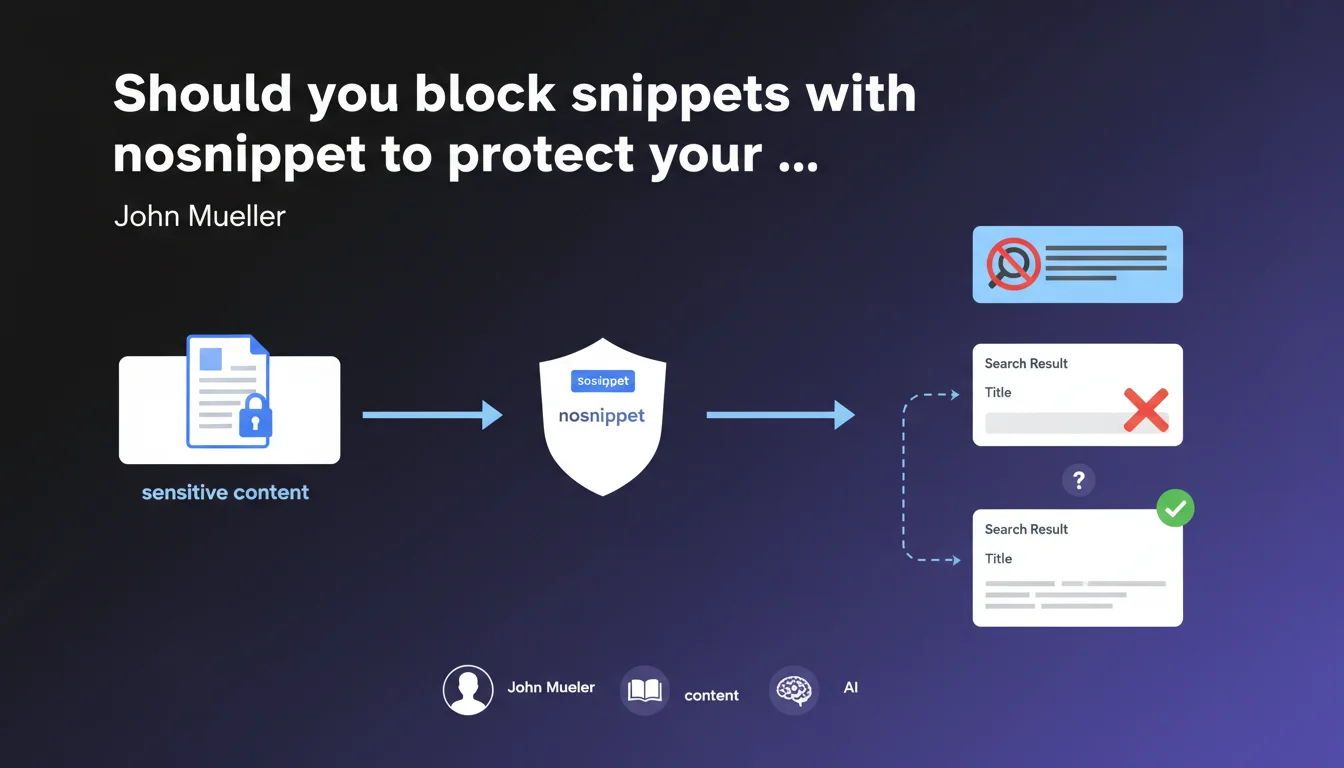
The meta tag 'nosnippet' blocks the display of content excerpts in search results while keeping the title visible. Google presents this as a solution to protect sensitive information (secret recipes, proprietary methodologies) without sacrificing the page's overall visibility.
What you need to understand
What exactly is the nosnippet tag?
The meta nosnippet tag is inserted into the <head> of a page via <meta name="robots" content="nosnippet">. It instructs search engines not to display content excerpts in search results.
The page title remains displayed, the URL too. But no description, no rich snippet, no featured snippet. The result becomes a clickable title without visual context.
Why does Google mention "secret ingredients"?
The secret ingredients example is striking for recipe websites or proprietary knowledge bases. If you publish a unique methodology, you may want to be found on the topic without giving away the complete answer in the SERP.
It's a trade-off between visibility and protection. You're betting on the click to reveal the information, at the risk of losing CTR due to a lack of attractive snippet.
What other tags affect snippet display?
Nosnippet isn't alone. Max-snippet:[number] limits the excerpt length in characters. Noarchive blocks caching. Noimageindex prevents image indexing on the page.
- nosnippet: no content excerpt displayed
- max-snippet:0: equivalent to nosnippet
- max-snippet:150: limits the excerpt to 150 characters
- data-nosnippet: HTML attribute to block specific sections of content
- These directives are combinable with other robots tags (noindex, nofollow, etc.)
SEO Expert opinion
Is this approach really effective for protecting content?
Let's be honest: nosnippet protects nothing technically. The content remains indexed, crawlable, and accessible to anyone who clicks. If someone wants to steal your secret recipe, they'll click.
What nosnippet does is make theft less passive. Content aggregators, basic scrapers that extract snippets, AIs that ingest text from SERPs — all these actors must make an extra effort. But a determined competitor won't be stopped.
What's the real cost in terms of CTR?
That's where it pinches. A result without a snippet loses visual appeal. Users scan descriptions to assess relevance before clicking. Without context, your title must carry all the weight.
If your title isn't ultra-explicit and compelling, expect a CTR drop. [To verify]: Google provides no data on the average impact of nosnippet on click-through rates — and for good reason, it's highly dependent on the query and competitive context.
In what cases does this directive make sense?
Rarely, frankly. If your content is truly sensitive, it shouldn't be indexed at all (noindex, or login wall). If you want to be found, assume the presence of a snippet — that's how organic visibility works.
Legitimate cases: ultra-targeted landing pages where the title alone converts the click, pages with dynamic or personalized content impossible to summarize, or compliance situations where displaying certain data in SERPs poses a legal issue.
Practical impact and recommendations
Should you use nosnippet on certain pages of your site?
The short answer: probably not. Most sites have more to gain from an optimized snippet than from a mutilated result. If you're an established brand, your title is explicit, and you already have authority, you can test.
But for 95% of sites, blocking snippets is like shooting yourself in the foot. The snippet is your sales pitch in the SERP — why remove it?
How do you implement nosnippet if really necessary?
Implementation is trivial. Add <meta name="robots" content="nosnippet"> to the <head> of the affected page. To block only a section, use the data-nosnippet attribute on a <div> or <span>.
Then verify via Google Search Console that the snippet has disappeared. Monitor CTR before/after — if you lose 30% of clicks, you have your answer.
- Audit pages where content displayed in snippets could be problematic (legal, competitive)
- Test nosnippet on a sample of low-traffic pages before wide deployment
- Monitor organic CTR post-implementation via GSC
- Prefer max-snippet to limit length rather than blocking everything
- Use data-nosnippet to exclude only sensitive sections (prices, internal contacts, methodologies)
- Never apply nosnippet to critical conversion pages (products, services)
❓ Frequently Asked Questions
Nosnippet empêche-t-il l'indexation de la page ?
Peut-on bloquer uniquement une partie du snippet ?
Nosnippet affecte-t-il les featured snippets ?
Quelle différence entre nosnippet et max-snippet:0 ?
Le CTR baisse-t-il systématiquement avec nosnippet ?
🎥 From the same video 13
Other SEO insights extracted from this same Google Search Central video · published on 30/06/2022
🎥 Watch the full video on YouTube →
💬 Comments (0)
Be the first to comment.