
Official statement
Other statements from this video 9 ▾
- □ Do structured data implementations really guarantee rich snippet display in Google search results?
- □ Is Google really cutting down the Page Experience Report to just Core Web Vitals and HTTPS?
- □ Did Google really move the robots.txt testing tool and why does it matter for your site?
- □ Should you still worry about crawl budget now that Google is removing the crawl frequency parameter?
- □ Should you slow down Googlebot when it's crawling your site too aggressively?
- □ What are Google's real priorities hidden behind its latest algorithmic updates?
- □ Should you block Google's generative AI in robots.txt? Here's what you need to know about Google-Extended
- □ Is the death of third-party cookies threatening your e-commerce conversions?
- □ Is Google finally giving you the structured data transparency you've been waiting for?
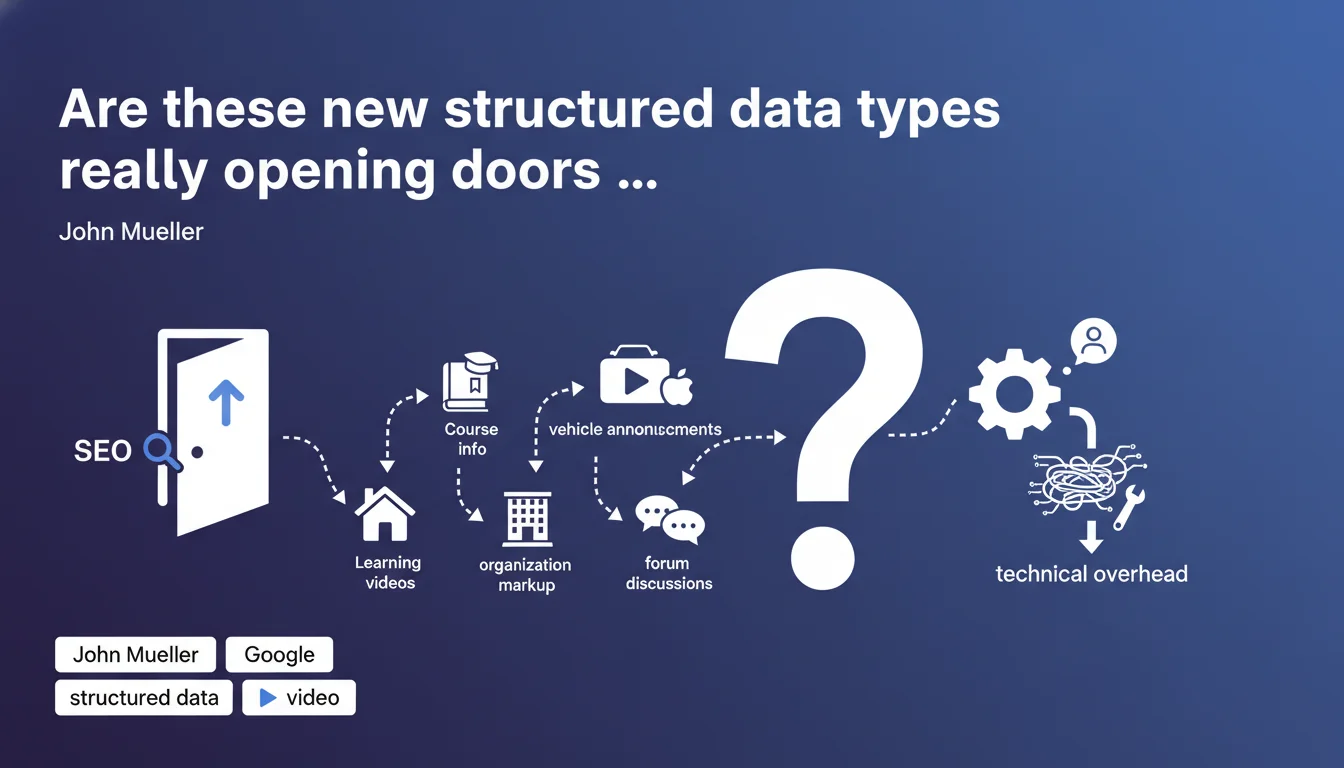
Google is rolling out six new structured data types: educational courses, automotive listings, educational videos, vacation rentals, expanded organization markup, and tagging for forum discussions and user profile pages. These additions aim to enrich search results in specific sectors. In practice? More opportunities for rich display, but also more technical complexity to manage.
What you need to understand
Why is Google multiplying structured data types?
Google is working to structure web content to better understand pages and display richer results. These new types address specific sectoral needs: education, automotive, tourism, online communities.
The objective is twofold. First, improve user experience by providing information directly in the SERPs (price, availability, ratings). Second, reduce reliance on plain text — Google wants clear, actionable data for its algorithms.
Which sectors are directly affected?
Educational platforms (online courses, universities) can now markup their educational content and videos. Auto dealerships gain a dedicated format for their listings. Vacation rentals (like Airbnb) finally have an official schema.
Forums and social networks — Reddit, Stack Overflow, LinkedIn — can markup discussions and user profiles. This changes the game for community platforms that want to push their user-generated content.
Do these new types replace existing schemas?
No, they complement the current toolkit. Organization markup is expanded (new fields), but core schemas (Article, Product, Event) remain unchanged. It's a strategy of progressive enrichment.
Google tests, iterates, then generalizes — or abandons. Some structured data types end up forgotten if adoption is low. Speakable, anyone?
- Six new types cover education, automotive, tourism, forums
- No replacement — enrichment of existing schemas
- Google wants actionable data, not ambiguous text
- Not all sectors are concerned — vertical targeting
- Adoption remains optional but strategic for visibility
SEO Expert opinion
Will these new types really impact your CTR?
Hard to quantify without real field data. [To be verified] — Google never shares precise numbers on the impact of rich snippets by type. Historically, well-implemented structured data increases CTR (between 10% and 30% according to studies), but it all depends on the sector and competition.
For vacation rentals and automotive listings, the effect should be measurable: price, availability, and visuals catch the eye. For forums and profiles? Less obvious. Google already displays discussion excerpts — markup could just formalize what already exists.
Will Google really leverage all these new schemas?
Caution advised. Google regularly announces new types of structured data that it never displays systematically. Implementation doesn't guarantee anything — it just makes you eligible.
The trigger criteria remain opaque: search volume, content quality, competition, geographic relevance. Some sites mark up everything correctly and see no rich snippets. Others — often the big players — immediately benefit from the new formats.
Is this multiplication of schemas good news?
Yes and no. For specialized sites, it's an opportunity to stand out in the SERPs. For small sites with limited technical resources, it's another headache.
The risk? Creating an SEO divide between those who can afford comprehensive markup maintenance and those who can't. Google is pushing toward increased complexity that mechanically favors large players and teams with solid technical expertise.
Practical impact and recommendations
Should you implement these new types immediately?
Only if your site falls into one of the targeted categories. Selling cars? Go for the Vehicle schema. Managing a forum or community? Test DiscussionForumPosting and ProfilePage.
For everyone else — news sites, standard e-commerce, corporate blogs — no rush. Focus first on the fundamentals: Article, Breadcrumb, Organization, Product, FAQ.
How do you verify implementation is correct?
Use the Google Rich Results Test for each new type you implement. Warning: technical validation ≠ guaranteed display. Google can validate the schema and never show it in results.
Monitor Search Console — Enhancements section. Google flags markup errors, but not actual SERP display. For that, you need to manually monitor search results or use a SERP tracking tool.
- Identify whether your sector is affected by the new types (courses, auto, vacations, forums)
- Prioritize established schemas before experimenting with new ones
- Use the Rich Results Test to validate technically
- Monitor Search Console for errors and warnings
- Test actual SERP display — validation guarantees nothing
- Document your implementation for easier maintenance
- Schedule regular monitoring — Google changes the rules often
These new types open opportunities for certain vertical sectors, but require specialized technical expertise and constant monitoring. Between Schema.org documentation, Google's specific requirements, and performance monitoring, complexity escalates quickly.
If your team lacks bandwidth or structured data skills, it may be wise to get support from an SEO agency specialized in this field that can master these technical challenges and integrate these optimizations into a coherent overall strategy.
❓ Frequently Asked Questions
Les données structurées sont-elles un facteur de classement ?
Que se passe-t-il si mon balisage contient des erreurs ?
Peut-on combiner plusieurs types de schémas sur une même page ?
Google affichera-t-il ces nouveaux rich snippets partout dans le monde ?
JSON-LD, Microdata ou RDFa : quel format privilégier ?
🎥 From the same video 9
Other SEO insights extracted from this same Google Search Central video · published on 19/12/2023
🎥 Watch the full video on YouTube →
💬 Comments (0)
Be the first to comment.