
Official statement
Other statements from this video 9 ▾
- □ Données structurées : Google ouvre-t-il vraiment de nouvelles opportunités ou complique-t-il encore la tâche ?
- □ Les données structurées garantissent-elles vraiment un affichage en résultats enrichis ?
- □ Pourquoi Google simplifie-t-il le rapport d'expérience de page dans Search Console ?
- □ Pourquoi Google a-t-il déplacé l'outil de test robots.txt dans Search Console ?
- □ Faut-il encore se soucier du crawl budget maintenant que Google supprime le paramètre de fréquence d'exploration ?
- □ Comment ralentir Googlebot quand il explore trop votre site ?
- □ Quelles sont les vraies priorités derrière les dernières mises à jour algorithmiques de Google ?
- □ Google-Extended dans robots.txt : faut-il bloquer l'IA générative de Google ?
- □ La fin des cookies tiers menace-t-elle vos conversions e-commerce ?
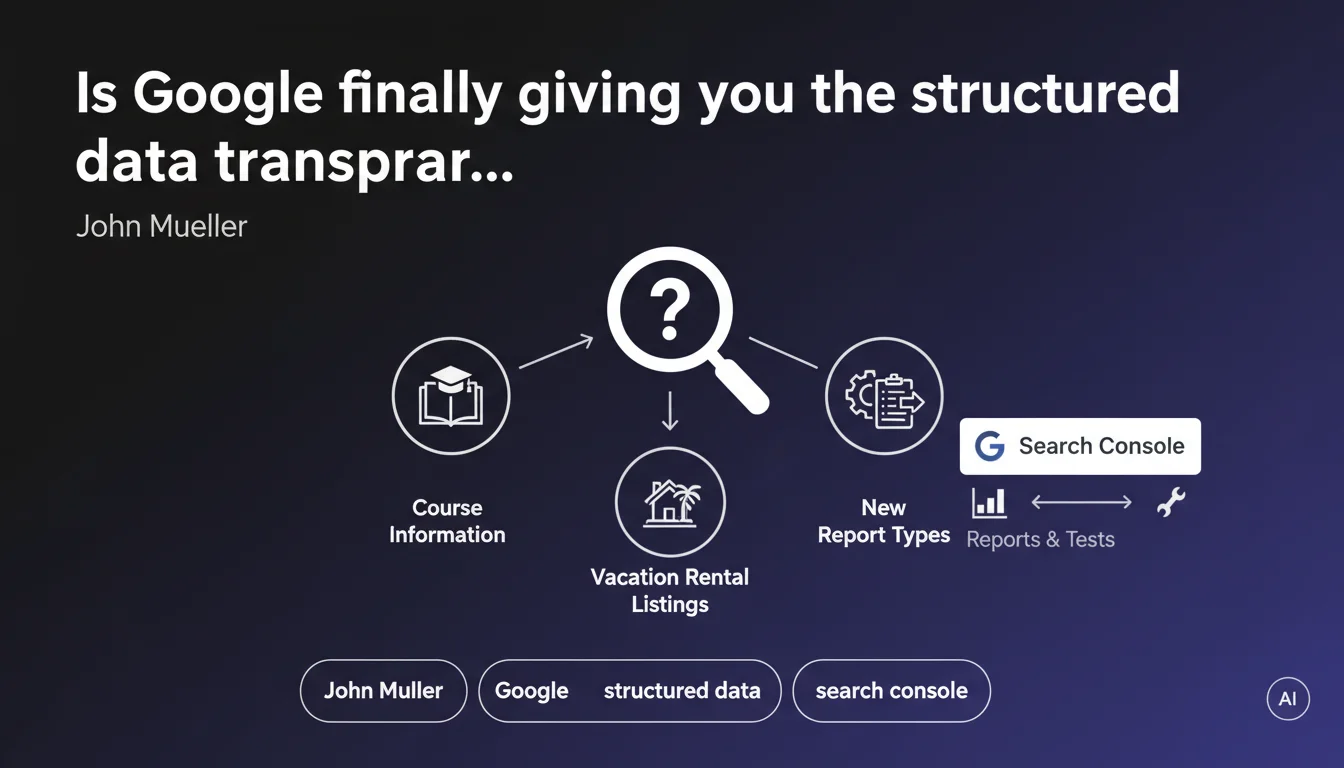
Google is rolling out new Search Console reports dedicated to emerging structured data types: online courses, vacation rentals, and other formats that have been poorly documented until now. These tools finally allow you to validate and monitor formats that many sites were already using without clear feedback. The real question is whether this increased visibility will become an indirect ranking factor.
What you need to understand
Which new types of structured data are being covered?
Google explicitly mentions online courses and vacation rentals, two highly competitive verticals where structured data plays a key role in landing rich snippets. But the wording suggests there are others — without specifying which ones.
Until now, these types were validatable through the Rich Results Test, but errors reported in Search Console were often piecemeal. Now, each format has its own report with metrics for impressions, errors, and improvement suggestions.
Why this shift now?
Google has gradually expanded its rich results catalog over the years. But the maintenance on the Search Console side was lagging: functional structured data types in production had no dedicated report.
This update fills a major gap in the toolkit. Let's be honest, it's also a way for Google to push adoption of these formats by making their implementation less opaque. The more sites use them, the richer the ecosystem of rich snippets becomes — and the more differentiated results Google can display.
What concretely changes in this report for a site that already has structured data?
If your site already uses these formats, you'll finally see the critical errors that block eligibility for rich results, and especially the warnings that, while non-blocking, can harm markup relevance.
The report also provides data on impressions by rich result type, which allows you to correlate markup quality with actual SERP visibility. Before, it was a guessing game: you had to cross-reference Google Analytics, third-party tools, and manual tests.
- Access to dedicated reports by structured data type (courses, rentals, etc.)
- Visibility into critical errors and non-blocking warnings
- Impression metrics by rich snippet format
- Ability to validate fixes directly from Search Console
- Error history to track progress after corrections
SEO Expert opinion
Is this announcement consistent with what we're seeing in the field?
Yes and no. Over the past few months, we've noticed better error reporting in Search Console for certain structured data types — particularly events and products. But this improvement remains uneven across verticals.
For vacation rentals, for example, many sites apply schema.org LodgingBusiness or Offer without clear feedback from Google. If this report finally allows you to see which properties are misconfigured, that's a real win. [To verify]: are all the announced types actually available to all Search Console accounts, or is this a gradual rollout? Google doesn't clarify.
Which structured data types still remain unclear?
Google remains tight-lipped about formats that are widely used: FAQs, HowTo, or even SpecialAnnouncement (hugely popular during the pandemic, but poorly maintained since). Some reports exist, others don't — and Google's prioritization logic isn't always obvious.
If you're working on an e-commerce site using Product, Review, and AggregateRating, you already have a dedicated report. But if you manage an education site with Course, you had to make do with the Rich Results Test and hope it works. This gap is shrinking, but gray areas remain.
Should we expect an impact on rankings?
Google keeps saying that structured data isn't a direct ranking factor. But that's half the truth: they influence CTR through rich snippets, so indirectly traffic and potentially user behavior.
With these new reports, Google makes it easier to optimize structured data — which suggests it wants to encourage their massive adoption. If tomorrow 80% of sites in a vertical have flawless markup, those who don't play along risk losing relative visibility. Not because of a penalty, but through contrast effect in the SERP.
Practical impact and recommendations
What should I do if my site targets these verticals?
First step: audit the Search Console reports for the new structured data types announced. If you manage an online learning site or a booking platform, you need to check that the reports are active and identify critical errors.
Next, compare the Search Console data with a test via the Rich Results Test and the Schema Markup Validator. The three tools don't always report the same warnings — and some blocking errors can slip through unnoticed in a single tool.
What errors are most common with these structured data types?
For online courses (schema.org/Course), recurring issues involve the provider and offers properties: many sites forget to provide the price or training organization, making the markup incomplete in Google's eyes.
For vacation rentals, it's often the accommodation type (Hotel, Hostel, Apartment…) that's problematic, or the absence of precise geo data (latitude/longitude). Google is very strict about these properties to prevent abuse.
How do I validate that fixes are actually being picked up?
After fixing, use the "Validate fix" function in Search Console. Google will re-crawl the affected pages and update the status within a few days (sometimes a few weeks depending on crawl frequency).
In parallel, monitor the impressions for rich snippets in the performance report. If your markup is correct but impressions aren't rising, it means Google is choosing not to display the enriched result — either due to lack of relevance or because the query doesn't warrant it.
- Check that new Search Console reports are activated for your site
- Audit critical errors and warnings for each structured data type
- Cross-reference diagnostics from Search Console, Rich Results Test, and Schema Validator
- Fix missing or poorly formatted properties (offers, provider, geo…)
- Test markup validity on a representative sample of pages
- Request validation in Search Console after fixes
- Monitor evolution of rich snippet impressions over the next 2-4 weeks
❓ Frequently Asked Questions
Ces nouveaux rapports sont-ils disponibles pour tous les sites dans Search Console ?
Un site sans ces données structurées est-il pénalisé en référencement ?
Peut-on combiner plusieurs types de structured data sur une même page ?
Le Rich Results Test et le rapport Search Console montrent-ils les mêmes erreurs ?
Combien de temps faut-il pour que les corrections de structured data soient prises en compte ?
🎥 From the same video 9
Other SEO insights extracted from this same Google Search Central video · published on 19/12/2023
🎥 Watch the full video on YouTube →
💬 Comments (0)
Be the first to comment.