
Official statement
Other statements from this video 9 ▾
- □ Données structurées : Google ouvre-t-il vraiment de nouvelles opportunités ou complique-t-il encore la tâche ?
- □ Les données structurées garantissent-elles vraiment un affichage en résultats enrichis ?
- □ Pourquoi Google simplifie-t-il le rapport d'expérience de page dans Search Console ?
- □ Pourquoi Google a-t-il déplacé l'outil de test robots.txt dans Search Console ?
- □ Faut-il encore se soucier du crawl budget maintenant que Google supprime le paramètre de fréquence d'exploration ?
- □ Comment ralentir Googlebot quand il explore trop votre site ?
- □ Google-Extended dans robots.txt : faut-il bloquer l'IA générative de Google ?
- □ La fin des cookies tiers menace-t-elle vos conversions e-commerce ?
- □ Pourquoi Google élargit-il soudainement ses rapports Search Console aux données structurées ?
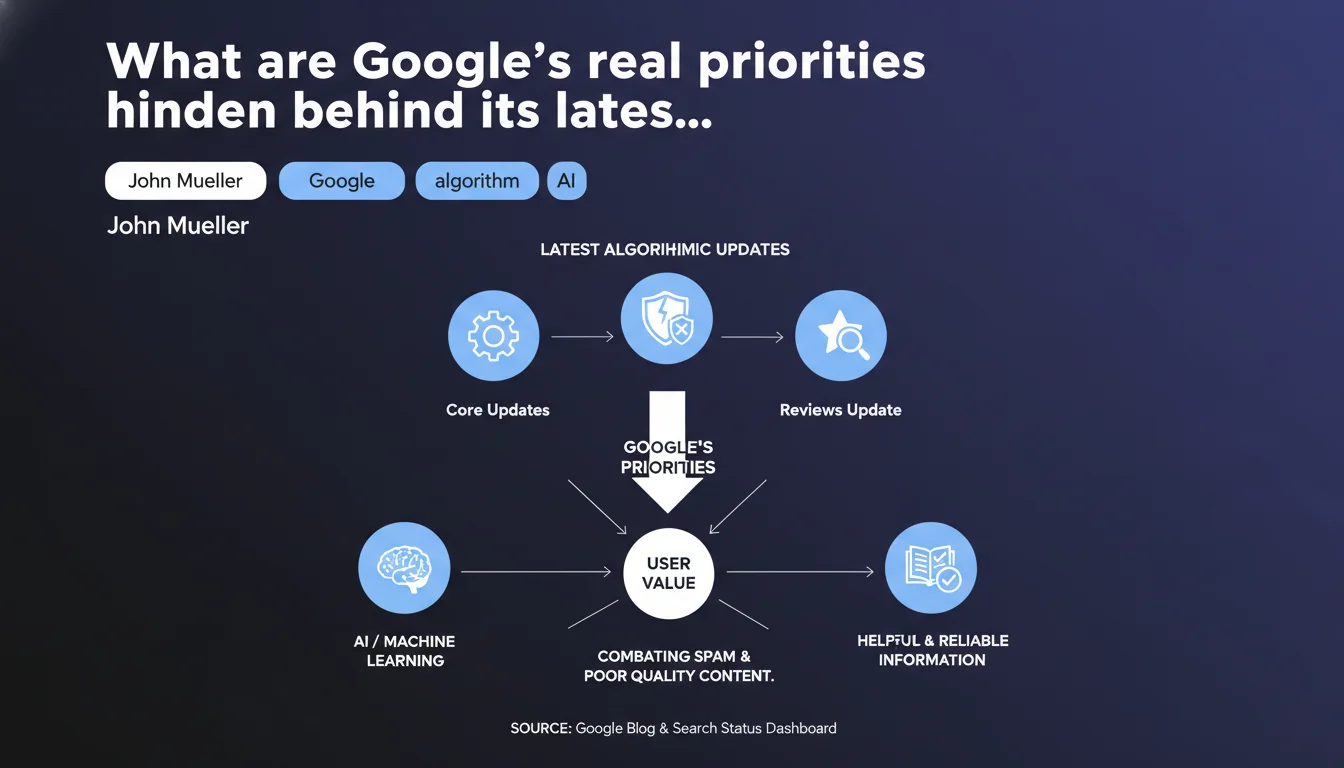
Google has simultaneously rolled out multiple major updates: Core Updates, a spam update, and a Reviews update. The announcement remains highly generic, redirecting to the blog and dashboard without actionable details. The key takeaway: monitor these grouped deployments that can create cumulative effects that are difficult to diagnose.
What you need to understand
Why is Google rolling out multiple updates simultaneously?
Google now orchestrates grouped deployments of updates that target different layers of its algorithm. A Core Update modifies global relevance signals, the spam update strengthens filters against manipulation, and the Reviews update specifically targets review content.
This coordinated schedule is no accident. It allows Google to mask the individual effects of each update behind an algorithmic cocktail where nobody can precisely isolate what caused a traffic fluctuation.
What does this announcement really mean for an impacted site?
Let's be honest: this statement is a textbook example of vague communication. No precise timeline, no specific metrics, just redirection to generic resources.
For a practitioner, it means you'll need to cross-reference multiple data sources — Search Console, analytics, position tracking tools — to determine whether your site was affected, and especially which component of this update bundle impacted it.
What concrete signals should you monitor?
- Abnormal SERP volatility on your primary keywords over 7 to 14 days
- Selective traffic drops on specific page categories (review pages, informational content, etc.)
- Manual action messages appearing in Search Console or increased exclusions for spam
- Differentiated behavior by query type: certain verticals take harder hits from these grouped updates
SEO Expert opinion
Is this vague communication a deliberate strategy?
Absolutely. By bundling multiple updates and remaining deliberately vague about evaluation criteria, Google protects itself against two risks: reverse-engineering attempts and accusations of arbitrary targeting.
The problem? This opacity makes diagnosis nearly impossible for moderately impacted sites. You lose 15% of traffic — is it due to the Core Update that reevaluated your overall relevance, the spam filter that demoted certain pages, or the Reviews update if you have review content? [To verify] by cross-referencing with patterns observed on similar sites.
Do field observations contradict these announcements?
Regularly. Google announces "general" Core Updates, but we observe highly sector-specific impacts: e-commerce, health, finance often experience disproportionate shocks compared to other verticals.
The parallel spam update also creates false positives — legitimate sites penalized because a behavioral signal remotely resembles manipulation. And Google never documents this publicly.
How much credibility should you give official resources mentioned?
Google's blog and status dashboard? These are surface-level indicators. Useful for confirming an update is underway, but completely insufficient for understanding the levers being activated.
Real insights come from empirical cross-referencing: SEO forums, case studies, correlation analysis between technical signals (speed, structure, backlinks) and observed fluctuations. Google will never publicly document the thresholds or weightings applied.
Practical impact and recommendations
What should you concretely do when these updates roll out?
First, identify whether your site is actually impacted. Many normal fluctuations are wrongly attributed to updates. Segment your Search Console data by page type, search intent, product category.
Next, don't react immediately. The first 48-72 hours of a rollout are often unstable, with yo-yo effects before stabilization. Document variations, but avoid rushed structural modifications.
What mistakes should you absolutely avoid?
Mistake #1: assuming a traffic drop is necessarily due to algorithmic penalty. Sometimes it's an evolution of the SERPs (new featured snippets, People Also Ask capturing clicks) unrelated to your site's quality.
Mistake #2: massively revising your content or internal linking in panic mode. If Google reevaluated your site's thematic relevance, adding text by the ton won't solve anything. You need to identify the degraded signal — authority, freshness, depth, UX — before acting.
- Export a snapshot of your positions before/during/after the update on your top 100 keywords
- Compare organic traffic curves with sector trends (tools like SEMrush, Sistrix)
- Check Search Console for any manual messages or increased exclusions
- Analyze whether direct competitors gained the traffic you lost (visibility reallocation)
- Audit the most impacted pages to detect common patterns (thin content, toxic backlinks, speed)
- Wait 14 days before any major structural modification
How can you turn these fluctuations into opportunities?
Grouped updates create repositioning windows. If competitors drop while you stay stable, it's time to accelerate link building and premium content production to consolidate.
Conversely, if you're impacted, it's an opportunity for a complete technical and editorial audit: semantic structure, user experience, E-E-A-T signals, link profile. These complex diagnostics often require specialized expertise — many companies choose to partner with a specialized SEO agency to avoid false leads and prioritize truly profitable initiatives.
❓ Frequently Asked Questions
Combien de temps dure généralement le déploiement d'une Core Update ?
Peut-on récupérer du trafic perdu lors d'une Core Update ?
La mise à jour spam peut-elle toucher un site légitime ?
Comment savoir quelle mise à jour a impacté mon site ?
Faut-il attendre la prochaine Core Update pour récupérer ?
🎥 From the same video 9
Other SEO insights extracted from this same Google Search Central video · published on 19/12/2023
🎥 Watch the full video on YouTube →
💬 Comments (0)
Be the first to comment.