
Official statement
Other statements from this video 14 ▾
- □ Do ccTLDs Really Give You a Geographic SEO Advantage?
- □ Does your domain extension really impact SEO rankings?
- □ Should you really avoid cheap domain extensions for your SEO?
- □ Why does Google treat certain ccTLDs the same way as generic domain extensions?
- □ Do .edu and .gov domains really provide an SEO advantage?
- □ Does your domain extension (TLD) really impact your search rankings?
- □ Does a .coffee or .tech domain really boost your search rankings?
- □ Should you always verify a domain's history before buying it?
- □ Do keywords in your domain name really matter for SEO rankings?
- □ Do hyphens in domain names really hurt your SEO rankings?
- □ Should you prioritize branding over exact keywords in your domain name?
- □ Does your choice between www and non-www really impact your search rankings?
- □ Is it time to ditch the m. subdomain for mobile?
- □ Should you really avoid publishing a 'Coming Soon' page on a new domain?
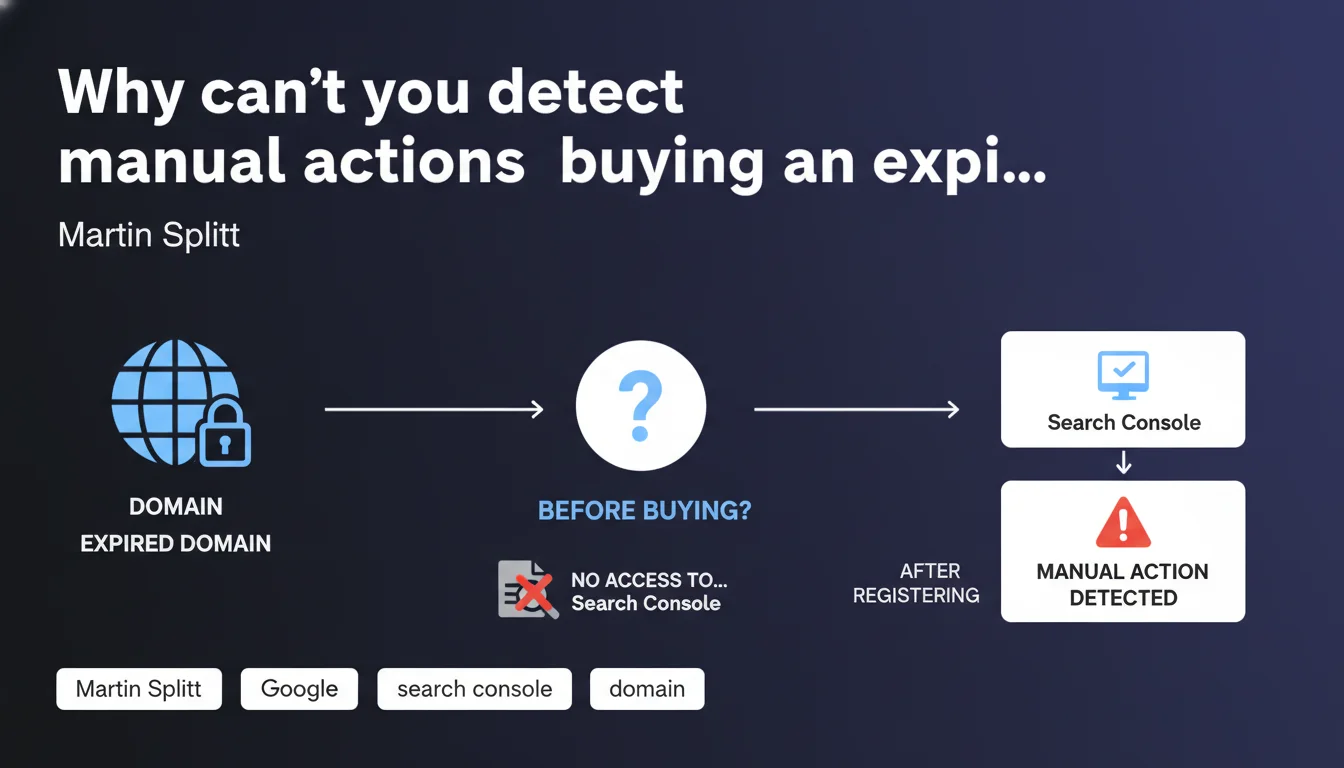
Google confirms it's impossible to check whether a domain has a manual action before registering it in Search Console. In practice, buying expired domains is like playing Russian roulette: you'll only discover a penalty after acquisition, when it's too late to back out. This structural risk calls into question the entire strategy of buying expired domains without a safety net.
What you need to understand
What is a manual action and how does it affect a domain?
A manual action occurs when a human reviewer at Google detects practices that violate guidelines: artificial links, massive duplicate content, pure spam. Unlike algorithmic adjustments, these penalties are notified in Search Console and require human intervention to be lifted.
The problem? This notification is only visible to the legitimate domain owner, the one who has access to Search Console. If you buy an expired domain without registering it first — which is impossible since you don't own it yet — you're flying blind.
Why doesn't Google offer a public verification tool?
Martin Splitt confirms a deliberate information asymmetry. There is no mechanism to verify the history of penalties before acquisition. No API, no reliable third-party tool, nothing.
Google could technically expose this data — after all, manual actions are documented in its systems. But the company chooses not to, probably to prevent this information from becoming a market signal in domain trading. Result: you buy at your own risk.
What concrete risks does this entail for expired domain buyers?
You invest in an expired domain for its backlink history or perceived authority. You register it in Search Console, and boom: manual action for artificial links from 3 years ago. You inherit a penalty that the previous owner never lifted.
The worst part? Even after an accepted reconsideration request, the domain remains flagged in Google's history. Algorithms maintain long-term memory of past behavior. You never truly start from scratch.
- Inability to verify manual actions before purchasing an expired domain
- Exclusive notification via Search Console, accessible only after legal ownership
- Risk of inheriting unresolved penalties from the previous owner
- No reliable third-party tool to detect these sanctions upfront
- Persistent history even after the manual action is lifted
SEO Expert opinion
Is this statement consistent with on-the-ground observations?
Absolutely. SEO practitioners have known this reality for years: no external tool detects manual actions. Platforms like Ahrefs, Majestic, or SEMrush can analyze backlinks, but they don't see what happens in Google's internal systems.
The problem goes deeper. Even indirect signals — sudden traffic drops, ranking disappearances — don't distinguish a manual action from an algorithmic update like Penguin or Helpful Content. You're navigating blind until you register in Search Console.
What nuances should be added to this claim?
There are a few preliminary indicators, but they remain imperfect. A Wayback Machine analysis can reveal massive spam content. A link profile of 100% directories or suspicious Asian sites suggests a questionable past. But these signals prove nothing — a clean domain can have an odd profile, a penalized domain can look clean on the surface.
Another nuance: not all manual actions are equal. A penalty for thin content lifts relatively quickly if you publish solid content. An action for artificial links requires massive disavowing and several months of purgatory. The risk is therefore graduated, but you only discover it after purchase. [To verify]: some domain resellers claim to have contacts at registrars to verify history — pure smoke in 99% of cases.
In what cases could this rule be circumvented?
Legally? Never. You can't register a domain in Search Console without owning it. Some attempt creative workarounds: buying the domain through a third party who verifies before transfer, negotiating a withdrawal clause if a manual action is detected. But these strategies rely on trust and remain legally fragile.
The only viable approach: buy domains with verifiable and transparent history. Prioritize domains that belonged to known companies, whose Wayback history shows legitimate usage. But even then, an intermediate owner could have ruined the domain between two archives.
Practical impact and recommendations
How can you minimize risk when buying an expired domain?
First rule: never buy an expired domain without a buffer budget to absorb a total loss. If your strategy relies entirely on the inherited authority of a domain, a single penalized domain can ruin your project.
Second rule: verify the Wayback Machine history over at least 3 different periods. Look for warning signs: content in incoherent multiple languages, casino/pharma pages, suspicious redirects. It's not foolproof, but it filters out the worst cases.
Third rule: immediately upon acquisition, register the domain in Search Console. If a manual action is detected, don't develop the site before obtaining a penalty lift. Every day spent publishing content on a penalized domain is wasted time.
What alternatives exist to avoid this structural risk?
The most obvious: create a new domain. Yes, you start from scratch in terms of authority, but you control the history. In the long run, a clean domain often outperforms a poorly chosen expired domain.
If you absolutely must exploit expired domains, focus on acquiring active sites rather than abandoned domains. A site sold by its owner gives access to Search Console before the transaction — you negotiate with full knowledge. Yes, it's more expensive. But that's the price of transparency.
What if you discover a manual action after purchase?
Don't panic — some actions lift easily. Start by analyzing the nature of the penalty: artificial links, thin content, user-generated spam? Each type requires a different strategy.
For artificial links, prepare yourself for painstaking work: massive disavowing, cleaning over-optimized anchors, requesting removal from source sites. Document every action in your reconsideration request — Google wants to see tangible efforts, not vague promises.
For thin content, publish substantial and unique content before submitting your reconsideration request. Google doesn't lift an action on the promise of doing better — it wants to see real improvements.
- Verify Wayback history over multiple periods before purchase
- Analyze the backlink profile to detect suspicious patterns (over-optimized anchors, spam sites)
- Register the domain in Search Console immediately after acquisition
- Don't develop content while a manual action is unresolved
- Prioritize purchasing active sites with Search Console access pre-transaction
- Build a buffer budget to absorb losses on penalized domains
- Document all corrective actions for reconsideration requests
- Consider creating new domains for strategic projects
❓ Frequently Asked Questions
Peut-on contourner cette limitation avec des outils SEO tiers ?
Un domaine expiré sans action manuelle est-il forcément sain ?
Combien de temps après achat faut-il pour détecter une action manuelle ?
Une action manuelle levée laisse-t-elle des traces dans l'algorithme ?
Vaut-il mieux acheter un domaine expiré ou créer un domaine neuf ?
🎥 From the same video 14
Other SEO insights extracted from this same Google Search Central video · published on 20/07/2023
🎥 Watch the full video on YouTube →
💬 Comments (0)
Be the first to comment.