
Official statement
Other statements from this video 14 ▾
- □ Does your domain extension really impact SEO rankings?
- □ Should you really avoid cheap domain extensions for your SEO?
- □ Why does Google treat certain ccTLDs the same way as generic domain extensions?
- □ Do .edu and .gov domains really provide an SEO advantage?
- □ Does your domain extension (TLD) really impact your search rankings?
- □ Does a .coffee or .tech domain really boost your search rankings?
- □ Should you always verify a domain's history before buying it?
- □ Why can't you detect manual actions before buying an expired domain?
- □ Do keywords in your domain name really matter for SEO rankings?
- □ Do hyphens in domain names really hurt your SEO rankings?
- □ Should you prioritize branding over exact keywords in your domain name?
- □ Does your choice between www and non-www really impact your search rankings?
- □ Is it time to ditch the m. subdomain for mobile?
- □ Should you really avoid publishing a 'Coming Soon' page on a new domain?
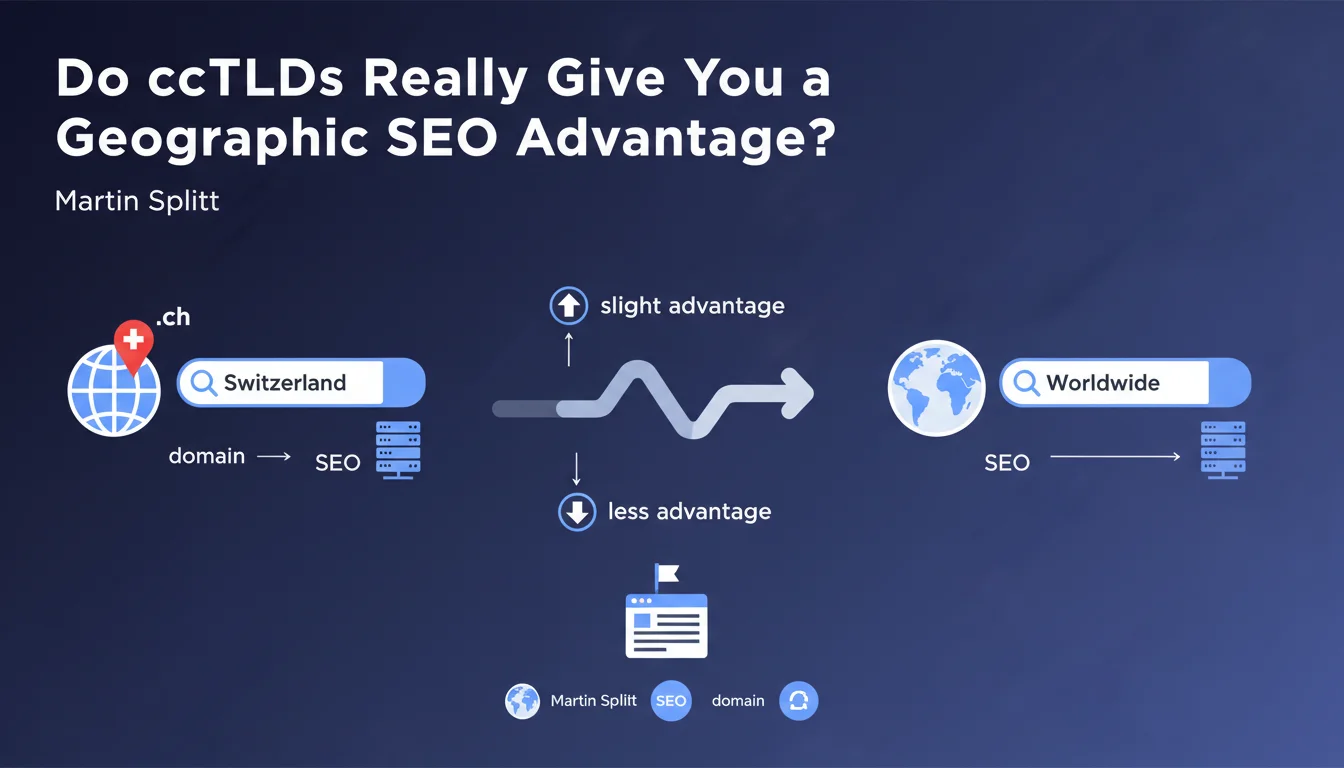
Google confirms that country-code domains (ccTLDs like .ch, .fr, .de) influence geo-targeting in search results. A .ch site will have a slight advantage for queries performed from Switzerland. This geographic preference remains moderate but real in the ranking algorithm.
What you need to understand
What is a ccTLD and how does it work?
A ccTLD (Country Code Top-Level Domain) is a domain extension tied to a specific country: .fr for France, .ch for Switzerland, .de for Germany. Unlike generic extensions (.com, .net), these domains send a strong geographic signal to Google.
Martin Splitt clarifies that this signal influences automatic geo-targeting. When you use a .ch, Google considers by default that your content primarily targets Swiss users — without you needing to configure anything in Search Console.
What does "a slight advantage" actually mean?
Google's wording deliberately remains vague. "Slight advantage" doesn't mean your .ch will automatically beat every .com on a local query. It means that, with equivalent content quality, Google may favor the ccTLD corresponding to the user's geolocation.
It's neither a dominant ranking factor nor an anecdotal detail. It's one signal among many — content relevance, authority, UX signals, local backlinks, LocalBusiness structured data — that combine to define a page's geographic relevance.
In what cases is this signal truly decisive?
The ccTLD becomes strategic in contexts where local competition is strong and other signals are relatively balanced between multiple sites. If you're targeting a well-defined national market with a homogeneous audience, the ccTLD clarifies your intent.
Conversely, for an international brand targeting multiple countries, this logic becomes complicated. A .com with manual Search Console geo-targeting by directory (/fr/, /de/) can be more flexible than managing multiple ccTLDs separately.
- ccTLDs send an automatic geographic signal to Google without additional configuration
- This signal offers a moderate advantage for local searches, not a ranking guarantee
- Content relevance, domain authority, and UX signals remain top priority
- Generic extensions (.com) can compensate through manual targeting in Search Console
- The choice between ccTLD and multilingual structure depends on your international strategy and technical resources
SEO Expert opinion
Is this statement consistent with what we observe in the field?
Yes, overall. Empirical tests show that a well-optimized .fr often performs better than an equivalent .com for geo-localized queries in France — especially in competitive sectors like local e-commerce or proximity services.
But be careful: the gap is never massive. If your .com has crushing authority, solid internal linking, and an established trust history, it will easily beat a recent .fr with few backlinks. The ccTLD is not a magic wand.
What nuances doesn't Google specify here?
The statement remains vague about the actual intensity of this "slight advantage." [To verify]: no figures, no precise weighting. We don't know if this signal accounts for 5% or 15% in the final ranking decision for a local query.
Another gray area: how does Google handle ambiguous ccTLDs? Some domains like .co (Colombia) or .io (British Indian Ocean Territory) are technically ccTLDs but used as generic extensions by startups worldwide. Does Google treat them as de facto gTLDs? Splitt doesn't say.
Finally, nothing about the interaction between ccTLD and Search Console targeting. If you own a .ch but manually target France in GSC, what happens? Does the technical ccTLD signal take precedence or does GSC override it? [To verify] — field feedback suggests GSC can override the ccTLD, but this isn't officially documented.
Practical impact and recommendations
Should you switch to a ccTLD if you're targeting a single national market?
If you're exclusively focused on a single country — say Switzerland — and have no plans for rapid expansion elsewhere, yes, a .ch makes sense. You simplify the signal sent to Google, you reassure local users (a non-negligible psychological effect), and you benefit from a slight algorithmic boost.
But don't migrate lightly. A domain migration, even well-executed, carries risks: temporary ranking loss, 301 redirects to monitor, updating all your external backlinks if possible. Evaluate the benefit/risk ratio with lucidity.
How do you manage a multi-country strategy without multiplying ccTLDs?
If you're targeting multiple markets — France, Germany, Switzerland — you have three main options: a .com with subdirectories (/fr/, /de/, /ch/), a .com with subdomains (fr.example.com), or separate ccTLDs (.fr, .de, .ch).
Subdirectories centralize authority on a single domain, simplify technical management, and reduce costs. Multiple ccTLDs maximize local signals but fragment your authority, multiply SEO budgets (content, backlinks, technical) and complicate maintenance.
There's no universal answer. Assess your capacity to produce quality localized content for each market, your link-building budget, and your technical agility. If you're unsure, start with a subdirectory structure — you can always pivot to ccTLDs later if a specific market takes off.
What critical mistakes should you avoid with ccTLDs?
- Don't improperly configure hreflang between your different language versions — even with ccTLDs, Google needs to understand relationships between your pages
- Don't use a ccTLD without adapting content, language, and currency to the target market — a .de with English content and prices in dollars sends contradictory signals
- Don't neglect local hosting — a .ch hosted on a server in Asia adds latency for Swiss users and weakens the geographic signal
- Don't forget to claim each ccTLD separately in Google Search Console and monitor its performance individually
- Don't underestimate maintenance costs — each ccTLD is a separate domain to optimize, secure (SSL), renew, and monitor technically
- Don't ignore local backlinks — a .fr without links from French sites loses much of its geographic relevance
❓ Frequently Asked Questions
Un .com peut-il rivaliser avec un ccTLD sur un marché local ?
Faut-il obligatoirement héberger un ccTLD dans le pays correspondant ?
Peut-on cibler plusieurs pays avec un seul ccTLD ?
Les ccTLD comme .io ou .co sont-ils traités comme des extensions nationales ?
Migrer d'un .com vers un ccTLD est-il risqué pour le SEO ?
🎥 From the same video 14
Other SEO insights extracted from this same Google Search Central video · published on 20/07/2023
🎥 Watch the full video on YouTube →
💬 Comments (0)
Be the first to comment.