
Official statement
Other statements from this video 14 ▾
- □ Les ccTLD donnent-ils vraiment un avantage géographique en SEO ?
- □ Faut-il vraiment éviter les TLD bon marché pour son référencement ?
- □ Pourquoi Google traite-t-il certains ccTLD comme des domaines génériques ?
- □ Les domaines .edu et .gov offrent-ils vraiment un avantage SEO ?
- □ Le choix du nom de domaine (TLD) a-t-il vraiment un impact sur le référencement ?
- □ Un TLD en .coffee ou .tech booste-t-il vraiment votre référencement naturel ?
- □ Faut-il systématiquement vérifier l'historique d'un domaine avant de l'acheter ?
- □ Pourquoi ne peut-on détecter les actions manuelles qu'après avoir acheté un domaine expiré ?
- □ Les mots-clés dans le nom de domaine sont-ils vraiment si peu efficaces pour le SEO ?
- □ Les tirets dans les noms de domaine pénalisent-ils vraiment le SEO ?
- □ Faut-il privilégier le branding aux mots-clés exacts dans le nom de domaine ?
- □ WWW ou non-WWW : votre choix de sous-domaine impacte-t-il vraiment votre référencement ?
- □ Faut-il abandonner le sous-domaine m. pour mobile ?
- □ Faut-il vraiment éviter les pages 'Coming Soon' sur un nouveau domaine ?
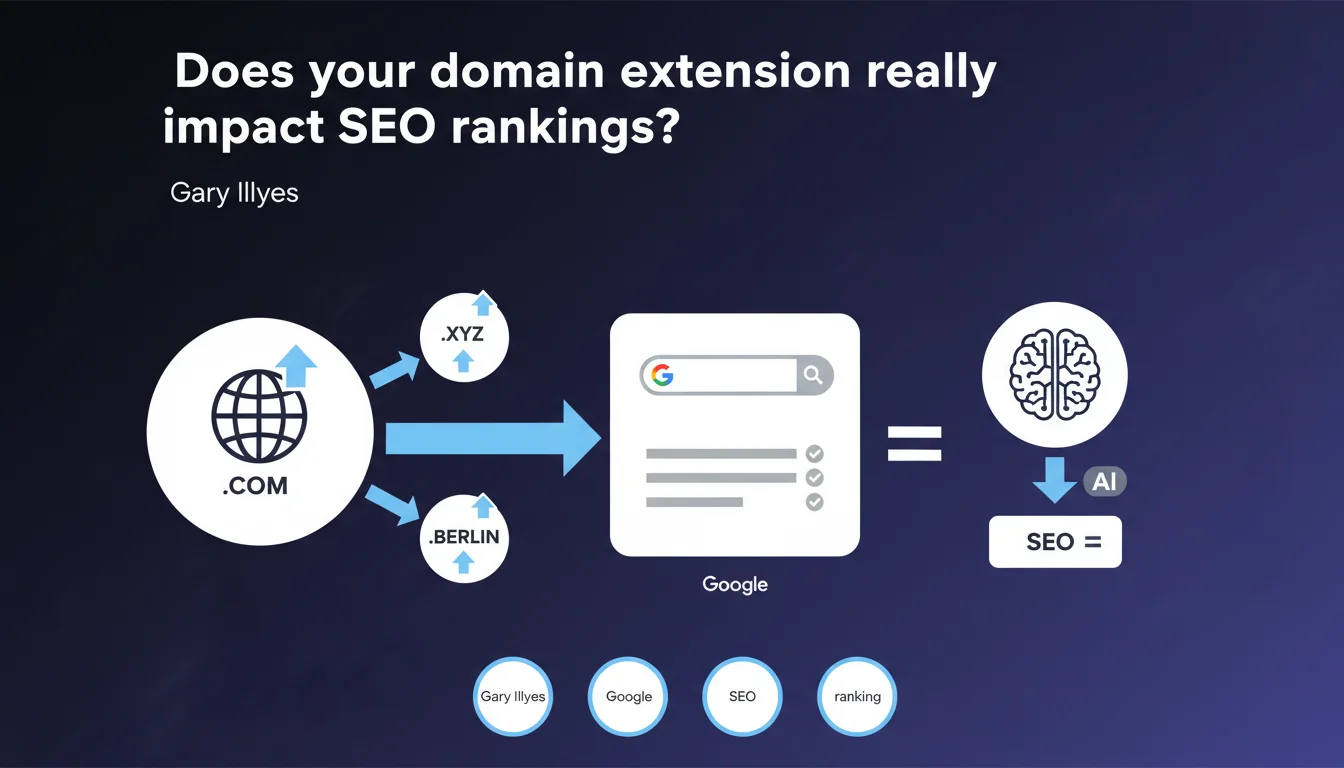
Google treats all generic top-level domains (gTLDs) equally in its ranking algorithms. A .com offers no inherent SEO advantage over a .xyz, .tech, or .berlin. Only content quality, site authority, and standard technical signals matter.
What you need to understand
Why did Google need to clarify this point about TLDs?
For years, the SEO industry has perpetuated a stubborn myth: .com domains would naturally rank better than other extensions. This belief stems from .com's overwhelming presence in search results, but it confuses correlation with causation.
The truth? .com domains dominate because they're historically the most used by established sites that benefit from domain age, authority, and strong backlink profiles. The extension itself is just a neutral container.
What does "equal treatment" actually mean for Google?
In practice, Google's algorithm applies no weighting coefficient based on TLD during ranking. An identical article published on example.com and example.xyz starts with equal chances of ranking.
This neutrality applies to all gTLDs (generic Top-Level Domains) — whether traditional (.net, .org) or newly created (.app, .dev, .shop). Country-code TLDs (ccTLDs) like .fr or .de follow different logic, with implicit geographic targeting.
What are the practical implications of this statement?
- Domain name availability takes priority over extension if SEO fundamentals are solid
- An exotic TLD can impact user perception and click-through rate (CTR), which indirectly influences SEO
- New TLDs (.ai, .io) suffer no algorithmic penalty — but may lack trust with certain audiences
- Alignment between extension and business sector (.tech for a startup, .law for a law firm) can reinforce perceived relevance
SEO Expert opinion
Does this statement align with real-world observations?
Yes, largely. Tests conducted on new sites with different TLDs consistently show an absence of pure algorithmic discrimination. A well-optimized .xyz site can easily outrank a mediocre .com.
But — and this is where it gets tricky — the algorithm is only part of the equation. User behavior, on the other hand, is not neutral. A .com domain statistically inspires more trust than a .xyz or .top among the general public. This CTR difference in SERPs sends indirect signals to Google through engagement metrics.
What nuances should we add to this official narrative?
Let's be honest: Google is discussing direct algorithmic neutrality here, not commercial equivalence. Three points deserve attention:
First, certain TLDs are historically associated with spam (.info, .biz to a lesser extent). If the algorithm doesn't penalize them in theory, these extensions attract site profiles that themselves trigger negative quality signals. [To verify]: Google denies any TLD blacklist, but the statistical association exists.
Second, manual anti-spam filters and quality review teams scrutinize suspicious domains more closely. A free .tk or .ml domain will face more scrutiny than an established .com — even if it's not an automatic penalty.
Third, EEAT context (Experience, Expertise, Authoritativeness, Trustworthiness) comes into play. For YMYL sites (health, finance), an unconventional TLD can weaken authority perception — which indirectly impacts rankings through quality raters' evaluations.
When does this rule really not apply?
Country-code TLDs escape this equality logic. Google interprets them as a local targeting signal — a .fr will naturally be favored for queries from France, even without explicit geolocation in Search Console.
For queries with strong geographic intent ("plumber Paris", "restaurant Marseille"), a local ccTLD offers tangible advantage. This is the exception that proves the rule.
Practical impact and recommendations
What should you concretely do when choosing a domain?
Don't sacrifice a memorable, brandable domain name for a mediocre .com. If example-seo-solution-france.com is the only .com left, but example.digital or example.tech are available and relevant, the latter are probably better choices.
Prioritize semantic alignment between your business and the TLD if possible. A .agency for an agency, .store for an e-commerce site, .consulting for consulting — these extensions strengthen positioning clarity.
For an international site without specific geographic anchoring, stick with a gTLD (.com, .net, or new generation). Avoid ccTLDs unless you're explicitly targeting a single national market.
What mistakes must you absolutely avoid?
- Never choose a TLD solely to include a keyword in the URL (example: keyword.seo) — impact is zero and user perception can be negative
- Avoid extensions historically associated with spam (.info, .tk, .ml) unless your project has a substantial marketing budget to overcome distrust
- Don't multiply TLDs to "protect" your brand without a solid redirect strategy — you risk authority dilution and duplicate content issues
- Don't overlook long-term renewal: a domain registered for 1 year inspires less trust than a 5-10 year commitment
How can you verify that your TLD choice isn't penalizing your visibility?
Monitor your engagement metrics in Search Console: organic CTR, bounce rate, time on site. An abnormal CTR drop despite good rankings may signal a trust issue linked to the extension.
Test user perception through parallel ad A/B tests: same URL displayed with different extensions in parallel ads. The CTR delta will give you a clear indication of reputational impact.
For domain migrations (switching TLDs), strictly follow Google guidelines: permanent 301 redirects, update internal links, change address in Search Console, keep old domains active for at least 6-12 months minimum.
TLD choice is much more about branding and user psychology than pure SEO technique. If your overall strategy is solid — quality content, healthy backlink profile, optimized user experience — the extension is just a detail.
That said, orchestrating a domain migration, building an international architecture with the right TLDs per market, or evaluating the risk/opportunity ratio of an atypical extension requires deep SEO expertise. These decisions shape your online presence for years — a strategic mistake here costs real visibility and correction expenses. If you're unsure about the best approach for your specific project, guidance from a specialized SEO agency can help you avoid costly decisions and point you toward the solution best suited to your competitive context.
❓ Frequently Asked Questions
Un .com se positionne-t-il mieux qu'un .fr sur Google France ?
Les nouveaux TLD comme .ai ou .io sont-ils pénalisés par Google ?
Faut-il migrer mon site d'un .xyz vers un .com pour améliorer mon SEO ?
Peut-on utiliser plusieurs TLD pour le même site sans duplicate content ?
Les TLD géographiques (.paris, .london) ont-ils un avantage SEO local ?
🎥 From the same video 14
Other SEO insights extracted from this same Google Search Central video · published on 20/07/2023
🎥 Watch the full video on YouTube →
💬 Comments (0)
Be the first to comment.