
Official statement
Other statements from this video 14 ▾
- □ Les ccTLD donnent-ils vraiment un avantage géographique en SEO ?
- □ Le choix du TLD a-t-il un impact sur le référencement naturel ?
- □ Faut-il vraiment éviter les TLD bon marché pour son référencement ?
- □ Pourquoi Google traite-t-il certains ccTLD comme des domaines génériques ?
- □ Les domaines .edu et .gov offrent-ils vraiment un avantage SEO ?
- □ Le choix du nom de domaine (TLD) a-t-il vraiment un impact sur le référencement ?
- □ Un TLD en .coffee ou .tech booste-t-il vraiment votre référencement naturel ?
- □ Faut-il systématiquement vérifier l'historique d'un domaine avant de l'acheter ?
- □ Pourquoi ne peut-on détecter les actions manuelles qu'après avoir acheté un domaine expiré ?
- □ Les mots-clés dans le nom de domaine sont-ils vraiment si peu efficaces pour le SEO ?
- □ Les tirets dans les noms de domaine pénalisent-ils vraiment le SEO ?
- □ Faut-il privilégier le branding aux mots-clés exacts dans le nom de domaine ?
- □ WWW ou non-WWW : votre choix de sous-domaine impacte-t-il vraiment votre référencement ?
- □ Faut-il abandonner le sous-domaine m. pour mobile ?
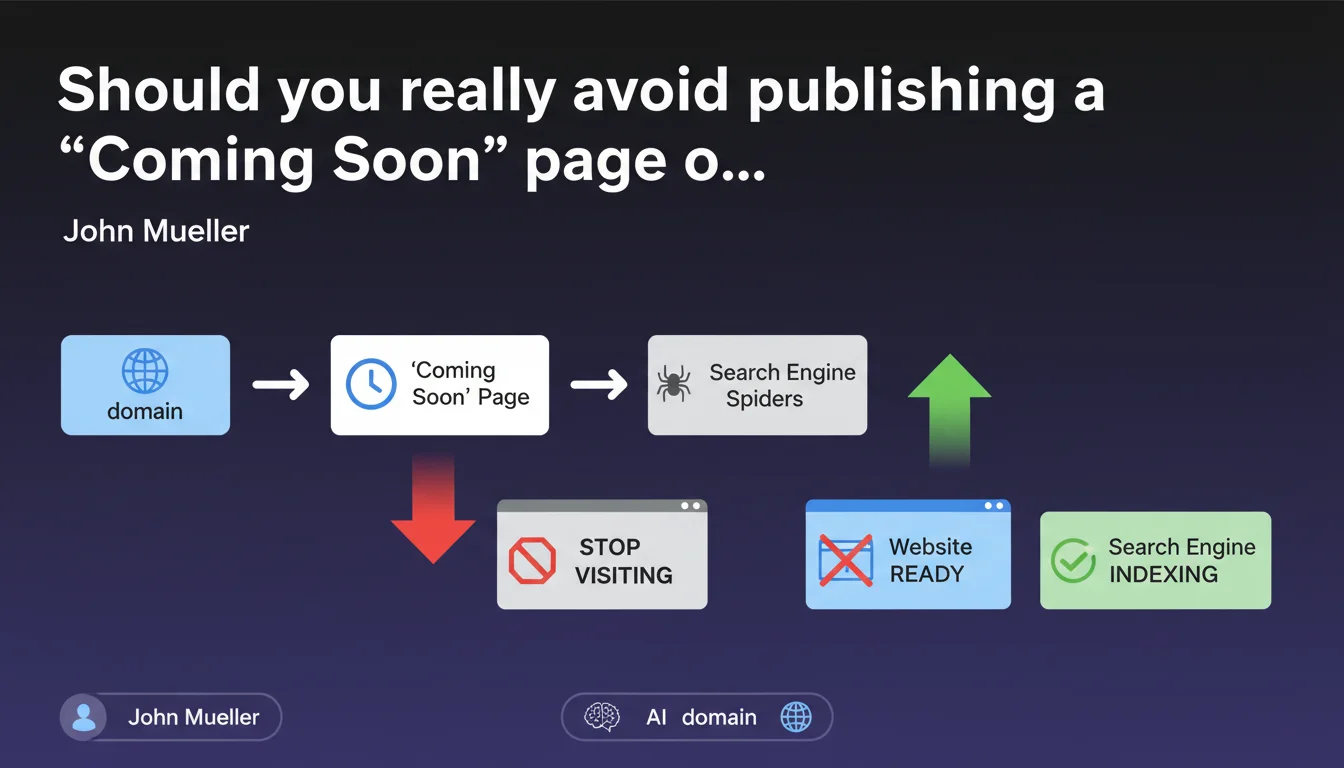
Google formally advises against publishing a 'Coming Soon' page on a new domain. The search engine will index it, consider that the site has nothing to offer, and drastically reduce its crawl frequency. It's better to keep the domain inaccessible until the content is ready.
What you need to understand
Why does a 'Coming Soon' page pose a problem for Google?
When Googlebot discovers a new domain with only a 'Coming Soon' page, it records this information in its index. The signal sent is clear: this site has no exploitable content.
The problem is that Google allocates a limited crawl budget to each domain. If the search engine determines there's nothing to index, it will drastically space out its visits. Result: when you finally launch your real content, you'll have to wait for Google to return — and that can take weeks.
Does this recommendation apply to all websites?
Mueller specifically talks about new domains. An established site with a crawl history can afford temporary maintenance without serious consequences. But a virgin domain has no trust capital.
The nuance is important: if your domain already has a link profile, historical traffic, or indexed presence, a temporary page won't cause the same damage. Google already has reasons to come back.
What's the difference between a 'Coming Soon' page and a maintenance page?
A maintenance page on an existing site typically uses an HTTP 503 status code that signals temporary unavailability. Google understands the signal and maintains its usual crawl frequencies.
A 'Coming Soon' page typically returns 200 OK, which tells Google this is the site's final content. The search engine indexes this empty page and adjusts its priorities accordingly.
- A new domain with 'Coming Soon' page = strong negative signal for Google
- The crawl budget will be drastically reduced from the first visit
- Return to normal crawl frequency will take time after the real launch
- An established site with history can handle temporary maintenance without drama
- The HTTP status code makes all the difference: 200 vs 503
SEO Expert opinion
Is this guidance consistent with what we observe in practice?
Let's be honest: this is a logical recommendation that aligns with observed behaviors. A new domain without content captures no interest from Googlebot. Initial crawls are naturally spaced out, and an empty page only makes the situation worse.
On the other hand, Mueller oversimplifies. He doesn't discuss cases where a 'Coming Soon' page could serve to capture early backlinks or launch a brand awareness campaign before full launch. In some industries, having minimal online presence is better than nothing — especially if you use a properly configured 503. [To be verified] depending on your business context.
What nuances are missing from this statement?
Mueller doesn't specify the critical timeframe. How long does Google consider a site to remain in this 'empty' category? One week? One month? Six months? This gray temporal zone is frustrating for those planning a launch.
Another blind spot: what if you've already made this mistake? Mueller says to wait until the site is ready, but he gives no recovery advice. Should you force a recrawl via Search Console? Submit an XML sitemap? Push content progressively? The silence on these points is problematic.
In what cases doesn't this rule apply strictly?
If you're launching a domain with a pre-launch marketing strategy, a well-optimized 'Coming Soon' page can make sense — provided you return a 503 and plan a rapid launch. Some sites generate buzz, capture signups, or backlinks before even having final content.
Similarly, a rebranding with domain change shouldn't fall into this category. You already have an SEO profile to transfer via 301 redirects, so the new domain isn't really 'new' in Google's eyes.
Practical impact and recommendations
What should you do concretely before a site launch?
The recommendation is clear: keep the domain inaccessible until the site is ready. Use a password, IP restriction, or work on a development subdomain. Only make the domain public when you have indexable and useful content.
If you absolutely must have an online presence before the full launch, opt for a 503 status code with a Retry-After header. This signals to Google that content is coming soon without compromising your future crawl budget. Concretely? Configure your server to return this HTTP status on all URLs.
What mistakes should you absolutely avoid?
Never publish a 'Coming Soon' page with a 200 OK status code on a new domain. This is the most common mistake: developers set up a temporary page without thinking about SEO implications. Google will index it as final content.
Another trap: leaving this page sitting for months. The longer the delay between discovery and real launch, the more Google classifies you as an abandoned or valueless site. If you're planning a launch in 6 months, don't make the domain accessible now.
How do you recover if this has already happened?
If your domain has already been crawled with a 'Coming Soon' page, act fast. Publish your complete final content as quickly as possible. Don't do a gradual launch — put everything live at once to maximize the signal sent to Google.
Next, submit a complete XML sitemap via Search Console and request manual indexing of priority URLs. Monitor server logs to verify that Googlebot returns to explore the site with normal frequency. It will take a few weeks, but you should see improvement.
- Keep the domain inaccessible (password, IP restriction) until full launch
- If presence is mandatory: use a 503 status code with Retry-After, never a 200
- Don't publish a 'Coming Soon' page months before the actual launch
- At launch, publish all content at once, not gradually
- Immediately submit a complete XML sitemap via Search Console
- Request manual indexing of strategic pages
- Monitor server logs to verify Googlebot's return
❓ Frequently Asked Questions
Puis-je utiliser une page 'Coming Soon' avec un code 503 sur un nouveau domaine ?
Combien de temps après une page 'Coming Soon' faut-il pour retrouver un crawl normal ?
Cette règle s'applique-t-elle aussi aux sous-domaines ?
Et si j'ai déjà des backlinks pointant vers mon domaine avant le lancement ?
Peut-on indexer une page 'Coming Soon' avec du contenu marketing riche ?
🎥 From the same video 14
Other SEO insights extracted from this same Google Search Central video · published on 20/07/2023
🎥 Watch the full video on YouTube →
💬 Comments (0)
Be the first to comment.