
Official statement
Other statements from this video 14 ▾
- □ Do ccTLDs Really Give You a Geographic SEO Advantage?
- □ Does your domain extension really impact SEO rankings?
- □ Should you really avoid cheap domain extensions for your SEO?
- □ Do .edu and .gov domains really provide an SEO advantage?
- □ Does your domain extension (TLD) really impact your search rankings?
- □ Does a .coffee or .tech domain really boost your search rankings?
- □ Should you always verify a domain's history before buying it?
- □ Why can't you detect manual actions before buying an expired domain?
- □ Do keywords in your domain name really matter for SEO rankings?
- □ Do hyphens in domain names really hurt your SEO rankings?
- □ Should you prioritize branding over exact keywords in your domain name?
- □ Does your choice between www and non-www really impact your search rankings?
- □ Is it time to ditch the m. subdomain for mobile?
- □ Should you really avoid publishing a 'Coming Soon' page on a new domain?
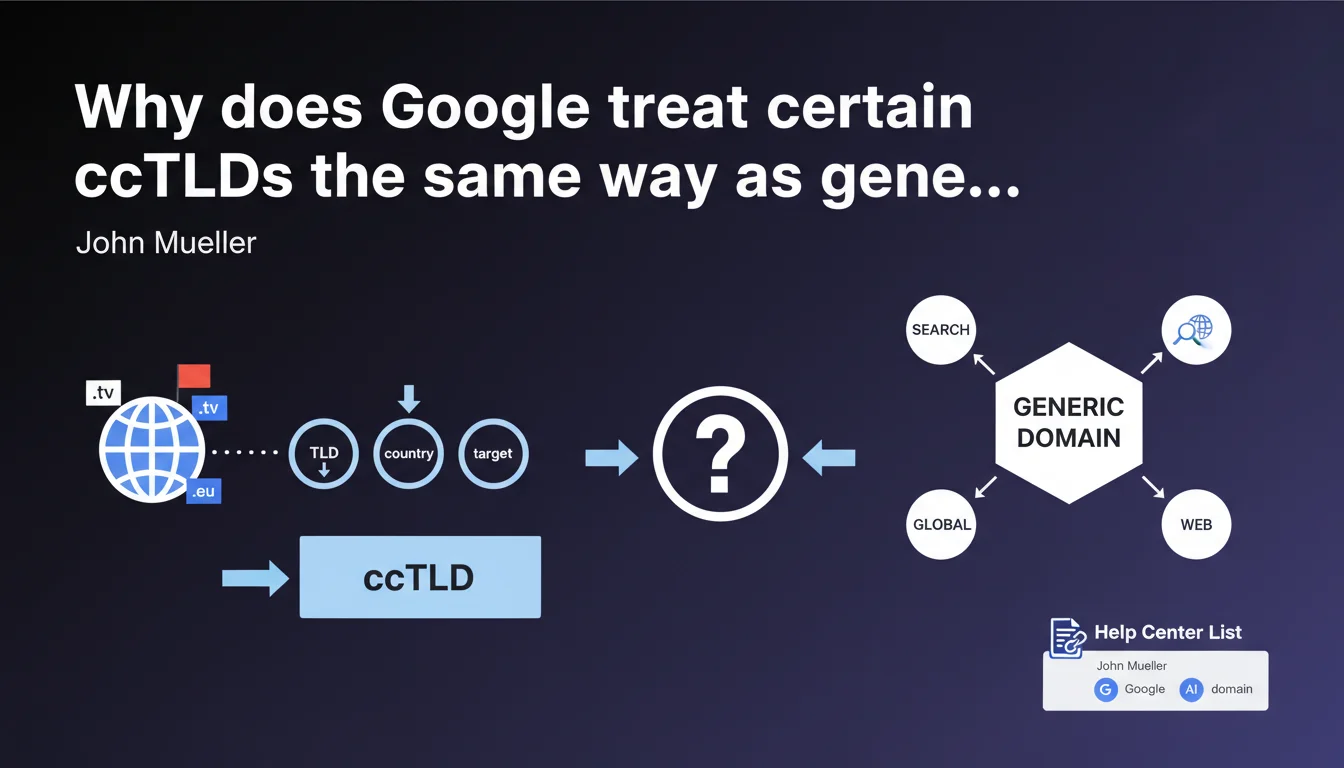
Google considers certain ccTLDs (.tv, .asia, .eu, etc.) as gTLDs, meaning they receive no automatic geographic targeting. Unlike a .fr or .de, these extensions don't assume any specific local market. The exact list of affected ccTLDs is published by Google in its Help Center.
What you need to understand
What's the difference between ccTLD and gTLD in Google's treatment?
A ccTLD (country-code Top-Level Domain) like .fr, .be or .ca normally signals to Google an intent for geographic targeting. The search engine presumes the site is primarily aimed at the corresponding local audience.
gTLDs (.com, .org, .net) carry no intrinsic geographic indication — Google then relies on other signals: hosting location, language, local backlinks, Google Business Profile, Search Console settings.
Why do some ccTLDs escape this logic?
Extensions like .tv (Tuvalu), .co (Colombia) or .io (British Indian Ocean Territory) have been repurposed from their original use. .tv serves massively for video sites, .io for tech startups — nothing to do with their country of origin.
Google therefore decided to treat them as geographically neutral domains. No automatic local boost, no penalty either: geographic targeting must be configured manually.
How can I tell if my ccTLD is affected?
Google maintains an official list in its Help Center. This list evolves — some ccTLDs are added over time based on their actual web usage.
- "Classic" ccTLDs (.fr, .de, .uk, .ca) remain geo-targeted by default
- ccTLDs treated as gTLDs (.tv, .asia, .eu, .me, .co, .io...) require manual configuration
- This distinction directly impacts visibility in local SERPs
- Geographic targeting can be defined via Google Search Console for neutral ccTLDs
SEO Expert opinion
Is this statement consistent with real-world observations?
Absolutely. We've observed for years that sites using .tv or .io get no advantage in the SERPs of Tuvalu or the British Indian Ocean Territory — which would be absurd given their usage.
The gTLD treatment reflects the actual commercial usage of these extensions. A .co has nothing to do with Colombia in 99% of cases — it's an alternative to .com. Google understood this and adapted its algorithm accordingly.
What nuances should we add to this rule?
Let's be honest: this geographic neutrality is not fixed. Google can reevaluate a ccTLD if its usage evolves. The .eu, for example, remains treated as a gTLD but carries a European connotation — useful for targeting the single market without choosing a specific country.
Another point: even with a "neutral" ccTLD, geographic signals remain considered. A site using .tv hosted in France, with French content and .fr backlinks, will have a strong presumption of France targeting. [To verify]: the exact impact of manual Search Console configuration vs. organic signals remains unclear in Google's communications.
In which cases does this distinction become critical?
If you're targeting multiple markets with a .io or .co, you must structure your site with subdirectories (/fr/, /de/) or subdomains (fr.site.io) — and configure targeting in Search Console.
With a .fr, Google presumes France by default. With a .io, it presumes nothing — which can be an advantage (multi-country flexibility) or a pitfall (lack of clear signal if poorly configured).
Practical impact and recommendations
What should I do if I'm using a ccTLD treated as a gTLD?
First action: verify in Google Search Console whether your extension appears on the list of neutral ccTLDs. If so, you have access to the "Geographic targeting" parameter in legacy properties (full domain).
Explicitly define your main target country if you're aiming for a specific local market. Without this configuration, Google relies solely on organic signals — language, hosting, backlinks — which can dilute your local visibility.
What strategy for multi-country targeting with a neutral ccTLD?
Neutral ccTLDs (.io, .co, .tv) offer unprecedented flexibility: you can structure your site by language/country without extension constraints.
Use subdirectories with hreflang (site.io/fr/, site.io/de/) and set Search Console to "undefined" at the root domain level. Each language section will benefit from its own geographic signals (content, local backlinks).
- Check whether your ccTLD appears on Google's official list of neutral extensions
- Configure geographic targeting in Search Console if you're targeting a single market
- Audit your current geographic signals: language, hosting, backlinks, local NAP
- For multi-country: structure using subdirectories + hreflang, no Search Console targeting at root level
- Verify registry eligibility restrictions (e.g. .eu reserved for EU residents)
- Monitor Core Web Vitals by geographic zone if you're targeting multiple continents
How do I avoid common mistakes?
Frequent error: migrating to a .io to "look like a startup" without realizing you're losing the geographic boost of a .fr. If 100% of your business is French, keeping the .fr is often still more effective.
Another pitfall: believing a .eu automatically boosts across all of Europe. It doesn't — you need to structure properly with hreflang and local signals per country. The .eu is just a neutral wrapper.
ccTLDs treated as gTLDs offer strategic freedom for multi-country targeting, but require rigorous configuration. Without Search Console setup and consistent geographic signals, you're flying blind.
These optimizations — international hreflang, multi-country architecture, extension tradeoffs — demand solid real-world expertise. If your SEO project has an international dimension or complex geographic targeting challenges, support from a specialized agency can secure your strategic choices and accelerate your results.
❓ Frequently Asked Questions
Puis-je cibler la France avec un domaine en .io ?
Le .eu m'aide-t-il à ranker dans toute l'Europe ?
Dois-je migrer mon .tv vers un .com pour améliorer mon SEO ?
Où trouver la liste officielle des ccTLD traités comme gTLD ?
Un ccTLD neutre impacte-t-il mon référencement local (Google Business Profile) ?
🎥 From the same video 14
Other SEO insights extracted from this same Google Search Central video · published on 20/07/2023
🎥 Watch the full video on YouTube →
💬 Comments (0)
Be the first to comment.