
Official statement
Other statements from this video 14 ▾
- □ Les ccTLD donnent-ils vraiment un avantage géographique en SEO ?
- □ Le choix du TLD a-t-il un impact sur le référencement naturel ?
- □ Faut-il vraiment éviter les TLD bon marché pour son référencement ?
- □ Pourquoi Google traite-t-il certains ccTLD comme des domaines génériques ?
- □ Le choix du nom de domaine (TLD) a-t-il vraiment un impact sur le référencement ?
- □ Un TLD en .coffee ou .tech booste-t-il vraiment votre référencement naturel ?
- □ Faut-il systématiquement vérifier l'historique d'un domaine avant de l'acheter ?
- □ Pourquoi ne peut-on détecter les actions manuelles qu'après avoir acheté un domaine expiré ?
- □ Les mots-clés dans le nom de domaine sont-ils vraiment si peu efficaces pour le SEO ?
- □ Les tirets dans les noms de domaine pénalisent-ils vraiment le SEO ?
- □ Faut-il privilégier le branding aux mots-clés exacts dans le nom de domaine ?
- □ WWW ou non-WWW : votre choix de sous-domaine impacte-t-il vraiment votre référencement ?
- □ Faut-il abandonner le sous-domaine m. pour mobile ?
- □ Faut-il vraiment éviter les pages 'Coming Soon' sur un nouveau domaine ?
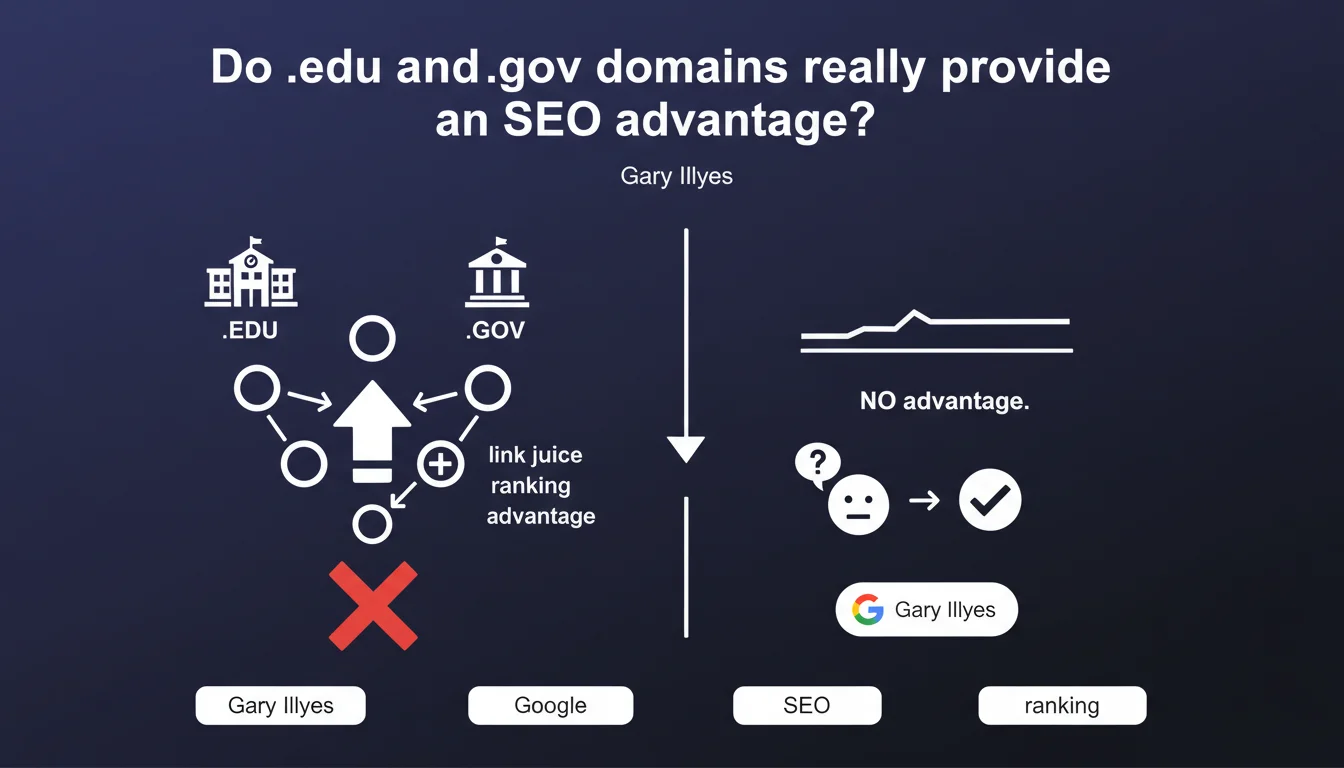
Gary Illyes states that .edu and .gov extensions do not pass more 'link juice' than standard domains. There is no algorithmic ranking advantage: only the intrinsic quality of the backlink matters, regardless of the TLD. Yet this persistent myth still pushes some SEOs to prioritize these link sources, incorrectly.
What you need to understand
Why has this myth persisted for so long?
The idea that .edu and .gov domains transmit more PageRank or trust stems from an era when Google explicitly valued certain authority signals linked to institutions. Early SEO guides fossilized this belief, transforming an observed correlation (sites with .edu/gov are often high-quality) into a supposed causation.
Let's be honest: obtaining a link from a university or government body remains difficult. This rarity creates confirmation bias — SEOs attribute to .edu links a performance they actually derive from thematic relevance, domain age, or editorial context.
What exactly does Google say in this statement?
Gary Illyes lays out a simple framework: no TLD (Top-Level Domain) receives preferential treatment in the algorithm. A link from a .edu is worth as much as a link from a .com, .org, or .fr of equivalent quality. The engine evaluates editorial trust, semantic relevance, domain authority — not the extension itself.
Concretely? If Harvard publishes a generic article with a nofollow link to your personal blog, the impact will likely be zero. Conversely, a .com specialized in your niche, with a strong link profile and relevant content, can transmit a much stronger signal.
What are the real criteria that matter for a backlink?
- Thematic relevance: the semantic context of the link and its coherence with the target content
- Authority of the source page: internal PageRank, inbound link profile, user engagement
- Editorial context: link placed naturally within body text, not in footer or directory
- Link attributes: dofollow/nofollow, optimized or generic anchor text
- Freshness and diversity: new referring domains vs. recurring links from the same domain
SEO Expert opinion
Is this statement consistent with real-world observations?
Yes and no. In practice, .edu and .gov links often perform better — but not for the reason you might think. These domains naturally accumulate authority through decades of existence, thousands of institutional backlinks, and near-exclusive use in serious editorial contexts. It's this overall profile that matters, not the extension.
The problem is that Google provides no numerical data. [To verify]: is there a hidden bonus tied to the history of an institutional domain, even if the extension itself isn't a signal? Difficult to settle without access to crawl logs or internal trust scores.
In what cases might this rule have nuances?
.edu and .gov domains are regulated at registration: you can't buy a .edu the way you buy a .com. This barrier to entry mechanically reduces spam. Google may not have an explicit bonus for these TLDs, but its spam detection algorithm treats them statistically more leniently.
Furthermore, certain Google patents mention seed sites or trusted sources to initialize trust graphs. If .edu/gov domains appear in these seed lists, they indirectly influence trust propagation — without the TLD itself being the decisive factor.
Should you still ignore these link sources?
Absolutely not. A link from a relevant .edu remains an excellent signal — simply not because it's a .edu. If you work in education, research, or the public sector, these backlinks are coherent with your topical authority. But blindly prioritizing a generic .edu over an ultra-specialized .com is a tactical mistake.
Practical impact and recommendations
What should you concretely do to adjust your backlink strategy?
Reevaluate your link-building KPIs. If you measure link performance solely by TLD or Domain Rating, you're missing the essentials. Instead, analyze the organic traffic of the source page, its thematic relevance via tools like Ahrefs Content Explorer or Semrush Topic Research, and the quality of its inbound link profile.
Don't let the .edu/gov myth bias your priorities. A link from a recognized expert blog in your niche (.com, .io, whatever) can generate more qualified traffic and trust signal than an administrative link buried in a government PDF.
What mistakes should you avoid in link acquisition?
- Don't overpay for a .edu/gov link purely for the prestige of the extension
- Avoid low-quality placements (footers, directories, comments) even on institutional domains
- Don't neglect niche .com/.org sites with ultra-relevant content just because they lack a 'premium' TLD
- Never buy links in bulk from .edu sources sourced from hidden PBN networks disguised as student sites
- Don't overlook link attributes: a .edu with nofollow provides zero juice, whatever the seller claims
How do you verify the true value of a potential backlink?
Use a multi-criteria analysis grid: monthly organic traffic of the page (Ahrefs, Semrush), number of referring domains pointing to that page, semantic coherence with your target content, domain age and penalty history (Wayback Machine, Google Search Console if accessible).
Also test engagement: a page with comments, social shares, and high time-on-page likely transmits more signal than an institutional PDF consulted once a year. And that's where it gets tricky: this analysis demands time, tools, and fine-tuned SEO expertise.
❓ Frequently Asked Questions
Un lien .edu transmet-il vraiment la même valeur qu'un lien .com ?
Pourquoi certains SEO continuent-ils à privilégier les liens .edu/gov ?
Google a-t-il déjà donné un avantage aux TLD .edu ou .gov par le passé ?
Dois-je refuser un lien .edu si l'opportunité se présente ?
Comment détecter un lien .edu de mauvaise qualité ?
🎥 From the same video 14
Other SEO insights extracted from this same Google Search Central video · published on 20/07/2023
🎥 Watch the full video on YouTube →
💬 Comments (0)
Be the first to comment.