
Official statement
Other statements from this video 8 ▾
- □ Is there really no way to force Google to re-index your entire website at once?
- □ Does Google automatically reindex major changes on your website?
- □ Why can a simple 301 redirect make all the difference during a website redesign?
- □ Should you really use a 404 or 410 status code for deleted pages?
- □ Should you really link your new pages from high-authority pages to accelerate indexing?
- □ Why does Google recommend showing critical changes on your existing pages instead of creating new URLs?
- □ Does Google really crawl some pages more often than others, and how can you influence this?
- □ Are XML sitemaps really essential for getting your website indexed by Google?
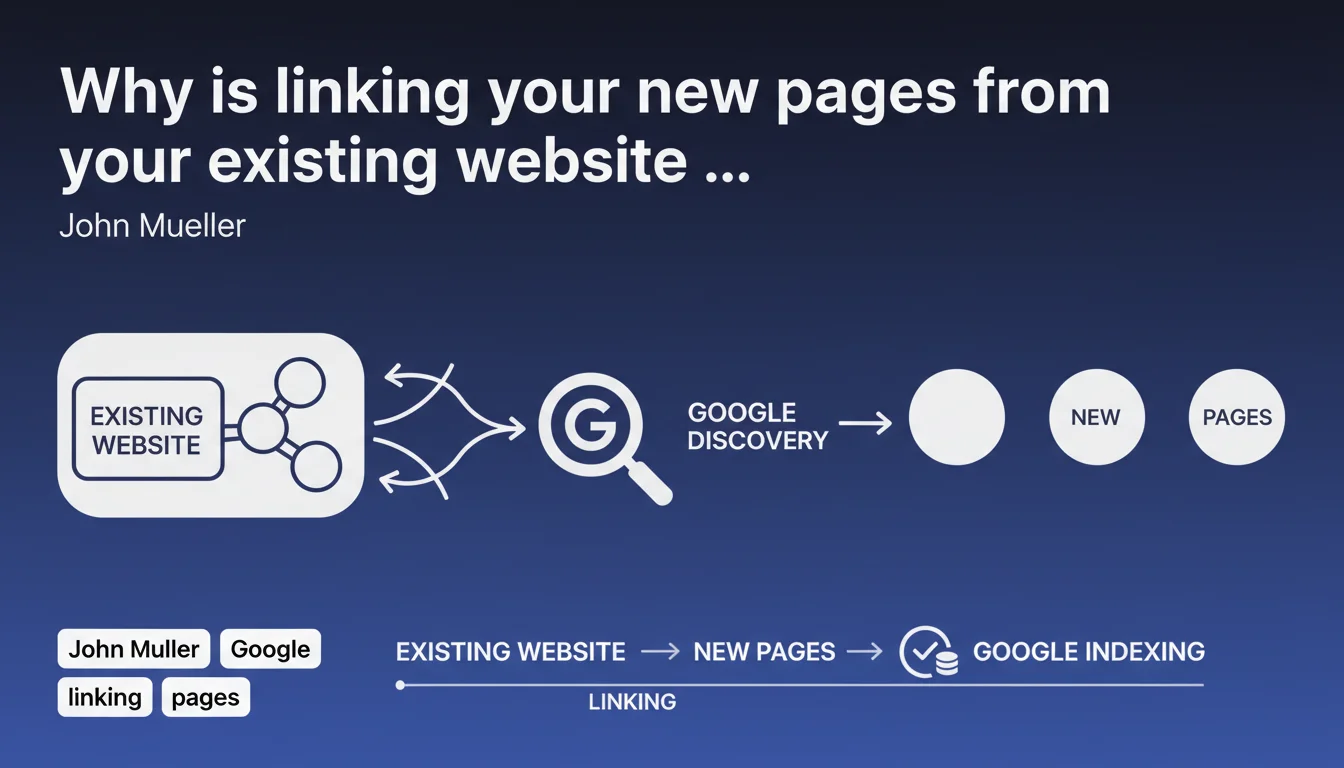
Google reminds us of a fundamental principle that's often overlooked: a new page must be linked from your existing website to be discovered and indexed. Without this internal linking, even the best page risks remaining invisible to Googlebot. It's a prerequisite for crawling, before any question of quality or relevance even comes into play.
What you need to understand
Why does Google insist on internal linking for discovering new pages?
Mueller's statement touches on the very foundation of how Googlebot works: crawling through links. Google doesn't magically scan all URLs on a site. It follows paths — primarily internal and external links.
An orphaned page, even if technically indexable, remains invisible if no link points to it. The XML sitemap helps, certainly, but it guarantees nothing. The internal link, on the other hand, is a strong priority signal: it tells Google "this page is important enough that I mention it within my existing content".
Is submitting the URL through Search Console enough?
No. Manual submission (URL inspection tool) speeds up one-time discovery, but it doesn't replace architecture. Google prioritizes natural crawling through links, because that's what determines how frequently the bot visits and how deeply it explores.
A well-linked site allows Googlebot to quickly discover new pages and re-crawl them regularly. Without a link, even a manually submitted URL may never be re-crawled after its initial indexation.
Which types of internal links really matter?
All standard HTML links count, but their weight varies. A link from the homepage, a category page, or a recent high-traffic article passes more "crawl juice" than a link buried in a footer or a deep page.
JavaScript links are now followed by Google, but they remain less reliable. Stick with pure HTML for critical new pages.
- Internal link = signal of discovery AND priority for Googlebot
- The XML sitemap complements but never replaces internal linking
- Links from strong pages (traffic, internal PageRank) accelerate indexation
- Orphaned pages risk never being crawled, even if technically accessible
SEO Expert opinion
Is this statement consistent with practices observed in the field?
Absolutely. We regularly observe sites with hundreds of non-indexed pages, simply because they are orphaned or too deep in the site architecture. Crawl budget is not infinite, especially for medium-sized or new sites.
Mueller isn't saying anything new here — he's reminding us of a basic principle. But it's precisely because this basic principle is too often neglected. Technical teams publish pages via CMS, forget about internal linking, then wonder why they aren't indexed. The sitemap alone isn't enough, especially if the site already has crawl budget issues.
What nuances should be applied to this recommendation?
First point: not all internal links are equal. A link from an already well-crawled page (homepage, main category) has more impact than a link from a page buried 5 clicks deep. The position of the link also matters — a link within editorial content carries more weight than a generic footer link.
Second nuance: timing. If you add 500 new pages at once without solid architecture, Google won't crawl everything instantly. You need to prioritize strategic pages by linking them from strong points on your site.
What's the line between optimizing and over-optimizing internal linking?
Google has never given a precise number on the maximum internal links per page. [To be verified] but field observation suggests that beyond 150-200 links on a page, impact diminishes. The logic is simple: the more links there are, the less each one counts individually.
The real risk isn't a penalty, but inefficiency. Dense linking without editorial or semantic logic simply wastes crawl budget. Better to have 10 relevant and contextual links than 100 generic links in a footer.
Practical impact and recommendations
What should you do concretely when publishing a new page?
Before even publishing, identify 3 to 5 existing pages from which you'll create a link to the new page. Choose thematically close pages, already well-crawled, and with traffic.
Integrate the link into your editorial content, with descriptive anchor text (not "click here"). Avoid bulk link blocks — one natural link in a paragraph carries more weight than a link in a list of 50 URLs.
How do you audit orphaned pages on an existing site?
Use a crawler like Screaming Frog or Oncrawl to compare URLs crawled from the homepage with those in your XML sitemap. URLs present in the sitemap but not discovered by the crawler are likely orphaned.
Then check Search Console: pages marked "Discovered – currently not indexed" or "Crawled – currently not indexed" may indicate an internal linking issue or insufficient crawl budget.
What mistakes should you avoid in your new page linking strategy?
Don't just add a link in the footer or secondary menu. Google follows these links, certainly, but they carry weak weight. Prioritize editorial links in the body text.
Also avoid creating artificial "link hubs" — catch-all pages without editorial value that list 200 URLs. Google will crawl them, but without guaranteed value.
- Identify 3-5 strong existing pages to create links from for each new page
- Integrate links into editorial content, not generic areas (footer, sidebar)
- Use descriptive and contextual anchor text
- Crawl your site regularly to detect orphaned pages
- Cross-check XML sitemap data vs actual crawl to find undiscovered URLs
- Prioritize strategic new pages by linking them from your homepage or main categories
- Monitor Search Console to identify "Discovered – not indexed" pages related to missing internal links
❓ Frequently Asked Questions
Est-ce que soumettre une nouvelle page via le sitemap XML suffit pour l'indexer ?
Combien de liens internes faut-il créer vers une nouvelle page ?
Les liens dans le footer ou le menu comptent-ils autant que les liens éditoriaux ?
Comment savoir si mes nouvelles pages sont orphelines ?
Une page orpheline peut-elle finir par être indexée avec le temps ?
🎥 From the same video 8
Other SEO insights extracted from this same Google Search Central video · published on 23/01/2024
🎥 Watch the full video on YouTube →
💬 Comments (0)
Be the first to comment.