
Official statement
Other statements from this video 8 ▾
- □ Peut-on vraiment forcer Google à ré-indexer un site entier d'un coup ?
- □ Google réindexe-t-il automatiquement les changements majeurs sur un site ?
- □ Pourquoi une simple redirection 301 peut-elle faire toute la différence lors d'une refonte ?
- □ Faut-il vraiment utiliser un code 404 ou 410 pour les pages supprimées ?
- □ Pourquoi lier vos nouvelles pages depuis le site existant est-il crucial pour l'indexation Google ?
- □ Pourquoi Google recommande-t-il d'afficher les changements critiques sur les pages existantes plutôt que de créer de nouvelles pages ?
- □ Pourquoi Google crawle-t-il certaines pages plus souvent que d'autres ?
- □ Les sitemaps XML sont-ils vraiment indispensables pour l'indexation de votre site ?
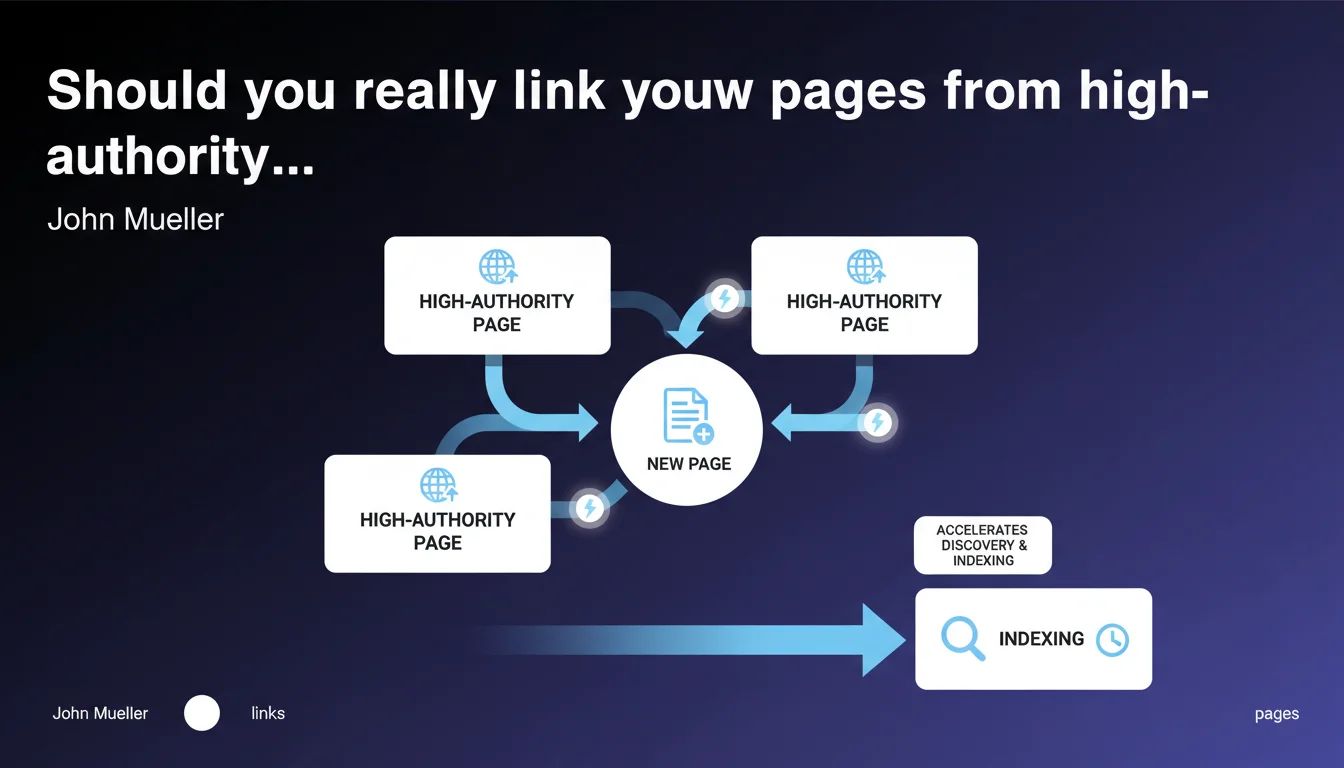
Google confirms that smart internal linking accelerates the discovery and indexing of new pages. In practice: if a page is strategic, create links to it from your strongest pages rather than leaving it orphaned. It's about crawl budget transfer and priority signaling.
What you need to understand
John Mueller reminds us here of a rule that many apply intuitively, but without always understanding the mechanisms. Internal linking isn't just for user navigation — it actively directs Googlebot in its exploration and hierarchizes your content.
Let's be honest: Google doesn't crawl all pages with the same frequency. Crawl budget is a limited resource, especially on large sites.
Why do important pages accelerate indexing?
An "important" page — homepage, main categories, highly visited content — is crawled more regularly. By placing a link to a new page there, you mechanically reduce the time it takes Googlebot to discover it.
The bot follows links during its crawl passes. If your new page is only accessible after 5 clicks from the home, it will wait several crawl cycles before being found. If it's linked directly from a page crawled daily, the delay drops to just a few hours.
What is an "important page" according to Google?
No precise official definition — and that's where it gets tricky. You can reasonably identify these pages via:
- High organic traffic over the last 30 days
- Quality backlinks pointing to them
- Crawl frequency observable in Search Console (log files or crawl reports)
- Structural position: homepage, category hubs, strategic landing pages
Does internal linking influence only discovery or also ranking?
Both. Discovery first: without internal links, no fast indexing. But beyond that, the semantic context transmitted by anchor text and surrounding content helps Google understand the target page's topic.
Linking from a thematically close page strengthens perceived relevance. It's an additional signal — not the most powerful, but cumulative. And on competitive queries, every signal counts.
SEO Expert opinion
This recommendation is consistent with what we observe in practice. On high-volume sites, a new page placed 3 clicks deep can take several days to be indexed, whereas a direct link from the home makes it appear in just a few hours.
The problem is that Mueller doesn't specify the quantitative criteria for qualifying a page as "important". Internal PageRank? SEO traffic? Crawl frequency? Probably a mix — but without hard numbers, we're left with interpretation.
Does this logic apply to all types of sites?
Yes and no. On a small 50-page site, crawl budget isn't a major concern — Googlebot visits everything regularly. The impact remains positive, but marginal.
On an e-commerce site with 10,000 products or a media publishing 20 articles daily, it's critical. Without linking hierarchy, some pages will never be crawled, or too late to capture traffic on trending topics.
What nuances should be applied to this recommendation?
Adding dozens of links from the homepage won't magically transform its crawl budget. Google detects over-optimization — a footer stuffed with deep links has no real weight.
The idea is to create contextual and justified links: a paragraph in a pillar article, a "See also" section, a callout in a bestselling product page. Naturalness comes first.
Furthermore, Mueller doesn't mention anchor text — a point that's nonetheless essential. Generic anchor text ("learn more") conveys less context than descriptive anchor text ("optimize internal linking for crawl efficiency").
[To verify]: no official data on the threshold from which a site should prioritize this type of strategy. Recommendations remain qualitative.
Practical impact and recommendations
What should you concretely do to optimize internal linking?
Start by identifying your strongest pages. Export data from Search Console (clicks, impressions) and cross-reference with your backlink analysis (Ahrefs, Majestic, etc.). List your 10-20 pages that concentrate the most traffic and authority.
Next, when launching a new strategic page, integrate it manually into the content of these strong pages — not via an automatic "related articles" module. A dedicated paragraph, an editorial update, a contextual callout.
What mistakes should you absolutely avoid?
Don't create artificial links in bulk from the homepage or footer. Google values contextual relevance, not raw quantity. A link from a thematically close page is worth more than ten off-topic links.
Also avoid neglecting anchor text: vague anchor text dilutes the semantic signal. Prefer descriptive formulations that clarify the topic of the target page.
How do you verify your strategy is working?
Track indexation delay in Search Console. Compare the average time between publication and first appearance in the index for pages linked from your hubs vs. those more isolated. A significant gap validates the approach.
Also analyze server logs if you have access: you'll concretely see which paths Googlebot takes and how frequently it recrawls certain sections.
- Identify your 10-20 strongest pages (traffic + backlinks + frequent crawl)
- Create contextual links to each new strategic page from these hubs
- Use descriptive and natural anchor text, never generic
- Monitor indexation delay in Search Console to measure impact
- Analyze server logs to understand crawl patterns
- Never artificially stuff the footer or sidebar with deep links
Smart internal linking remains one of the most underexploited levers. When executed well, it accelerates indexing, improves topical understanding, and optimizes crawl budget — three cumulative gains that are far from negligible.
On complex sites, this strategy requires careful analysis of structure, crawling, and SEO performance. If you manage a large product catalog or intense editorial flow, it may be wise to hire a specialized SEO agency to audit your architecture and deploy truly optimized linking.
❓ Frequently Asked Questions
Combien de liens internes faut-il ajouter depuis une page importante ?
Le maillage interne peut-il remplacer les backlinks externes ?
Faut-il systématiquement lier depuis la homepage ?
Cette stratégie fonctionne-t-elle aussi pour l'indexation mobile-first ?
Comment mesurer l'impact du maillage sur l'indexation ?
🎥 From the same video 8
Other SEO insights extracted from this same Google Search Central video · published on 23/01/2024
🎥 Watch the full video on YouTube →
💬 Comments (0)
Be the first to comment.