
Official statement
What you need to understand
What is Google's official position on the www/non-www change?
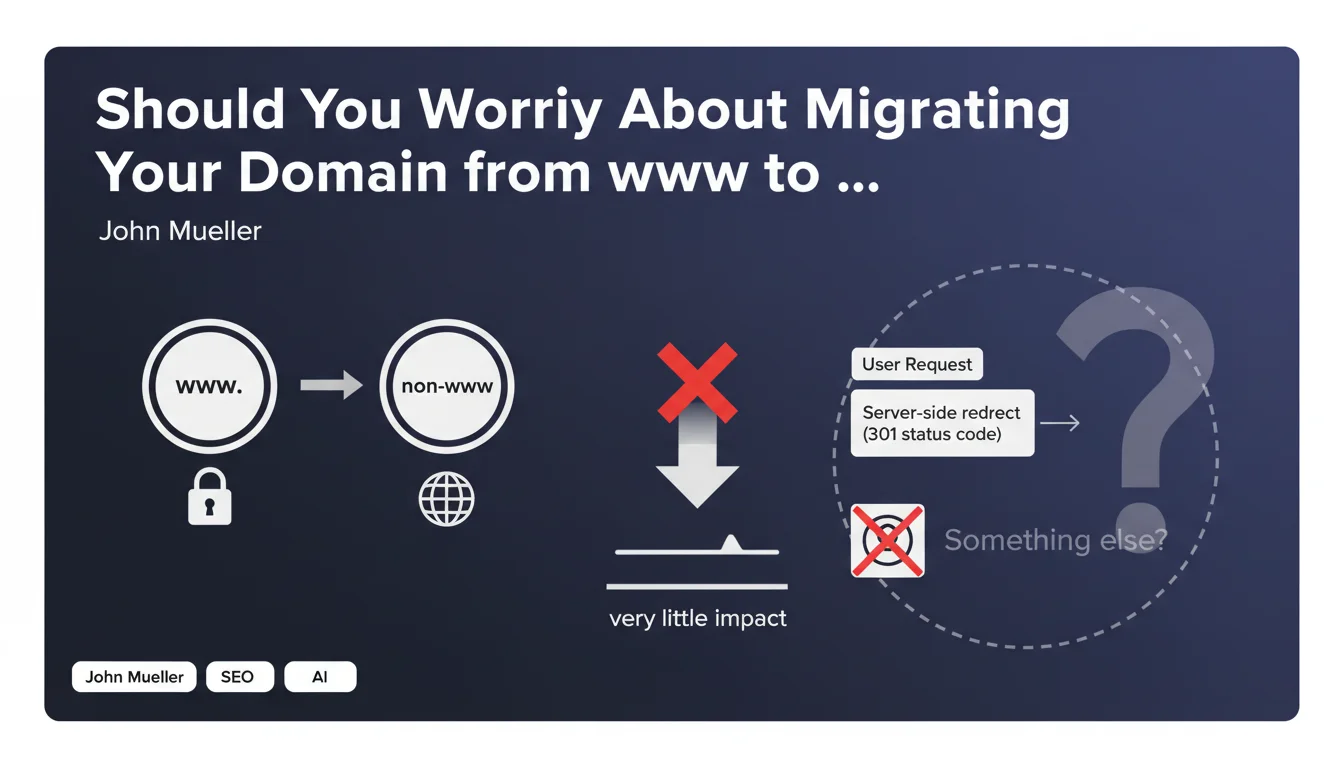
John Mueller, Google's spokesperson, clearly states that switching from the www subdomain to its non-www version has virtually no negative impact on organic search rankings. This statement contradicts certain widespread concerns in the SEO community.
The technical explanation is simple: server-side 301 redirects are interpreted independently of the user-agent. Google treats this change as a simple domain consolidation, without loss of authority or rankings.
Why do some people observe fluctuations during this migration?
Mueller specifies that if significant variations in traffic or rankings are noticed after such a change, the real cause lies elsewhere. The www/non-www switch often becomes the scapegoat for underlying technical problems.
The migration can reveal pre-existing issues: misconfigured redirects, duplicate content, 404 errors, or deeper structural modifications made simultaneously.
How does this differ from a complete URL restructure?
Google clearly distinguishes the simple www prefix change from a structural URL overhaul. The former operation is considered minor, while the latter requires particular attention.
A modification of the URL architecture (changing directory structure, parameters, extensions) represents a far more complex undertaking with real risks for SEO.
- The www/non-www change is treated as a simple domain consolidation by Google
- 301 redirects work independently of the user-agent
- Observed fluctuations generally have other technical causes
- Google differentiates this minor change from a structural URL overhaul
- The migration is generally processed quickly by Google's crawlers
SEO Expert opinion
Is this statement consistent with real-world observations?
After 15 years of SEO practice, I can confirm that well-executed www/non-www migrations indeed cause no lasting damage. The hundreds of migrations I've supervised show complete recovery within 2 to 4 weeks maximum.
The key lies in quality technical implementation. A clean 301 redirect, coupled with coherent canonical tags and a Search Console update, is more than sufficient.
What critical nuances should be added to this statement?
Mueller's statement, while true, simplifies a slightly more complex reality. Processing timing can vary depending on the site's crawl frequency and its overall authority.
Sites with low authority or limited crawl budget may observe a transitional period of 3 to 6 weeks where both versions coexist in the index. This temporary situation does not constitute a loss of rankings but rather a consolidation phase.
In what cases can this migration pose problems?
Complications arise mainly from implementation errors: redirect chains, 302 redirects instead of 301s, or failure to update canonical tags. These errors create contradictory signals for Google.
Another pitfall concerns multilingual or multi-regional sites using subdomains. The migration then requires particular attention for each language variation and coordination with hreflang tags.
Practical impact and recommendations
What should you do concretely before and during the migration?
Preparation constitutes 80% of success. Start by inventorying all indexed URLs via Search Console and establish a complete mapping of necessary redirects.
Implement permanent 301 redirects server-side (.htaccess, nginx.conf, or application level). Verify that no redirect chains are created and that each old URL points directly to its new version.
Simultaneously update all technical elements: canonical tags, XML sitemap, robots.txt file, internal links, and declare the address change in Google Search Console.
What common mistakes must absolutely be avoided?
The most frequent error consists of forgetting certain properties in Search Console. Create and verify all four versions (http://www, https://www, http://, https://) for an optimal transition.
Never neglect external links and backlinks. Although 301 redirects transmit authority, contact your main partners to update their outbound links to your new canonical version.
How can you verify that the migration proceeded correctly?
Use monitoring tools to track crawl evolution. Google Search Console will indicate the progress of redirect processing and indexing evolution.
Monitor your rankings on strategic keywords for 4 to 6 weeks. Any abnormal variation requires immediate investigation to identify the real cause, which will probably be external to the www/non-www change.
- Implement permanent server-side 301 redirects for all URLs
- Update all canonical tags to the new version
- Declare all four domain versions in Google Search Console
- Submit a new XML sitemap with URLs in their final version
- Verify the absence of redirect chains (maximum 1 hop)
- Update all internal links on the site
- Configure SSL certificates to cover both versions
- Monitor rankings and crawling for at least 6 weeks
- Contact main partners to update backlinks
- Document all modifications precisely to facilitate diagnostics
💬 Comments (0)
Be the first to comment.