
Official statement
Other statements from this video 8 ▾
- □ Google réindexe-t-il automatiquement les changements majeurs sur un site ?
- □ Pourquoi une simple redirection 301 peut-elle faire toute la différence lors d'une refonte ?
- □ Faut-il vraiment utiliser un code 404 ou 410 pour les pages supprimées ?
- □ Pourquoi lier vos nouvelles pages depuis le site existant est-il crucial pour l'indexation Google ?
- □ Faut-il vraiment lier ses nouvelles pages depuis les pages importantes pour accélérer l'indexation ?
- □ Pourquoi Google recommande-t-il d'afficher les changements critiques sur les pages existantes plutôt que de créer de nouvelles pages ?
- □ Pourquoi Google crawle-t-il certaines pages plus souvent que d'autres ?
- □ Les sitemaps XML sont-ils vraiment indispensables pour l'indexation de votre site ?
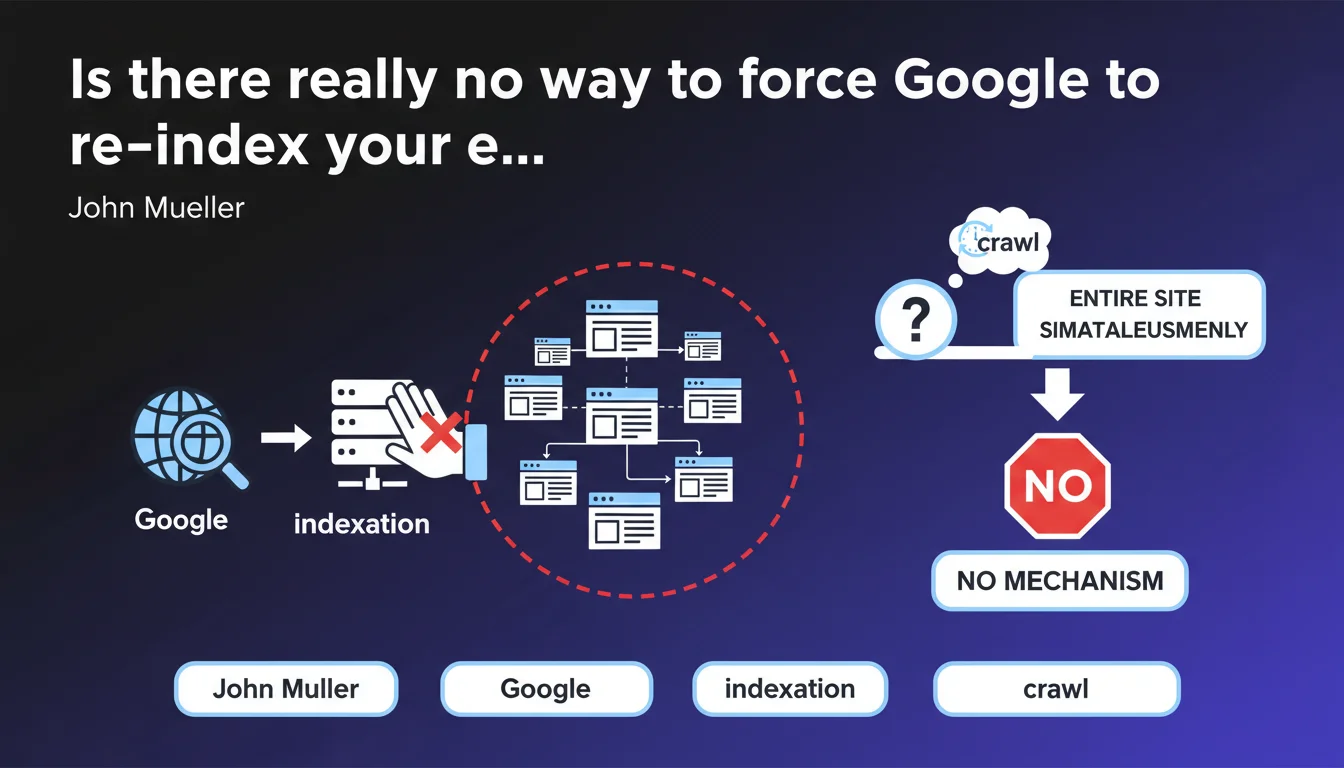
Google provides no mechanism to trigger a complete recrawl and reprocessing of a site in a single action. There is no magic button to re-index an entire domain on demand. Webmasters must rely on standard methods of progressive crawling and URL submission.
What you need to understand
Why does Google make such a point about the absence of a mass re-indexing tool?
Google is responding here to a recurring expectation among SEO professionals: the ability to force a complete recrawl after a migration, major redesign, or significant structural change. The absence of such a mechanism is explained by the very logic of Google's crawling process.
The robot explores the web according to its own priorities: site popularity, update frequency, allocated crawl budget. Offering a total re-indexing button would create a massive spam vector and destabilize algorithmic balance.
What tools exist then to influence crawling?
Google provides partial mechanisms: the URL inspection tool in Search Console allows you to submit individual pages, XML sitemaps signal priority content, and robots.txt files guide the bot's behavior.
But none of these tools trigger simultaneous recrawling of thousands of pages. The process remains asynchronous and controlled by Google's algorithms, not by the webmaster.
What are the concrete implications for redesign projects?
A technical migration or structural change will never be taken into account instantaneously. You must anticipate a propagation delay that varies depending on site size and authority.
Sites with low crawl budget can take several weeks to see their modifications fully indexed. This reality requires rigorous planning and prior testing.
- No total re-indexing button exists in Search Console or elsewhere
- Crawling remains controlled by Google according to its internal criteria
- Available tools (URL inspection, sitemap) only concern partial actions
- A redesign requires anticipating an unavoidable propagation delay
- Low-authority sites experience longer indexation delays
SEO Expert opinion
Is this statement consistent with practices observed in the field?
Yes, absolutely. In practice, even major institutional or e-commerce sites receive no preferential treatment allowing instant re-indexation. Crawling remains progressive, even after a migration announced via Search Console.
Some professionals hoped that a combination of actions — sitemap submission + massive URL inspection + address change — could simulate a complete recrawl. Experience shows it cannot: Google keeps its own pace.
What nuances should be added to this official position?
While Google offers no public tool, there likely exist internal levers for certain strategic partners (major media outlets, critical public service sites). [To verify] — no official documentation confirms this, but field observations suggest disparities in treatment.
Furthermore, artificially increasing the update rate (through regular programmatic modifications) can accelerate recrawling. But this technique amounts to manipulation and carries risks: it can waste crawl budget unnecessarily or trigger penalties if detected as spam.
In what cases does this rule pose a real operational problem?
Emergency migrations — CMS change for security reasons, company mergers requiring rapid domain consolidation — directly confront this limitation. It's impossible to force Google's hand.
Similarly, a penalized site that fixes all its issues cannot accelerate the re-evaluation process. It must wait for Google to naturally recrawl the affected pages, which can take weeks.
Practical impact and recommendations
What should you do concretely during a redesign or migration?
Abandon the idea of immediate re-indexation. Instead, plan an optimized crawling strategy: submit a clean, prioritized XML sitemap, manually inspect strategic pages (top landing pages, main category pages), and ensure your internal linking facilitates rapid discovery of new URLs.
Monitor Search Console daily to identify crawl errors and fix them on the fly. The more technically clean your site, the more naturally Google will accelerate its exploration.
What errors should you avoid after a major technical change?
Don't overwhelm the URL inspection tool with hundreds of simultaneous submissions. Google limits these actions and may consider excessive use as suspicious.
Also avoid massively modifying your content just after a migration to "force" a recrawl. Google could interpret these changes as instability and slow its exploration as a precaution.
How do you measure crawl progress after migration?
Use the coverage reports in Search Console to track the evolution of indexed pages. Compare with your XML sitemap to identify gaps.
Also monitor your server logs: the frequency of Googlebot visits to your new URLs will give you a reliable indication of recrawl pace. If this pace stagnates, it's a warning signal.
- Submit a clean XML sitemap listing only priority canonical URLs
- Manually inspect strategic pages (top 20-50 URLs by traffic)
- Optimize your internal linking to facilitate discovery of new pages
- Immediately fix any crawl errors reported in Search Console
- Monitor server logs to measure actual Googlebot visit frequency
- Don't multiply excessive manual submissions — Google limits them and may slow crawling
- Anticipate several weeks for complete recrawl on large sites
❓ Frequently Asked Questions
Peut-on accélérer le recrawl d'un site après une migration ?
Combien de temps faut-il pour qu'un site soit entièrement ré-indexé après une refonte ?
L'outil d'inspection d'URL permet-il de soumettre plusieurs pages en masse ?
Existe-t-il des outils tiers permettant de forcer un recrawl complet ?
Les sites à forte autorité bénéficient-ils d'un recrawl plus rapide ?
🎥 From the same video 8
Other SEO insights extracted from this same Google Search Central video · published on 23/01/2024
🎥 Watch the full video on YouTube →
💬 Comments (0)
Be the first to comment.