
Official statement
Other statements from this video 11 ▾
- □ Is page experience really enough to guarantee good UX for Google?
- □ Should you really prioritize users over machines in SEO?
- □ Why does Google prefer hyphens over underscores in URLs—and what's the real impact on your rankings?
- □ Do accordions really hurt your SEO, or is it just an old myth?
- □ Has hidden content become just as important as visible content for Google?
- □ Does Googlebot really fail to index content hidden behind user clicks?
- □ Is Google really unable to crawl your navigation if it doesn't use proper anchor links?
- □ Are Core Web Vitals really enough to measure user experience?
- □ Why won't Google give you precise criteria on certain UX aspects—and what should you do about it?
- □ Are human-readable and consistent URLs really a ranking factor?
- □ Does web accessibility directly impact your Google rankings?
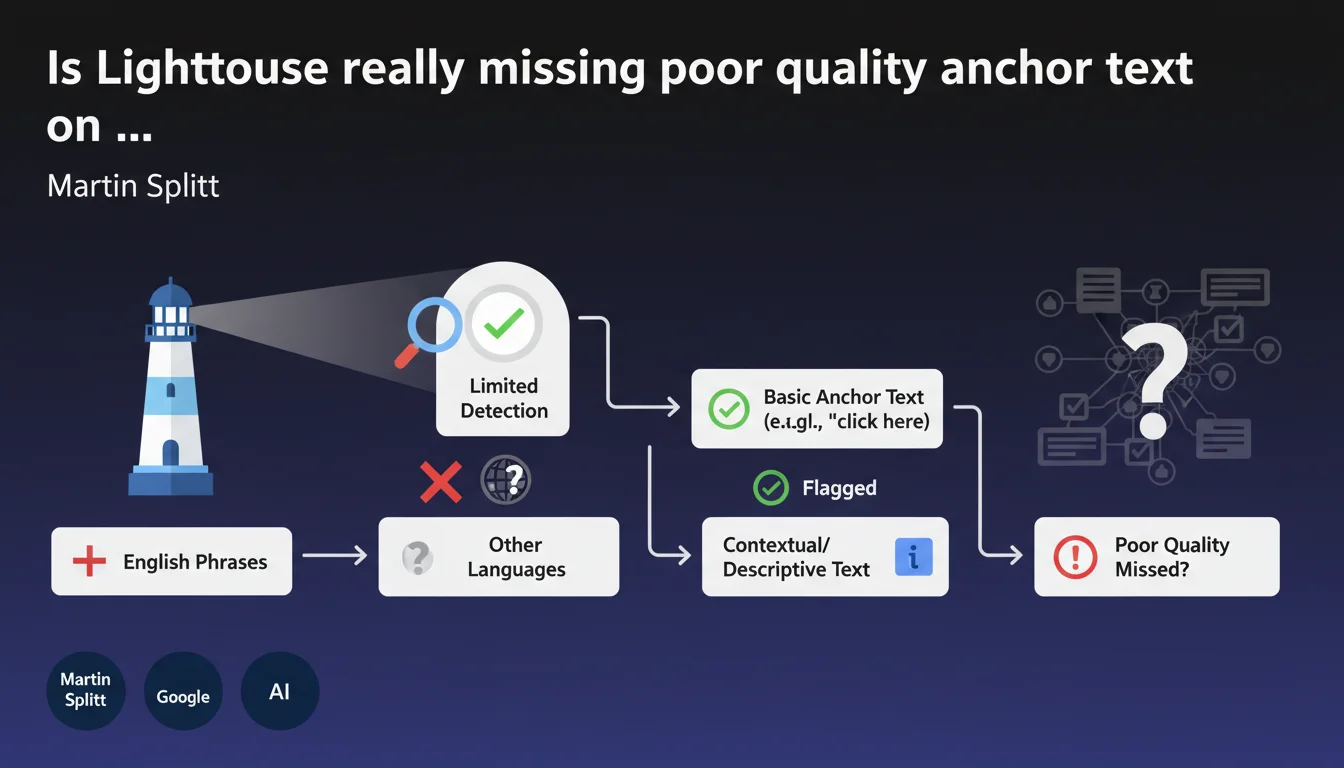
Lighthouse only detects a few generic English expressions like 'click here' to flag non-descriptive link text. This check is purely superficial: it doesn't work on other languages or even slightly different variations. In other words, a link saying 'cliquez ici' in French completely escapes detection.
What you need to understand
What does Lighthouse actually check on link anchors?
The Lighthouse tool includes an automated test designed to identify uninformative link text. Specifically, it compares each link's anchor against a predefined list of English formulas: 'click here', 'read more', 'learn more', and so on.
Whenever an anchor matches one of these expressions exactly, Lighthouse raises an alert. That's it. No semantic analysis, no contextual evaluation, no consideration of the target page's content.
Why is this detection so limited?
The list used by Lighthouse is fixed and exclusively English-language. If your site is in French, Spanish, German, or any other language, no real verification actually applies.
Even in English, the slightest variation goes undetected. 'Click right here'? Not detected. 'Read this article'? Not detected. The system only recognizes exact matches with a handful of formulas.
What value should you place on this Lighthouse audit?
This audit has very low indicative value for anyone seriously optimizing internal linking. It in no way replaces manual analysis or in-depth crawling with Screaming Frog or Botify.
Google itself implicitly acknowledges that this tool remains basic. Therefore, you shouldn't rely on Lighthouse to validate the descriptive quality of your anchors — nor should you feel reassured if everything shows green.
- Lighthouse only detects a few fixed English formulas like 'click here' or 'read more'
- No verification applies to non-English language sites
- Even in English, the slightest variation or rewording escapes detection
- This audit doesn't replace thorough semantic analysis of internal linking
- A green score in Lighthouse doesn't guarantee the actual descriptive quality of your anchors
SEO Expert opinion
Does this technical limitation reveal something about Google's actual detection capabilities?
Lighthouse is not GoogleBot. Confusing the two is a common mistake. What Lighthouse detects — or misses — tells you nothing about the ranking algorithm's actual ability to assess the quality of an anchor.
Google has been analyzing the semantic context of links for years, the coherence between anchor and target page, the diversity of formulations. The algorithm leverages complex language models that have nothing to do with Lighthouse's fixed list.
Should you ignore this audit completely?
No, but you must put it in proper perspective: a beginner-level indicator. If Lighthouse detects 'click here' on your pages, that's indeed a signal worth correcting — but it's only the tip of the iceberg.
The real problem is all the links Lighthouse doesn't see: vague anchors ('learn more'), anchors duplicated identically across 50 different pages, overly generic anchors ('article'), anchors disconnected from the target topic. [Needs verification]: no public data precisely specifies how much Google actually penalizes these practices in its ranking algorithm.
Is this statement consistent with real-world observations?
Absolutely. We've always observed that Lighthouse misses obvious anchor problems on multilingual sites. A French site full of 'cliquez ici' gets a perfect score on this audit.
On the other hand, in terms of actual ranking, sites with descriptive and varied internal linking consistently perform better — confirming that GoogleBot goes well beyond what Lighthouse tests.
Practical impact and recommendations
What should you concretely do with this information?
First, don't change your internal linking strategy just because Lighthouse reports nothing. The absence of an alert doesn't mean your anchors are optimal.
Next, continue applying the fundamentals: each anchor must be descriptive, contextual, and varied. A link to an article about 'quality backlinks' should never point with the anchor 'click here' — even if Lighthouse doesn't detect it.
How do you effectively audit the quality of your link anchors?
Forget Lighthouse for this task. Export all your internal links via a crawler (Screaming Frog, Oncrawl, Botify) and analyze anchors manually or through scripts.
Identify problematic patterns: identical anchors repeated massively, anchors too short (less than 3 words), anchors disconnected from the target page's H1. This work takes time, but it's infinitely more reliable than any basic automated audit.
What mistakes must you avoid at all costs?
Never rely on a single tool to validate a critical SEO aspect. Lighthouse is useful for detecting obvious technical issues (missing alt text, insufficient contrast), but it never claimed to assess semantics finely.
Another pitfall: believing a non-English site can skip anchor audits because Lighthouse tests nothing. It's precisely the opposite — without an automated safety net, manual audit becomes even more essential.
- Never rely solely on Lighthouse to validate link anchor quality
- Crawl your entire site with a professional tool to extract all internal anchors
- Identify and correct generic anchors: 'click here', 'learn more', 'read more', etc.
- Verify consistency between the anchor and the H1 title of the target page
- Vary formulations to avoid duplication of identical anchors across multiple pages
- Favor descriptive anchors of 3 to 8 words including target keywords
- Document editorial rules to standardize link creation in new content
❓ Frequently Asked Questions
Lighthouse détecte-t-il les ancres 'en savoir plus' sur un site français ?
Un score parfait sur l'audit Lighthouse garantit-il la qualité de mes ancres ?
Google pénalise-t-il réellement les ancres génériques comme 'cliquez ici' ?
Quel outil utiliser pour auditer sérieusement les ancres de liens internes ?
Faut-il corriger toutes les ancres génériques d'un seul coup ?
🎥 From the same video 11
Other SEO insights extracted from this same Google Search Central video · published on 21/06/2022
🎥 Watch the full video on YouTube →
💬 Comments (0)
Be the first to comment.