
Official statement
Other statements from this video 12 ▾
- □ Faut-il vraiment se préoccuper du crawl budget pour votre site ?
- □ Comment Google définit-il réellement le crawl budget et quels leviers peut-on actionner ?
- □ Le crawl budget est-il un concept inventé par Google ou par les SEO ?
- □ Google n'indexe-t-il vraiment qu'une fraction du web à cause de ses coûts de stockage ?
- □ Les requêtes POST plombent-elles vraiment votre crawl budget ?
- □ Les codes 503 et 429 peuvent-ils vraiment réduire votre crawl budget ?
- □ Peut-on vraiment piloter son crawl budget depuis Google Search Console ?
- □ HTTP/2 améliore-t-il vraiment votre crawl budget ?
- □ Pourquoi vos URLs 'découvertes mais non crawlées' révèlent-elles un problème de fond ?
- □ Faut-il bloquer l'indexation de vos fichiers JavaScript pour optimiser le crawl budget ?
- □ Les 404 et robots.txt gaspillent-ils vraiment votre crawl budget ?
- □ Faut-il bloquer vos fichiers JavaScript décoratifs pour optimiser votre crawl budget ?
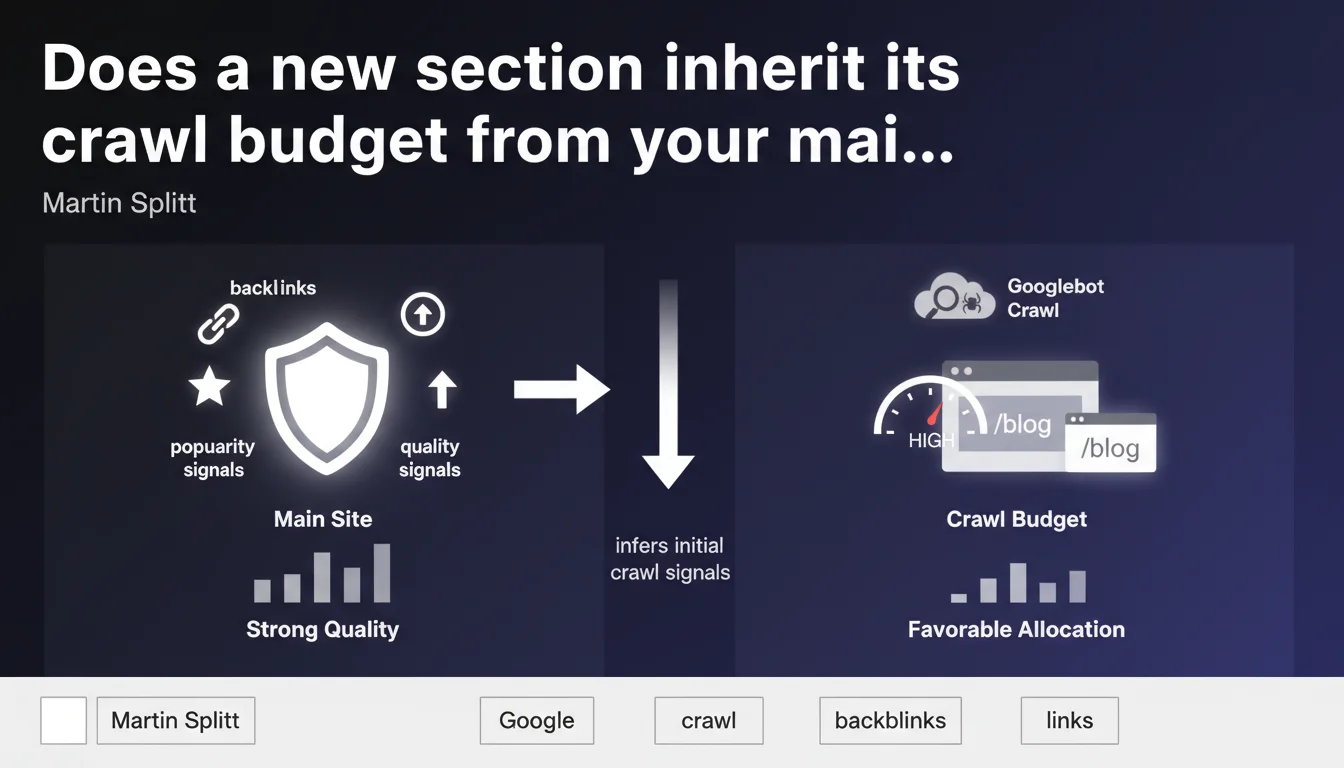
Google infers initial crawl signals for a new section (like /blog) based on the overall quality of your main site. If your domain already has a strong reputation (backlinks, popularity), your new section will benefit from more favorable crawl budget allocation right from launch. This confirms that the overall domain health directly impacts the discovery and indexing of new content.
What you need to understand
Does Google judge a new section by the standards of your existing site?
Yes, and it's a matter of algorithmic efficiency. Google doesn't treat each new section as virgin territory. When you launch /blog or /news, Googlebot already has a track record: your domain has authority, a link profile, a typical crawl rate.
Rather than starting from scratch, Google projects these existing quality signals onto the new section. If your main site has already proven its value (strong backlinks, consistent traffic, reliable content), the new section inherits priority treatment. The crawl budget allocated will be more generous from the first hours.
What does this change for SEO practitioners?
Concretely, you don't all start from the same point. An already well-established site will see its new content crawled and indexed faster than a recent or poorly-regarded domain. It's a mechanical advantage: Google trusts your domain and allocates more resources to discover what you publish.
But be careful — it's not a free pass. The inheritance concerns initial crawling, not ranking. If the content in the new section is poor, Google will quickly adjust its priorities downward.
- Initial crawl budget for a new section depends on the overall quality of the domain
- Sites with strong reputation (links, traffic) benefit from more generous crawling right from launch
- This inference concerns discovery and indexing, not ranking of pages
- If the new section's content disappoints, Google will adjust the crawl budget downward over time
Why does Google proceed this way?
Because crawling is expensive. Google can't afford to intensively scan every new directory on every domain on the web. It prioritizes based on the probability that content is relevant and high-quality.
A domain that's already performing well has statistically better chances of publishing useful content. It's a rational bet: Google allocates more resources where the return on investment (in terms of discovering quality content) is likely higher.
SEO Expert opinion
Is this statement consistent with real-world observations?
Yes, and it confirms what many practitioners already suspected. On well-established domains, new pages — whether a blog or product section — are often crawled within hours. On recent or poorly-regarded sites, the same content can wait days or even weeks.
But let's be honest: this statement remains quite vague about the precise mechanisms. Which quality signals carry the most weight? Number of backlinks? Click-through rate? Freshness of existing content? Martin Splitt doesn't say. [To verify]: the exact weighting of these signals in crawl budget inheritance remains unclear.
What nuances should we add?
First point: inheritance plays a role at launch, not indefinitely. If your new section publishes mediocre or duplicate content, Google will adjust the crawl budget downward. The initial advantage isn't a blank check.
Second nuance — and it's important: a medium-quality site that launches an exceptional section won't be penalized indefinitely. Google observes signals specific to each section (engagement, inbound links to /blog, social shares). If the section proves its value, the crawl budget will follow, even if the rest of the site is average.
In what cases does this rule not apply?
If you launch a new section on a separate subdomain (blog.yoursite.com rather than yoursite.com/blog), Google may treat this subdomain as a partially separate entity. Inheritance will be less direct, although some signals (like root domain authority) may still play a role.
Another edge case: sites that are victims of manual or algorithmic penalties. If your domain is penalized for spam or link manipulation, launching a clean new section probably won't be enough. Google will apply skepticism to the entire domain.
Practical impact and recommendations
What should you actually do before launching a new section?
First, audit your domain's overall health. If you plan to launch a blog or news section, verify that the rest of your site is in good shape: no massive 404 errors, correct response times, existing content of quality. Inheritance will work better if the main site is sending positive signals.
Next, prepare the technical groundwork. Make sure the new section is properly declared in your XML sitemap, that your URL structure is consistent, and that internal linking already points to this section (even before publication). Google must be able to easily discover the new pages.
- Audit your main site's SEO health (backlinks, speed, content) before launch
- Include the new section in your XML sitemap on day one
- Create internal links to the new section from well-crawled pages on your main site
- Monitor server logs to verify crawl frequency in the first weeks
- If crawling is slow, check your robots.txt file and accidental noindex directives
- Publish quality content from launch — initial inheritance won't compensate for weak content
What mistakes should you absolutely avoid?
Don't count on inheritance to make up for mediocre content. Yes, your new section will be crawled faster if the main site is strong. But if Google discovers weak or duplicate content, crawl budget will drop quickly. The initial advantage will be wasted.
Another common mistake: launching a section without promoting it. Even with good initial crawl budget, Google also observes engagement signals. If no one clicks, shares, or links to your new section, Google will draw conclusions. Make the launch known: internal links, newsletters, social media.
How can you verify your strategy is working?
Monitor your server logs in the first 48 hours after publication. You should see Googlebot visiting the new section regularly if inheritance is working in your favor. If crawling is rare or sporadic, that's a warning sign: either the main site has problems, or the new section is not easily discoverable.
Also use Google Search Console to check indexing speed. If pages from the new section appear in the index within hours, that's a good sign. If it drags on for days, investigate: sitemap problem, overly restrictive robots.txt, or insufficient overall quality signals.
The inheritance of quality signals from your main site to a new section is a real mechanical advantage for well-established domains. But this advantage doesn't replace a solid strategy: quality content, internal linking, active promotion.
If you anticipate a complex launch — with technical challenges, migrations, or large content volume — it may be wise to get professional help. A specialized SEO agency can audit your domain, optimize structure before launch, and monitor crawling in real-time to quickly fix any bottlenecks.
❓ Frequently Asked Questions
L'héritage du crawl budget fonctionne-t-il aussi pour un sous-domaine ?
Si mon site principal est de qualité moyenne, ma nouvelle section est-elle condamnée ?
Combien de temps dure cet avantage initial de crawl ?
Comment vérifier si ma nouvelle section bénéficie d'un bon crawl budget ?
Quels signaux de qualité comptent le plus pour l'héritage du crawl budget ?
🎥 From the same video 12
Other SEO insights extracted from this same Google Search Central video · published on 25/08/2022
🎥 Watch the full video on YouTube →
💬 Comments (0)
Be the first to comment.