
Official statement
Other statements from this video 7 ▾
- □ Googlebot découvre-t-il vraiment vos pages grâce aux liens internes ?
- □ Pourquoi l'élément HTML <a> avec attribut href est-il indispensable au crawl Google ?
- □ Pourquoi Google insiste-t-il pour que les liens restent de vrais liens HTML ?
- □ Le texte d'ancrage significatif est-il encore un levier SEO décisif ?
- □ Pourquoi trop de liens internes peuvent-ils nuire à votre SEO ?
- □ Comment trouver le bon équilibre dans la quantité de liens internes ?
- □ Pourquoi Google insiste-t-il encore sur l'importance des liens internes pour la navigation et la découverte de contenu ?
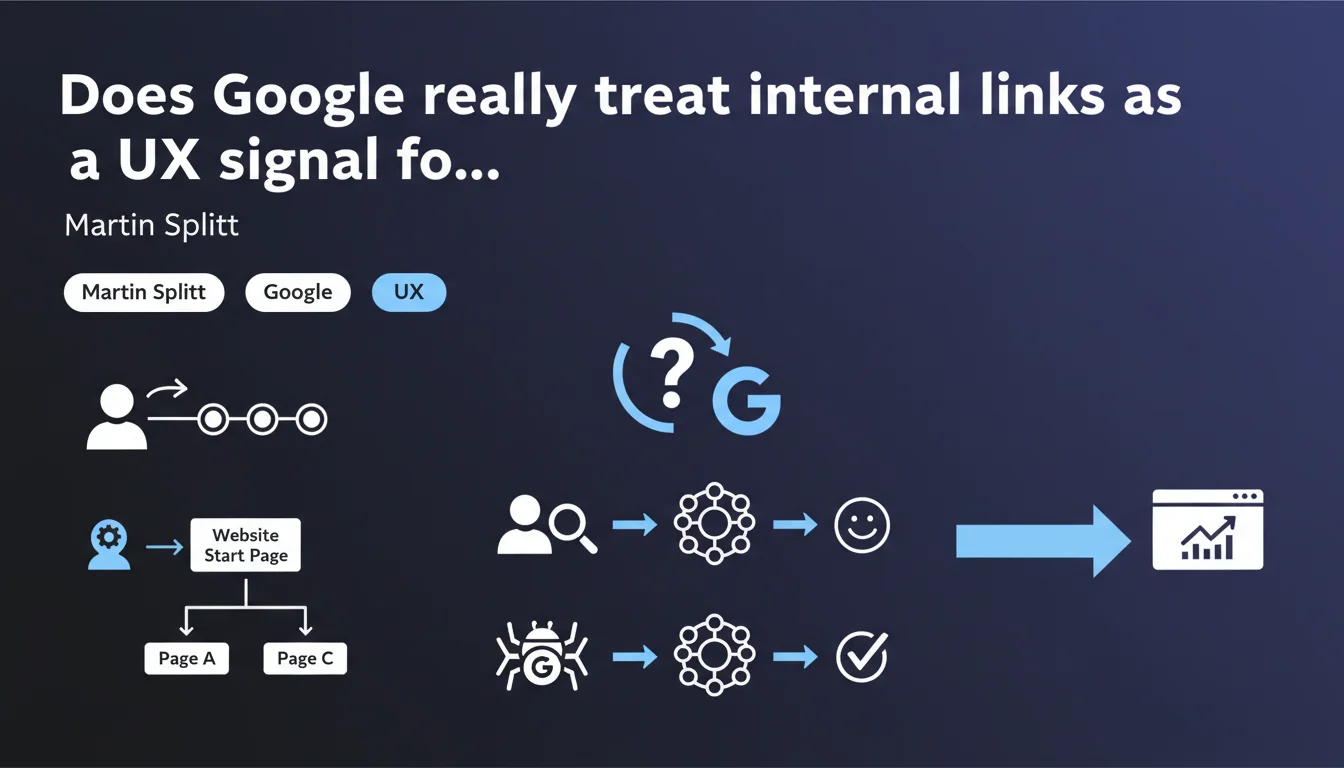
Martin Splitt claims that Googlebot uses internal links exactly the way a human user would to navigate a website. The key insight: internal links serve not just for crawling, but also to identify "logical next steps"—which implies a semantic understanding of user journeys.
What you need to understand
Does Googlebot really read internal links like a user would?
Splitt's phrasing is clear: Googlebot doesn't just extract URLs. It analyzes internal links to understand which pages are logically connected to each other, exactly like a visitor trying to navigate.
In practical terms, this means that the context of an internal link matters—not just its presence. A link placed in a generic menu doesn't carry the same weight as a contextual link inserted within a thematic paragraph.
What does Splitt mean by "logical next steps"?
This is where it gets interesting. Google is no longer just talking about crawling or PageRank flow, but about understanding user journeys.
An internal link that offers a "logical next step"—for example, an article on backlinks linking to a guide on link building—sends a signal of thematic coherence. Google rewards sites that intelligently guide their visitors, and this signal is conveyed through internal linking.
Why is this statement coming out now?
Splitt never gives a precise date, but this kind of reminder often comes when Google observes abusive SEO practices. Here, we can assume he's targeting two pitfalls: sites that barely link their pages internally (leaving orphaned pages), and those that create artificial linking structures with no user logic.
- Internal links serve more than just crawling: they're a signal of thematic relevance.
- The context of a link matters: a link naturally inserted within content is worth more than a link in the footer.
- Google rewards logical user journeys: sites that intelligently guide their visitors have an advantage.
- Orphaned pages are a problem: every important page should be accessible via at least one contextual internal link.
SEO Expert opinion
Is this statement consistent with real-world observations?
Yes, but with an important nuance. SEO testing has shown for years that internal linking improves crawlability and ranking. What's new here is the emphasis on the "user journey" dimension.
Splitt doesn't explicitly say that Google measures internal clicks to evaluate link relevance—but he clearly suggests that the expected behavior of a user is a criterion. [To verify]: how far does this "reading" go? Does Google use Analytics or Chrome data to validate that an internal link is actually being clicked? No public data confirms this.
What nuances should we add?
Be careful not to over-interpret. Splitt doesn't say that all internal links are equal. A link in a navigation menu doesn't carry the same weight as a contextual link in the middle of a paragraph.
Likewise, this statement doesn't mean you should link every page to every other page. Thematic coherence remains central: an internal link must make sense for the reader, otherwise it will be ignored—by both the user and the algorithm.
In which cases does this rule not apply?
Two situations deserve attention. First, sites with scattered architecture (multi-domain, isolated subdomains): Googlebot doesn't always follow links to external domains, even if they belong to the same group.
Second, sites with massive page volumes (e-commerce, content aggregators). There, crawl budget becomes a physical limit: even with perfect internal linking, not all pages will be crawled regularly. In this case, you must prioritize strategic pages via XML sitemaps and internal links from the homepage or main categories.
Practical impact and recommendations
What should you do concretely on your website?
First step: identify orphaned pages. An orphaned page is a page accessible only through internal search or an XML sitemap, with no links from other pages on the site. These pages are invisible to Googlebot if the crawler doesn't find them elsewhere.
Next, audit the logic of your existing internal linking. Ask yourself: "If I were a visitor who just read this page, what content would I want to check out next?" If the proposed link doesn't answer this question, it's probably useless.
How do you structure an effective internal linking strategy?
Prioritize contextual links inserted within the body text, rather than generic "Related Articles" blocks at the end of a page. Google knows how to distinguish between a relevant link and an automated one.
Second rule: limit the number of clicks from the homepage. An important page should never be more than 3 clicks away from the homepage. Beyond that, it loses authority and the likelihood of being crawled regularly.
What mistakes should you absolutely avoid?
Don't create overly rigid silo linking. A site where each category is isolated from others sends a fragmentation signal. Google rewards sites that create bridges between related topics.
Also avoid internal links in JavaScript that isn't accessible. If a link is generated dynamically without an HTML fallback, Googlebot may miss it. Always test with the URL Inspection tool in Search Console.
- List all orphaned pages and link them from at least one indexed page
- Prioritize contextual links in the body text over automated blocks
- Verify that each strategic page is accessible in fewer than 3 clicks from the homepage
- Audit internal link anchors: they must be descriptive and consistent with the target page
- Test your linking structure with the URL Inspection tool to confirm Googlebot follows it
- Avoid overly rigid silos: create bridges between related topics
Internal linking is one of the most underestimated SEO levers, yet it directly impacts crawling, indexing, and ranking. Restructuring internal linking across an entire website requires strategic vision and deep understanding of user journeys.
If this optimization seems complex to manage on your own—especially on a site with hundreds of pages—working with a specialized SEO agency can save you time and help avoid costly mistakes. Internal linking audits are one of those projects where hands-on experience makes all the difference.
❓ Frequently Asked Questions
Un lien interne dans un footer a-t-il la même valeur qu'un lien contextuel ?
Combien de liens internes faut-il par page ?
Les liens en JavaScript sont-ils suivis par Googlebot ?
Faut-il mailler toutes les pages entre elles ?
Comment détecter les pages orphelines sur un gros site ?
🎥 From the same video 7
Other SEO insights extracted from this same Google Search Central video · published on 23/07/2024
🎥 Watch the full video on YouTube →
💬 Comments (0)
Be the first to comment.