
Official statement
Other statements from this video 7 ▾
- □ Les liens internes sont-ils vraiment traités comme des signaux UX par Googlebot ?
- □ Googlebot découvre-t-il vraiment vos pages grâce aux liens internes ?
- □ Pourquoi l'élément HTML <a> avec attribut href est-il indispensable au crawl Google ?
- □ Pourquoi Google insiste-t-il pour que les liens restent de vrais liens HTML ?
- □ Le texte d'ancrage significatif est-il encore un levier SEO décisif ?
- □ Pourquoi trop de liens internes peuvent-ils nuire à votre SEO ?
- □ Comment trouver le bon équilibre dans la quantité de liens internes ?
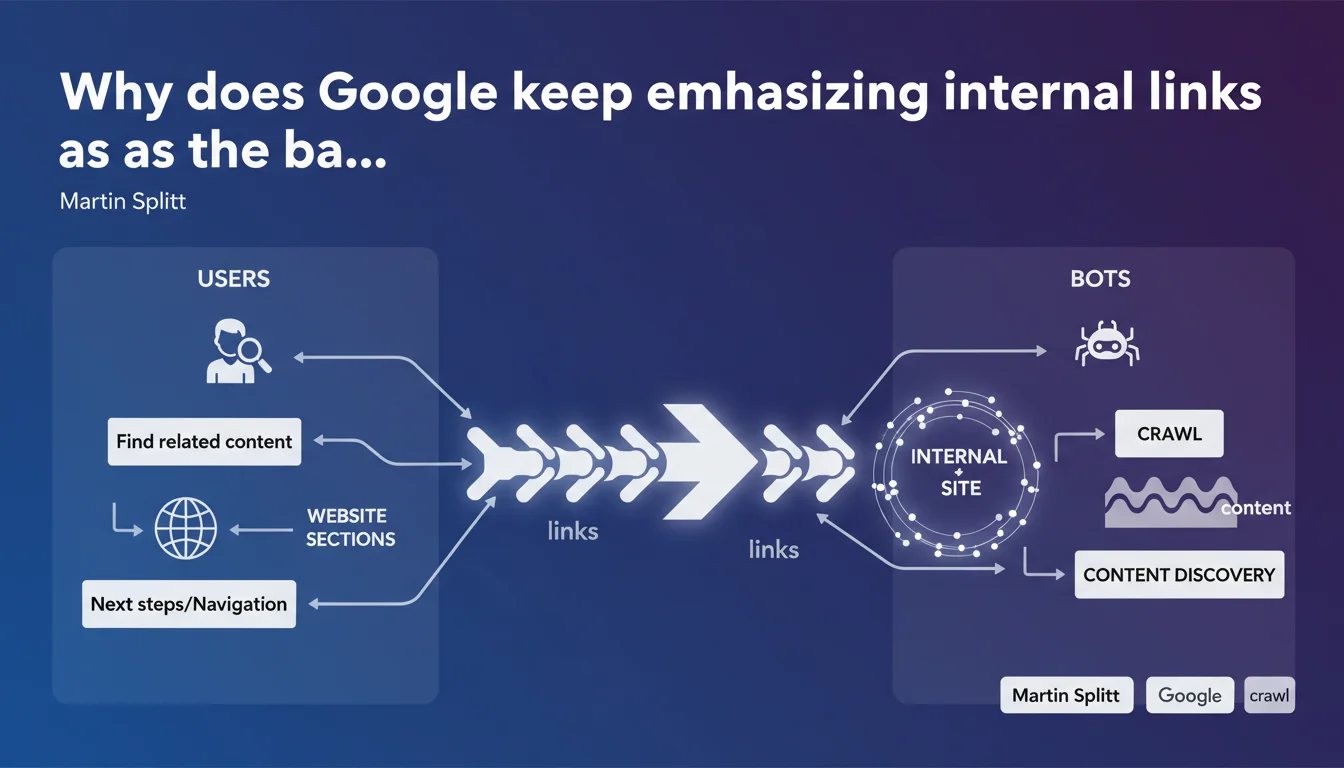
Martin Splitt reiterates that internal links serve both users and bots in discovering related content and navigating between sections of a website. This isn't a groundbreaking revelation, but rather a confirmation that internal linking architecture remains a fundamental pillar of crawlability and user experience. The absence of effective internal links equals orphaned pages and lost SEO potential.
What you need to understand
Martin Splitt reformulates here a foundational SEO principle: internal links form the skeleton of your site architecture. Without them, Googlebot cannot map your site or understand the semantic relationships between your pages.
This statement comes at a time when some websites rely solely on XML sitemaps or complex JavaScript structures, neglecting classical HTML linking. The result: entire sections of content remain inaccessible or undervalued.
What does "identify the next steps" concretely mean?
Google is talking here about contextual navigation: an article on "backlinks" should point to other resources on domain authority, link building, or link disavowals. These logical connections help Googlebot understand your overall topic and the depth of your expertise.
Bots follow the paths you create. If a page is only accessible after 5 clicks from the homepage, it will be crawled less frequently and carry less weight in your architecture.
Why repeat something so obvious?
Because the obvious isn't always applied in practice. Real-world audits still reveal sites with thousands of orphaned pages, weak navigation menus, or isolated silos that don't communicate with each other.
Google repeats fundamentals when mistakes persist. This reminder signals that the problem remains widespread, particularly on e-commerce sites and user-generated content platforms.
- Internal links create crawl paths and distribute internal PageRank
- They contextualize content by creating thematic clusters
- A page with no internal backlinks is invisible to the bot (even if it's in the sitemap)
- Your linking structure reveals your priorities: the more internal links a page receives, the more Google considers it important
- The anchor text of internal links plays a role in semantic understanding of the target page
SEO Expert opinion
Does this statement contain any new or lesser-known elements?
No. This is a reminder of the basics, and that's precisely what's telling.
When a Google spokesperson takes time to reformulate a twenty-year-old principle, it usually signals that implementation errors remain massive in the field. We still see sites with minimalist main menus, isolated silos, or product pages that link to nothing but the shopping cart.
What nuances should be added to this statement?
Not all internal links are equal. A link from the homepage carries more authority than a link from a page buried 6 clicks deep. Semantic context also matters: a link from a paragraph about link building to a page on backlinks has more value than a generic link from a footer.
The phrasing "enable identifying the next steps" is vague. [To verify]: Does Google use internal link structure to refine sitelinks in SERPs? No official confirmation on this, but field observations suggest a correlation.
Another rarely mentioned point: too many internal links on the same page can dilute their impact. If you stuff 300 links into your content, each one carries less weight. Finding the balance between rich linking and coherence remains delicate.
In what cases does this rule not fully apply?
On sites with auto-generated content or UGC platforms, maintaining coherent internal linking is a puzzle. Links must remain relevant — blind automated linking can create more noise than signal.
Single Page Applications (SPAs) also pose a specific challenge: if your internal links rely on JavaScript without HTML fallback, you break the basic principle mentioned by Splitt. Google can interpret them, but at a cost in crawl budget and reliability.
Practical impact and recommendations
What should you prioritize checking on your site?
Start by identifying orphaned pages: those with no internal backlinks from other pages on the site. Use a crawler like Screaming Frog or Oncrawl to detect them. If they're important, connect them to your information architecture via contextual links.
Next, analyze internal PageRank distribution. Do strategic pages (conversions, pillar landing pages) receive enough links from high-authority internal pages? If not, rebalance your linking structure.
How to structure an effective internal linking strategy?
Create thematic clusters: a pillar page (for example "Complete Guide to Link Building") should point to specialized sub-pages ("Obtaining Quality Backlinks", "Analyzing Your Link Profile", etc.), and these sub-pages should link to each other when relevant.
Use descriptive anchor text that contextualizes the target page. Avoid "click here" or "learn more" — prefer "link building strategies" or "optimize your internal linking".
Integrate links in the body of your content, not just in sidebars or footers. Google gives more weight to editorial links surrounded by relevant text.
What critical mistakes must you avoid?
- Don't leave pages orphaned (even temporarily)
- Avoid isolated silos: your categories should communicate when semantically coherent
- Don't overload your pages with internal links — quality over quantity
- Ban generic links without context ("related products" with no apparent logic)
- Don't neglect old pages with high potential: relink them from your new content
- Avoid circular linking loops without added value
- Never rely solely on XML sitemaps to get your pages discovered
Internal linking remains an underexploited SEO lever despite its direct impact on crawlability, indexation, and ranking. Auditing and optimizing this structure requires a holistic view of your architecture and a deep understanding of your business priorities.
If your site has thousands of pages or complex structure, managing this overhaul in-house can quickly become time-consuming. A specialized SEO agency has the tools and expertise to map your linking structure, identify opportunities, and implement a coherent strategy without breaking what already works.
❓ Frequently Asked Questions
Un sitemap XML suffit-il si mon maillage interne est faible ?
Combien de liens internes par page est optimal ?
Les liens en nofollow interne ont-ils un impact sur le crawl ?
Faut-il privilégier les liens depuis la homepage ou depuis des pages thématiques ?
Comment gérer le maillage interne sur un site e-commerce avec des milliers de produits ?
🎥 From the same video 7
Other SEO insights extracted from this same Google Search Central video · published on 23/07/2024
🎥 Watch the full video on YouTube →
💬 Comments (0)
Be the first to comment.