
Official statement
Other statements from this video 11 ▾
- □ Do Core Web Vitals Really Impact Your Content's Search Rankings?
- □ Is mobile-friendliness really no longer a Google ranking factor?
- □ Is Google really switching from FID to INP in Core Web Vitals — and should you worry?
- □ Are Core Web Vitals Really Not Enough to Guarantee a Good User Experience?
- □ Does the Rich Results Test code editor really transform how you validate structured data?
- □ Does Search Console Insights really work without Google Analytics? A game-changer for site owners?
- □ Does Google's improved video indexing report finally reveal the real blocking issues?
- □ Should you really stop using the ping endpoint to submit your sitemaps?
- □ Why is Google documenting a new generic crawler and revealing its IP addresses?
- □ Is Google's new spam report really a game-changer for SEOs?
- □ Should you rethink your domain strategy now that .ai has become a generic ccTLD?
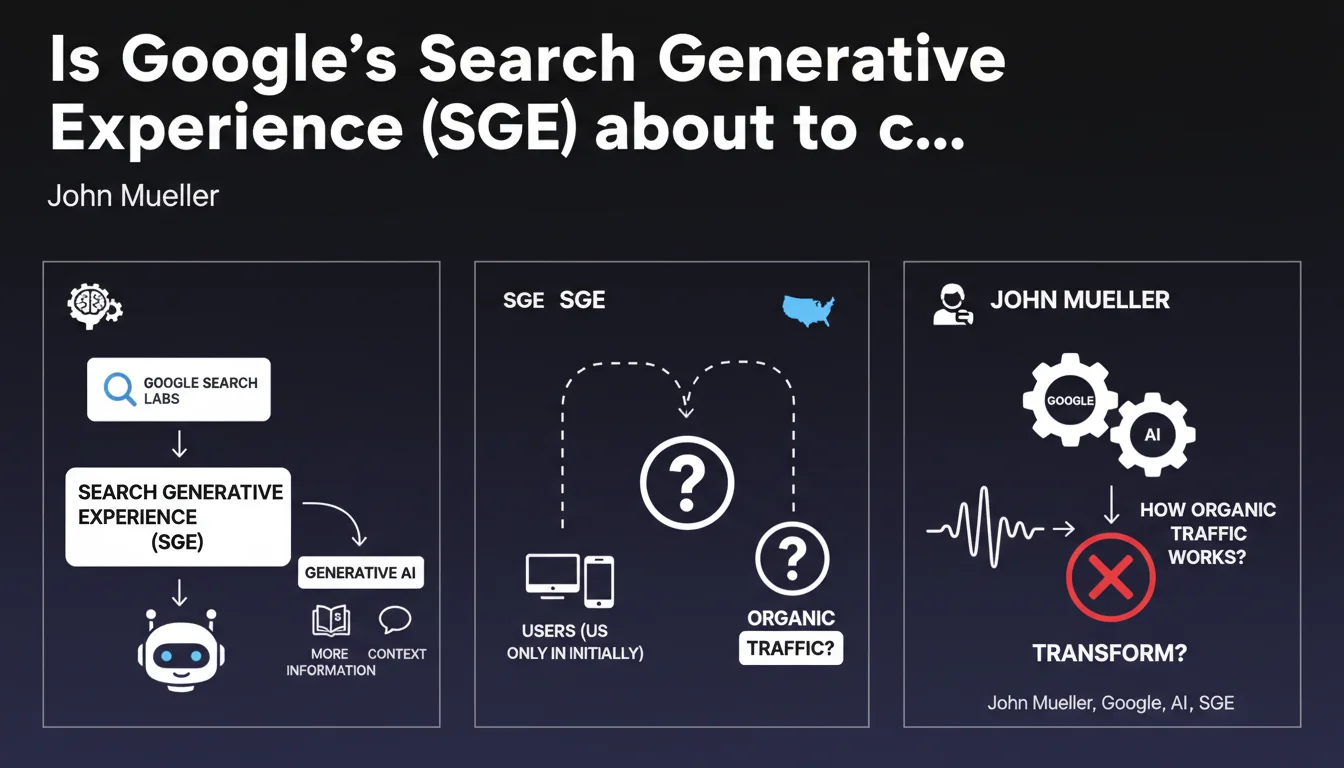
Google has launched Search Labs, a space where users can test experimental features, including Search Generative Experience (SGE). This new interface integrates generative AI directly into search results to deliver enriched and contextualized answers. For SEO professionals, this is a strong signal: traditional SERPs are evolving toward a conversational format where classic organic traffic could be significantly impacted.
What you need to understand
What exactly is Search Labs and why is Google launching this initiative now?
Search Labs is a public experimentation environment where Google tests features before mass deployment. The idea isn't new — Google has always tested internally — but this time, the company is opening the process to volunteer users.
The context? The rise of conversational tools like ChatGPT. Google is responding by integrating its own generative model directly into search results, rather than letting users migrate to other platforms.
What exactly does Search Generative Experience (SGE) consist of?
SGE displays an AI-generated answer above or alongside traditional organic results. This answer synthesizes multiple sources, cites references, and offers suggestions for follow-up questions.
The interface resembles a blend between an enriched featured snippet and a conversation. Users can ask follow-up questions without reformulating their query from scratch. It's a guided experience that keeps users on Google longer.
What is the immediate impact for SEO professionals?
The first effect is vertical compression of organic results. If an AI answer takes up the equivalent of 3-4 featured snippets in height, traditional positions 1-3 mechanically drop lower.
The second effect, more insidious: the click-through rate on organic results could drop if the AI answers the search intent well enough. Sites that depend on pure informational traffic are the most exposed.
- Search Labs is a public testing space for new Google features
- SGE uses generative AI to produce enriched answers directly in the SERPs
- Initial rollout is only in the United States, with opt-in access via Search Labs
- Traditional organic results lose visibility in favor of these generated answers
- The experience becomes conversational, with integrated follow-up questions
SEO Expert opinion
Is this statement consistent with real-world observations?
Yes, but with a time lag. Since the launch of SGE, we have indeed observed a measurable drop in CTR on certain informational queries in the United States. Independent studies show a decline of 15 to 30% depending on the vertical.
The problem is that Google provides no official data on actual impact. The only feedback comes from third-party tools or publisher testimonies. [To verify]: Google claims that SGE drives traffic through citations, but public data is lacking to confirm significant compensatory volume.
What nuances should be added to this announcement?
First nuance: SGE is not enabled by default. Users must join Search Labs and manually enable the experience. This significantly limits the exposed audience — for now.
Second nuance: Google's generative AI still makes factual errors. "Hallucinations" are frequent on niche or sensitive topics. Google will need to solve this problem before a widespread rollout, which could take time.
Third nuance — and this is central: SGE performs very differently depending on query type. On transactional or local queries, impact is minimal. On long informational queries ("how to do X", "why Y"), the impact is severe.
In what cases could this evolution actually be an advantage?
Paradoxically, some sites could gain visibility through SGE. If your content is cited as a source by the AI, you get a contextualized backlink visible in a premium area.
Brands with strong thematic authority are more likely to be cited. Generalist sites or aggregators of low-value content risk being ignored. This is accelerated Darwinism: only truly differentiated content will survive.
Practical impact and recommendations
What concrete steps should you take to adapt to SGE?
First action: audit your query mix. Identify what portion of your traffic comes from purely informational queries likely to be "solved" by an AI answer. If it's more than 50%, you're in the danger zone.
Second action: diversify your entry points. Newsletters, social media, partnerships — reduce your dependence on classic organic SEO traffic. This recommendation might seem defeatist, but it's pragmatic.
Third action: optimize to be cited. Structure your content with unique data, case studies, expert quotes. Google's AI prioritizes factually verifiable sources and content with strong editorial signature.
What mistakes should you avoid in this new context?
Don't attempt to "trick" the AI with keyword stuffing or black hat techniques. Generative models are trained to detect low-quality content — they're much better at this than older ranking algorithms.
Don't overlook transactional and local queries either. SGE has minimal impact on "buy X in Paris" or "best plumber Lyon". If you can pivot part of your strategy toward these intents, do it.
Finally, don't ignore engagement metrics. Google measures post-click behavior. If the AI drives traffic to your site but users leave immediately, you'll gradually lose this visibility.
How do you measure SGE's impact on your traffic?
Set up segments in Google Analytics to isolate US traffic (where SGE is active) and compare it to other geographic zones. If you notice a significant drop in the United States on certain pages, SGE is probably responsible.
Also use Search Console to identify queries where impressions increase but CTR drops. This is a classic indicator that a SERP feature (featured snippet, People Also Ask, or now SGE) is capturing attention without generating clicks.
- Audit the distribution of your queries between informational, transactional, and navigational
- Identify high-value content likely to be cited by the AI
- Structure your articles with factual data, verifiable sources, and schema.org formatting
- Diversify your acquisition channels to reduce dependence on organic SEO
- Monitor CTR and impressions in Search Console, especially on US traffic
- Test SGE yourself via Search Labs to understand how your competitors appear
- Strengthen on-site engagement: time spent, pages per session, conversions
❓ Frequently Asked Questions
SGE va-t-il remplacer complètement les résultats organiques classiques ?
Quand SGE sera-t-il disponible en France et dans d'autres pays ?
Les citations dans SGE génèrent-elles du trafic significatif ?
Peut-on optimiser spécifiquement pour apparaître dans les réponses SGE ?
SGE impacte-t-il toutes les requêtes de la même manière ?
🎥 From the same video 11
Other SEO insights extracted from this same Google Search Central video · published on 05/07/2023
🎥 Watch the full video on YouTube →
💬 Comments (0)
Be the first to comment.