
Official statement
Other statements from this video 9 ▾
- □ Pourquoi Googlebot signale-t-il des soft 404 sur vos pages géolocalisées vides ?
- □ Le cloaking géolocalisé est-il vraiment acceptable pour Google ?
- □ Afficher du contenu national par défaut est-il considéré comme du cloaking par Google ?
- □ Le cloaking est-il vraiment un problème si l'utilisateur n'est pas trompé ?
- □ Googlebot crawle-t-il vraiment votre site depuis plusieurs pays ?
- □ Faut-il attendre avant de juger l'impact d'une mise à jour algorithmique Google ?
- □ Pourquoi l'analyse des fichiers logs est-elle indispensable pour les gros sites ?
- □ Pourquoi une page vide détruit-elle votre expérience utilisateur et votre SEO ?
- □ Faut-il vraiment comparer l'état réel des pages avant et après une baisse de trafic ?
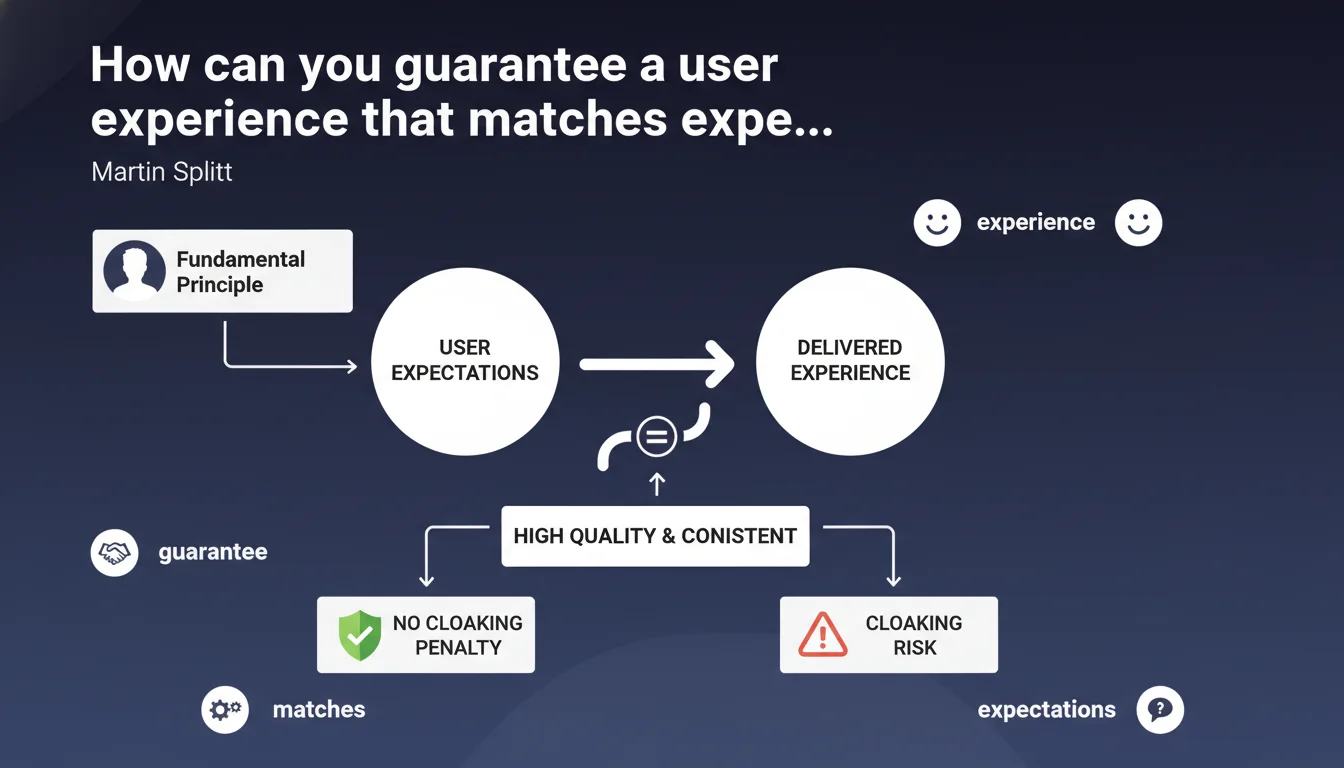
Google emphasizes that user experience must remain consistent with the user's initial expectations. Any gap between what your page promises in the SERPs and what it actually delivers can be interpreted as cloaking or deceptive practice. The stakes: align promise with reality to avoid algorithmic penalties.
What you need to understand
What does Google mean by "consistency with expectations"?
Google insists on a simple principle: what users see in search results must match what they find when they arrive on the page. Any major discrepancy — different content, degraded experience, unfulfilled promise — can be interpreted as an attempt at manipulation.
Concretely, if your title and meta description promise a detailed comparison but the page only offers an invasive contact form, you've created a disconnect. Google considers this a deceptive practice, even if technically you're not serving two distinct versions of the content.
How does this differ from traditional cloaking?
Traditional cloaking involves showing one version of the site to search engines and another to users. Here, Google broadens the scope: even without technical duplication, an inconsistency in experience is enough to cause problems.
The algorithm detects these gaps through behavioral signals — high bounce rate, immediate return to SERPs, low session duration. If these metrics betray recurring disappointment, your page risks losing ground.
Why this statement now?
Google has been refining its user experience evaluation criteria for years. With the growing integration of AI in SERPs and the rise of Core Web Vitals, alignment between expectations and reality is becoming a pillar of relevance.
This statement also aims to regulate borderline practices: aggressive pop-ups, deferred content, editorial bait-and-switch. Google is clearly signaling that perceived quality matters as much as technical quality.
- Experience must reflect the promises made in snippets and meta tags
- Any gap between what the SERP shows and what users discover is risky
- Behavioral signals allow Google to detect these inconsistencies without manual review
- Cloaking no longer limited to serving two distinct contents — perceived experience now counts
SEO Expert opinion
Is this statement consistent with practices observed in the field?
Yes — and it deserves to be highlighted. We've observed over the past several months a drop in visibility on pages using borderline techniques: content hidden behind multiple interactions, eye-catching titles unrelated to the substance, mobile experiences degraded compared to desktop.
Where it gets tricky is that Google provides no threshold, no objective metric to evaluate this "consistency." You're judged on fuzzy criteria, interpreted by an algorithm that constantly evolves. [To verify]: no official documentation specifies at what gap you fall into the red zone.
What nuances should be applied to this rule?
First point: Google perfectly tolerates adapting your content based on context — responsive design, geolocation personalization, language adjustments. What causes problems is the break in editorial promise.
Second nuance — and it's significant: Google evaluates this consistency through indirect signals. Technically flawless content that massively disappoints end users will ultimately be penalized. Conversely, a well-designed page can afford some gaps if engagement remains strong.
In which cases does this rule not really apply?
Let's be honest: large players benefit from a wider margin for error. An established media outlet can afford sensational titles or invasive interstitials without immediately losing positions — its authority compensates.
For an average or emerging site, tolerance is nearly zero. You don't have the trust capital to absorb repeated poor experience. Is it unfair? Perhaps. But it's observable in SERPs every day.
Practical impact and recommendations
What should you concretely do to align experience with expectations?
First priority: audit your title tags and meta descriptions. Every promise made in these elements must find a clear and immediate answer in visible content. No detours, no unnecessary friction.
Next, track experience breakdowns — intrusive pop-ups that hide content, undisclosed gated content, impoverished mobile versions. Anything that creates a disconnect between what the user expects and what they get must be fixed or at minimum signaled beforehand.
What errors must you absolutely avoid?
Never oversell your titles compared to actual content. A typical title like "Complete 2025 Guide" leading to 300 words without depth is a time bomb. Google will eventually adjust your CTR downward if users systematically flee.
Also avoid unjustified differentiated experiences — showing rich content to the bot and a light version to visitors, even for technical reasons, remains cloaking. If you must load content with delay, signal it properly with skeletons or visual indicators.
How do you verify that your site respects this consistency?
Analyze your behavioral metrics in Google Analytics and Search Console: session duration, bounce rate, pages per visit. A sharp discrepancy between high CTR and low engagement signals a problem.
Also test your site under real conditions — mobile, slow connections, ad blockers. The experience perceived by an average visitor must remain smooth and consistent, regardless of context.
- Verify that each title/meta description faithfully corresponds to page content
- Remove or delay pop-ups and interstitials that hide initial content
- Harmonize desktop and mobile experiences — no undisclosed degraded version
- Analyze behavioral metrics to detect expectation gaps
- Test the user journey from SERPs to conversion
- Document any deferred or conditional content with clear visual indicators
❓ Frequently Asked Questions
Un titre accrocheur est-il toujours considéré comme du clickbait par Google ?
Peut-on personnaliser le contenu selon le profil utilisateur sans risquer une pénalité ?
Comment Google détecte-t-il ces incohérences sans analyse manuelle ?
Un pop-up de conformité RGPD est-il considéré comme une rupture d'expérience ?
Les sites d'autorité échappent-ils vraiment à cette règle ?
🎥 From the same video 9
Other SEO insights extracted from this same Google Search Central video · published on 13/12/2022
🎥 Watch the full video on YouTube →
💬 Comments (0)
Be the first to comment.