
Official statement
Other statements from this video 13 ▾
- □ Is duplicate content on product pages really harmless for your SEO?
- □ Should you translate all your pages or focus your efforts on the most strategic ones?
- □ Is it really necessary to disable geotargeting in Search Console for an international site?
- □ Does Google really index hidden text in your HTML code?
- □ Should you prefer rel=canonical over user-agent redirects for unindexed pages?
- □ Should you implement your SEO optimizations all at once instead of gradually?
- □ No Google cache on my page: Should I be worried about my indexing?
- □ Does Googlebot really ignore all browser permissions when crawling?
- □ Should You Really Use Google's Indexing API to Speed Up Your Content Indexing?
- □ Is the Page Experience score really essential for making it into Top Stories?
- □ Does Google really assign an EAT score to your website?
- □ Does Google really favor sequential links or multiple pages for SEO pagination?
- □ Should you be concerned about Core Web Vitals measured exclusively on Chrome?
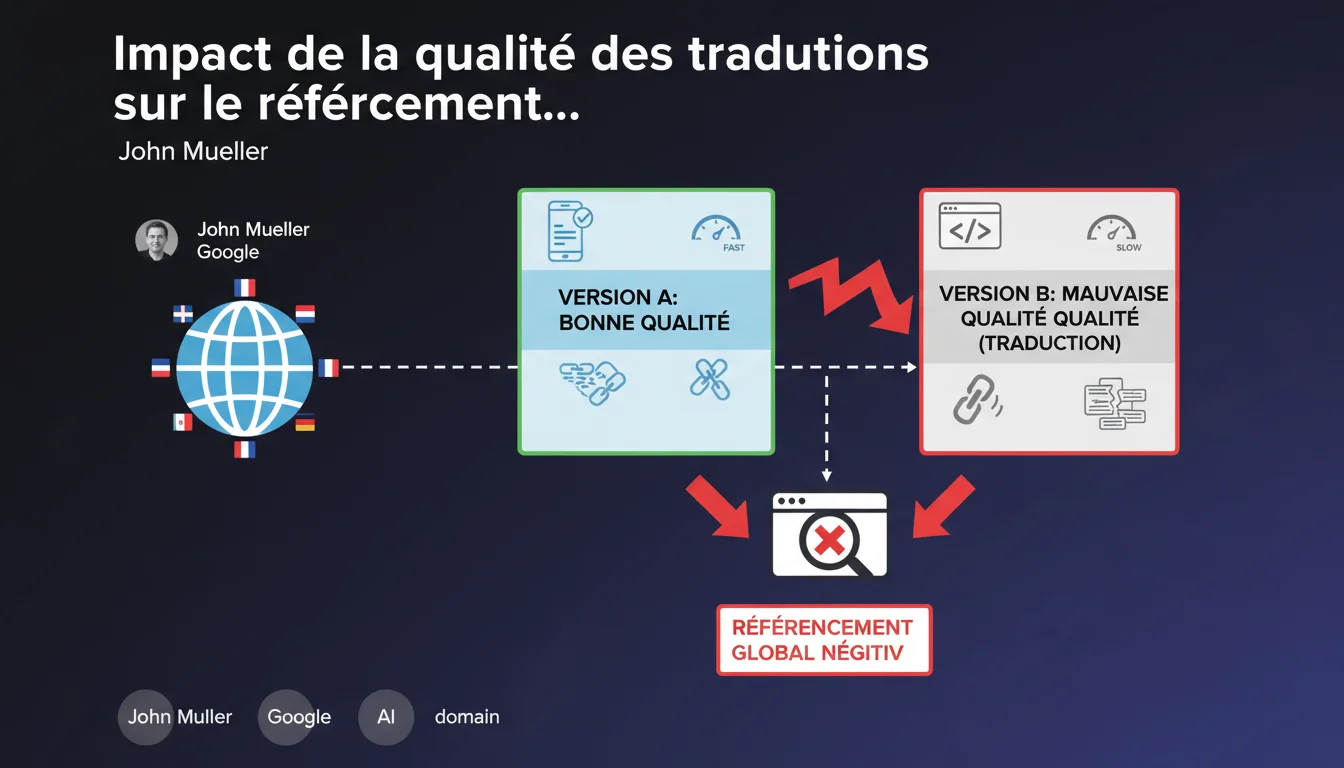
Google assesses the overall quality of a site, not just version by version. Poor translations in specific languages can degrade the SEO of the entire domain, including high-quality language versions. The quality of one language directly impacts the others on the same domain.
What you need to understand
Does Google Evaluate Each Language Version Independently?
No, and that's precisely where many people go wrong. Google does not strictly compartmentalize the language versions of the same domain. The algorithm builds a comprehensive quality assessment of the site, which encompasses all the languages present. If a significant portion of the content — let's say your automated translations in German, Spanish, and Italian — is of poor quality, this pollutes the overall signal. The engine interprets this mediocrity as an indicator of the overall reliability of the domain. Mueller does not provide a precise threshold, obviously. But the term "significant" suggests that we are not talking about a few isolated pages. If half of your languages utilize unedited, machine translations full of mistranslations — you are in the red zone. Specifically: a site offering 10 languages, of which 7 are of low quality, presents a favorable signal-to-noise ratio. Google sees more bad than good. It's an anti-spam logic. Google combats sites that artificially inflate their linguistic footprint with hastily translated content, solely to capture international traffic without effort. A domain that publishes mediocre content on a large scale sends a signal of low editorial investment. The algorithm draws conclusions about the entire project.What Does Google Mean by "Significant Portions"?
Why Does This Mechanism Exist?
SEO Expert opinion
Does This Statement Reflect Real-World Observations?
Yes, and it aligns with what has been observed for years on multilingual sites. Domains that launch 15 languages via Google Translate without proofreading often see their overall performance stagnate or decline, even in their original language. I've seen cases where the French version — flawless — lost ground after the massive addition of automatically translated versions. The domain as a whole took a hit. As soon as the poor translations were removed or corrected, rankings gradually improved. The notion of "significant portion" remains vague. Google does not publish any ratio. [To be verified]: does one mediocre language out of five suffice? Probably not. But three out of five? Very likely. Another point: Mueller speaks of "the same domain". This suggests that distinct subdomains (fr.example.com vs de.example.com) could theoretically be isolated differently. But honestly, subdomains often share signals from the root domain — so proceed with caution. Finally, this rule applies more to sites that push volume without supervision. If you launch two languages with professional translators and editorial validation, you are not in the crosshairs. If you use distinct domains for each language (example.fr, example.de), each domain is evaluated independently. The risk of cross-contamination disappears — but you also lose the pooling of authority. Very large sites with massive domain authority can probably absorb a few mediocre languages without losing everything. But it’s a risky bet.What Nuances Should Be Added?
In Which Cases Might This Rule Not Apply?
Practical impact and recommendations
What Should You Do Before Launching New Languages?
Before adding a language version, ask yourself a tough question: do you have the resources to produce quality content in this language? Native translator, proofreader, editorial validation. If the answer is no, don’t proceed. Raw machine translation is never a viable option for strategic pages. It can serve as a working basis, but it must be systematically proofread and corrected by a competent human. Don’t launch 10 languages at once via a machine translation plugin. This is the classic scenario that triggers this type of quality penalty. Also, avoid keeping mediocre languages "just in case". If a version does not generate traffic and the quality is lacking, delete it. Better to have three excellent languages than ten languages with seven being mediocre. Have a sample of 10-20 pages per language proofread by a competent native speaker. Not you, not Google Translate in reverse. Someone who knows the language. Analyze user metrics (bounce rate, time on site, pages per session) language by language. If a version shows catastrophic signals, it’s probably a quality issue.What Mistakes Should You Absolutely Avoid?
How Can You Audit the Quality of Your Existing Language Versions?
❓ Frequently Asked Questions
Si je mets mes traductions médiocres en noindex, est-ce que ça résout le problème ?
Les sous-domaines par langue (fr.example.com) sont-ils évalués indépendamment ?
Combien de langues médiocres faut-il pour affecter l'ensemble du site ?
La traduction automatique post-éditée est-elle acceptable pour Google ?
Faut-il privilégier des domaines séparés par langue pour éviter ce risque ?
🎥 From the same video 13
Other SEO insights extracted from this same Google Search Central video · published on 31/12/2021
🎥 Watch the full video on YouTube →
💬 Comments (0)
Be the first to comment.