
Official statement
Other statements from this video 13 ▾
- □ Les mauvaises traductions peuvent-elles pénaliser l'ensemble de votre site multilingue ?
- □ Le contenu dupliqué sur les fiches produits est-il vraiment sans danger pour votre référencement ?
- □ Faut-il traduire toutes vos pages ou concentrer vos efforts sur les plus stratégiques ?
- □ Faut-il vraiment désactiver le ciblage géographique dans Search Console pour un site international ?
- □ Google indexe-t-il vraiment le texte masqué dans votre code HTML ?
- □ Faut-il préférer rel=canonical aux redirections user-agent pour les pages non indexées ?
- □ Faut-il déployer ses optimisations SEO en une seule fois plutôt que progressivement ?
- □ Pas de cache Google sur ma page : est-ce un signal d'alarme pour mon indexation ?
- □ Googlebot ignore-t-il vraiment toutes les permissions du navigateur lors du crawl ?
- □ Faut-il vraiment utiliser l'API Indexing de Google pour accélérer l'indexation de vos contenus ?
- □ Le score Page Experience est-il vraiment indispensable pour apparaître dans Top Stories ?
- □ Pagination SEO : faut-il privilégier les liens séquentiels ou multiples pages ?
- □ Les Core Web Vitals mesurés uniquement sur Chrome : faut-il s'inquiéter de la représentativité ?
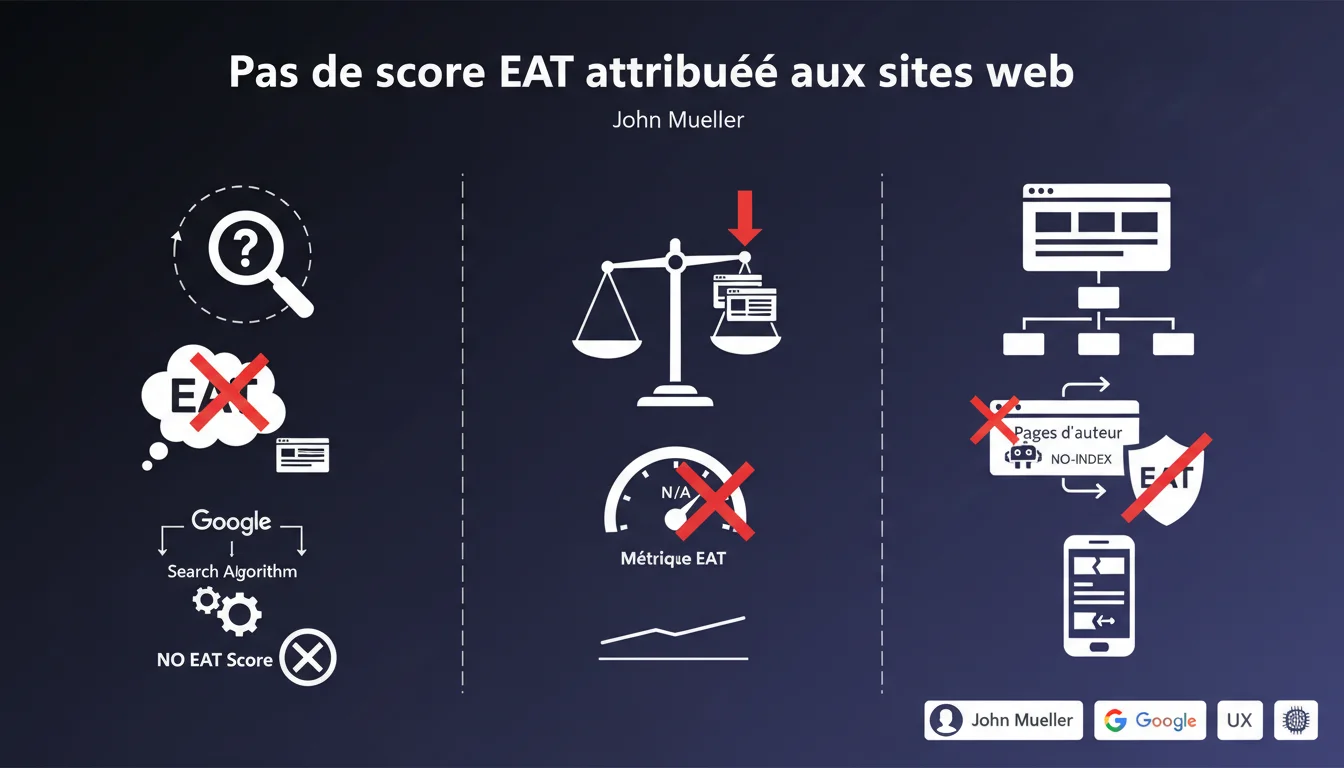
Google claims that no EAT score exists in its algorithm. Expertise, Authoritativeness, and Trustworthiness are not measurable metrics that increase or decrease as a numerical indicator. Therefore, removing author pages from the index does not impact a hypothetical 'EAT score' — because it simply does not exist.
What you need to understand
How does this clarification from Google change the game?<\/h3>
For years, the SEO industry has spoken about an « EAT score » as if it were a secret metric to optimize. Google sets the record straight:<\/strong> there is no EAT indicator in their systems. No gauge that rises or falls based on your actions.<\/p> This statement repositions EAT for what it truly is: a human evaluation framework<\/strong> intended for Quality Raters, not an algorithm that calculates a number. Quality Raters use these criteria to manually rate pages — but these ratings do not directly feed into your site's ranking.<\/p> The absence of an EAT score does not mean that Google ignores expertise. The algorithm incorporates hundreds of indirect signals<\/strong>: external mentions, citations, quality backlinks, content depth, thematic consistency.<\/p> These signals naturally reflect expertise without an 'EAT' metric existing. A medical site cited by recognized institutions will inherently carry more weight — but not because an EAT counter is ticking somewhere.<\/p> John Mueller clarifies that an author page can be removed from the index without impacting any supposed EAT score. This is a strong signal:<\/strong> Google does not mechanically reward the presence of an author page.<\/p> What matters is a concrete demonstration of expertise<\/strong> in the content itself, not the existence of a formatted bio. An author page can be useful for the user — it is not a direct SEO lever.<\/p>So, how does Google evaluate a site's expertise?
What does the mention of no-indexed author pages reveal?
SEO Expert opinion
Is this statement consistent with real-world observations?
Yes and no. In thousands of audits, sites that "work on their EAT" — quality backlinks, expert mentions, in-depth content — perform better. But:<\/strong> this does not prove the existence of an EAT score. It simply confirms that these practices generate signals that Google values.<\/p> The problem is that Google never details which precise signals<\/strong> reflect expertise. We know it plays a role — but how? What weight? In what contexts? [To be determined]<\/strong>: the lack of transparency leaves room for interpretations.<\/p> Because the SEO industry has plunged into a race for a fanciful “EAT score.” Plugins, EAT audits, consultants selling quantified EAT optimizations — an entire market has built around a misunderstanding.<\/p> Google reframes this: stop looking for a magic button.<\/strong> EAT is not a technical hack; it is a comprehensive editorial approach. This clarification protects Google from future accusations: 'You said there was no score, so we can’t blame you for manipulating it.'<\/p> Be careful: saying there is no EAT score does not mean Google totally ignores authority. For YMYL queries<\/strong> (health, finance), verification mechanisms are stricter — even without an explicit EAT metric.<\/p> A medical site without external mentions or qualified authors will never rise, score or not. The nuance<\/strong>: Google does not add up EAT points, but it aggressively filters unreliable content in certain sectors. The practical result is similar — but the mechanism differs.<\/p>Why does Google insist so much on this point?
In what cases does this rule not apply?
Practical impact and recommendations
What should you do concretely following this statement?
First action: stop tracking an “EAT score”<\/strong> in your dashboards. No SEO tool can measure something that does not exist in the algorithm. The marketed EAT metrics are proxies — sometimes useful, never official.<\/p> Focus on indirect signals: backlinks from recognized sources, mentions in authoritative publications, thematic consistency, content depth. These are the elements that Google captures — not a mystical gauge.<\/p> Yes, but for the user and perceived trust<\/strong>, not for an automatic SEO boost. A well-constructed author page enhances credibility — especially in YMYL. It can also generate direct clicks if the author has a reputation.<\/p> However, if your author page is an empty shell (2 generic lines), it’s better to no-index it. Google will not penalize you for its absence. Prioritize quality over formal compliance.<\/strong> Audit your content from the perspective of “demonstration of expertise,” not “EAT checklist.” Ask yourself: does this content concretely prove that the author masters the subject? Are external sources citing this content? Are there any authoritative backlinks? If the answer is no, no artifice (author page, LinkedIn bio, Author schema) will compensate. Expertise manifests itself; it is not declared.<\/strong>Are author pages still useful?
How can you check if your strategy aligns with this reality?
❓ Frequently Asked Questions
Si Google n'utilise pas de score EAT, pourquoi en parle-t-il autant dans ses guidelines ?
Faut-il supprimer les pages auteur de mon site ?
Les outils SEO qui proposent un score EAT sont-ils inutiles ?
Comment Google évalue-t-il l'expertise sans score ?
Cette déclaration change-t-elle quelque chose pour les sites YMYL ?
🎥 From the same video 13
Other SEO insights extracted from this same Google Search Central video · published on 31/12/2021
🎥 Watch the full video on YouTube →Related statements
Get real-time analysis of the latest Google SEO declarations
Be the first to know every time a new official Google statement drops — with full expert analysis.
💬 Comments (0)
Be the first to comment.