
Official statement
What you need to understand
Google has clarified its position on the concept of E-A-T (Expertise, Authoritativeness, Trustworthiness), a criterion often misunderstood by SEO practitioners. Contrary to common belief, having content signed by a recognized expert is not enough to guarantee good rankings if the content itself is of poor quality.
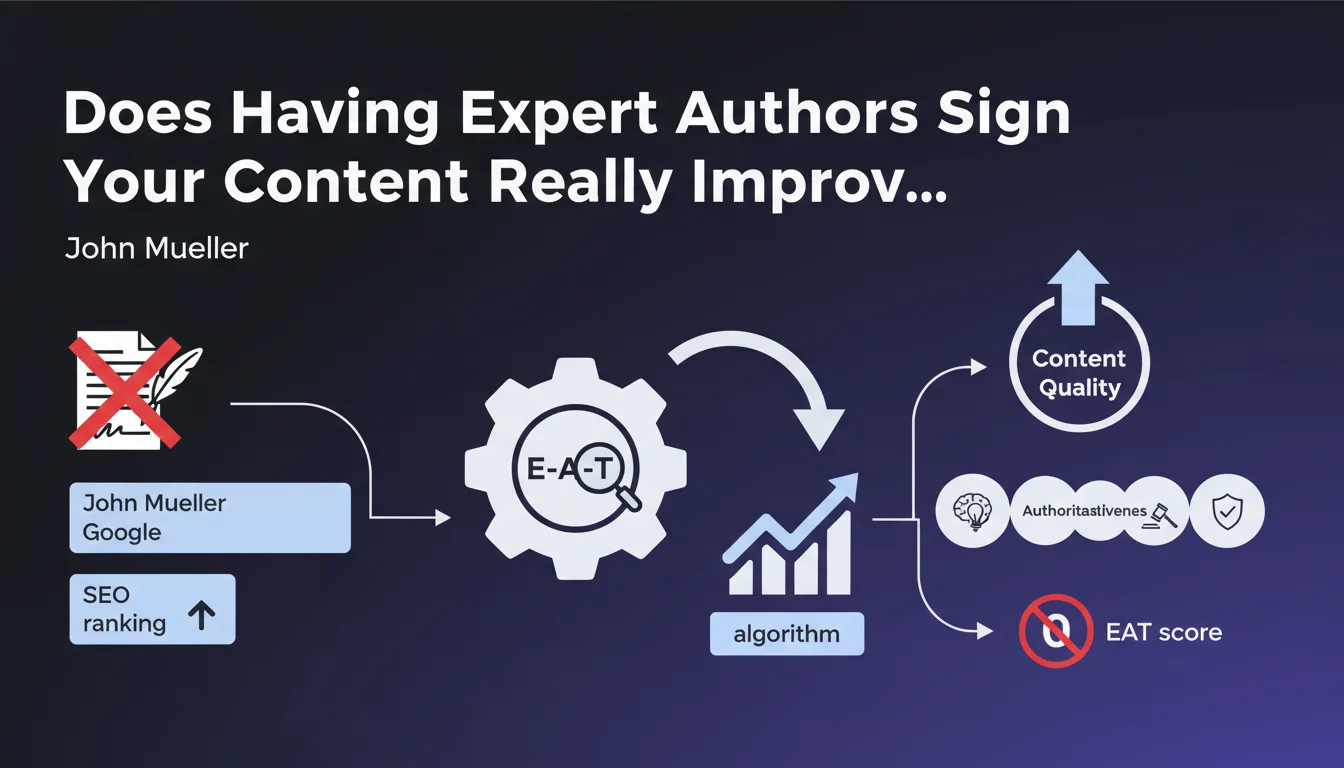
E-A-T is not a direct algorithmic score that Google would calculate for each page. It is primarily a conceptual framework created to guide Quality Raters, those human evaluators who help Google improve its algorithms. This concept therefore represents a series of best practices rather than a measurable ranking factor.
However, Google has revealed the existence of what they call "baby algorithms" - sub-algorithms that feed the main algorithm with signals allowing indirect evaluation of a content's E-A-T. These signals analyze the intrinsic quality of the text, its depth, accuracy, and relevance.
- Content quality always takes precedence over an author's signature
- There is no "E-A-T score" directly calculated by the algorithm
- Sub-algorithms indirectly evaluate expertise through content quality
- Buying an expert signature for mediocre content is ineffective
- E-A-T remains a guide for editorial best practices
SEO Expert opinion
This clarification from Google is perfectly consistent with what we have been observing for years on high-performing sites. Content that ranks sustainably is systematically content that demonstrates real expertise through its substance, not simply through an author's name.
However, we must nuance this: in YMYL (Your Money Your Life - health, finance, legal) sectors, the author's legitimacy can play an indirect but real role. A medical article signed by a certified physician, with links to their academic publications, naturally generates more trust and quality backlinks than anonymous content, even if well-written.
The real question is therefore not "do we need an expert?" but rather "how do we demonstrate expertise through the content itself?". Google's algorithms analyze depth of treatment, terminological precision, cited sources, and argumentative structure. Truly expert content naturally stands out through these tangible elements.
Practical impact and recommendations
Following these clarifications, here are the concrete actions to implement to optimize your content according to the real E-A-T criteria:
- Invest heavily in intrinsic quality: thorough research, verifiable data, exhaustive treatment of the subject
- Demonstrate expertise in the content: use precise domain terminology, cite studies, integrate statistical data and reliable sources
- Don't pay for ghost expert signatures: this practice is ineffective and potentially risky for your reputation
- For YMYL sites, combine real expertise with quality content: recruit or collaborate with real experts who genuinely contribute
- Create detailed author pages: qualifications, experience, publications, links to verifiable professional profiles
- Obtain external trust signals: mentions on authoritative sites, backlinks from recognized sources, citations in your field
- Structure your content in an expert manner: bibliography, clear methodology, explicit nuances and limitations
- Update regularly: expert content evolves with new knowledge in the field
In summary: Focus on creating content that demonstrates genuine expertise through its substance, depth, and precision. An expert's signature is only a complementary signal, never a substitute for quality.
These optimizations require a rigorous methodology and comprehensive strategic vision: in-depth semantic audit, structured editorial process, collaboration with subject matter experts, and monitoring of trust signals. Given the complexity of these challenges and the time needed to master them, support from a specialized SEO agency can prove decisive in structuring your E-A-T approach and obtaining measurable results without dispersing your internal resources.
💬 Comments (0)
Be the first to comment.