
Official statement
Other statements from this video 13 ▾
- □ Les mauvaises traductions peuvent-elles pénaliser l'ensemble de votre site multilingue ?
- □ Le contenu dupliqué sur les fiches produits est-il vraiment sans danger pour votre référencement ?
- □ Faut-il vraiment désactiver le ciblage géographique dans Search Console pour un site international ?
- □ Google indexe-t-il vraiment le texte masqué dans votre code HTML ?
- □ Faut-il préférer rel=canonical aux redirections user-agent pour les pages non indexées ?
- □ Faut-il déployer ses optimisations SEO en une seule fois plutôt que progressivement ?
- □ Pas de cache Google sur ma page : est-ce un signal d'alarme pour mon indexation ?
- □ Googlebot ignore-t-il vraiment toutes les permissions du navigateur lors du crawl ?
- □ Faut-il vraiment utiliser l'API Indexing de Google pour accélérer l'indexation de vos contenus ?
- □ Le score Page Experience est-il vraiment indispensable pour apparaître dans Top Stories ?
- □ Google attribue-t-il vraiment un score EAT à votre site ?
- □ Pagination SEO : faut-il privilégier les liens séquentiels ou multiples pages ?
- □ Les Core Web Vitals mesurés uniquement sur Chrome : faut-il s'inquiéter de la représentativité ?
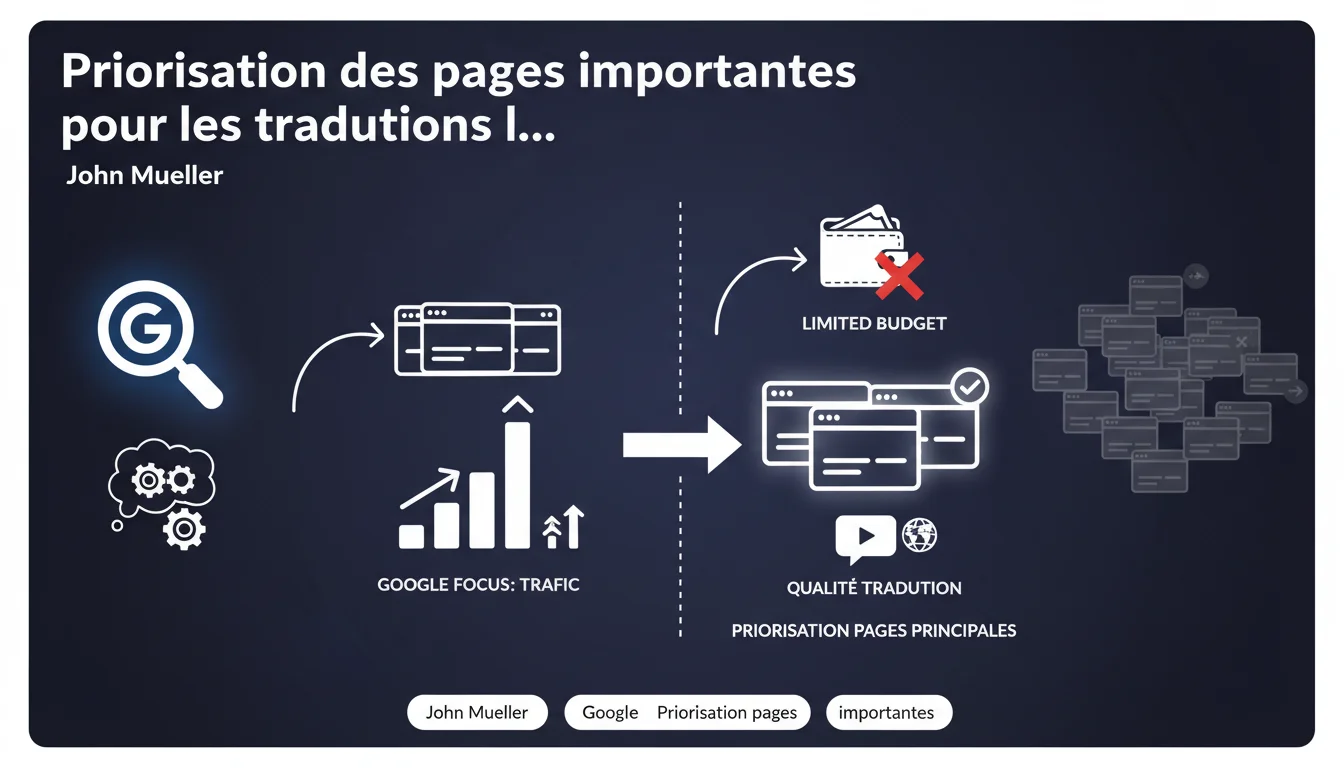
Google assesses the quality of a multilingual site mainly based on high-traffic pages, not on the entire catalog. In practice: it's better to have impeccable translations on 20% of your strategic pages than mediocre translations on 100% of the site. The translation budget becomes an SEO prioritization lever, not a uniformly distributed constraint.
What you need to understand
Mueller's statement addresses a budgetary reality: not all international sites can afford to translate all their content with the same level of quality. What is surprising is the explicit admission that Google does not attribute the same importance to all pages when qualitatively evaluating a domain.<\/p>
Until now, many practitioners assumed that a significant proportion of poorly translated pages could degrade the overall reputation of the site. Google seems to say the opposite: the algorithm weighs its judgment based on the actual traffic weight of the pages.<\/p>
What does Google mean by "important pages"?
Mueller explicitly refers to pages "generating a lot of traffic." This is a post-hoc definition, based on crawling and click data. The important pages are not those identified in your priority sitemap, but those that users actually visit.<\/p>
This means that Google looks at real usage signals — organic traffic, CTR in the SERPs, time spent — to determine which pages serve as benchmarks in its qualitative evaluation. A strategic page in your hierarchy but without traffic will not be scrutinized with the same intensity as a landing page that captures 10% of your sessions.<\/p>
How does Google evaluate the quality of a translation?
The statement does not specify, and that is frustrating. We know that Google detects unreviewed machine translations, terminological inconsistencies, and truncated sentences. But no specific technical signal is publicly documented.<\/p>
What is certain: Google does not simply count the number of translated pages. It considers linguistic consistency, fluency, cultural appropriateness — subjective criteria that its Quality Raters are trained to evaluate. Poor translations on high-traffic pages can therefore degrade the overall quality score of the domain.<\/p>
Why this logic of prioritization?
Google optimizes its crawling and evaluation resources. Finely analyzing 100,000 pages of an e-commerce catalog is pointless if 80% of the traffic is concentrated on 500 references. The algorithm seeks to quickly identify if a site deserves trust, and it does this by intelligently sampling the pages that matter.<\/p>
This approach aligns with the concept of crawl budget: Google does not treat all URLs with the same priority. Here, it applies the same principle to qualitative evaluation. A site with 10 perfectly translated pages that capture 90% of the traffic will be rated higher than a site with 1,000 poorly translated pages, of which 950 are invisible.<\/p>
- Google does not weigh all pages equally in its qualitative assessment.<\/li>
- High-traffic pages serve as a benchmark for judging the overall quality of the site.<\/li>
- It's better to concentrate your translation budget on strategic pages than to spread efforts thinly.<\/li>
- The quality of a translation impacts the algorithmic trust granted to the domain.<\/li>
- Google detects unreviewed machine translations, but specific technical criteria remain undocumented.<\/li><\/ul>
SEO Expert opinion
Is this statement consistent with field observations?
Yes, and it validates a practice already adopted by experienced SEOs. Successful international sites never translate everything at once. They start with landing pages, best-selling product pages, high-visibility editorial content. Long-tail pages, archives, and peripheral content can wait — or even remain in the source language if the translation ROI isn't there.<\/p>
What is new is Google's explicit admission. For years, we were told that duplicate content, even multilingual, was penalized. That each URL had to have unique and quality content. Now, Mueller essentially says: if your secondary pages are mediocre but your main pages are flawless, that's acceptable. It's a subtle but significant shift in doctrine.<\/p>
What nuances should be added to this logic?
First point: this logic works if and only if your strategic pages are correctly identified. A site with a flat structure, without a clear hierarchy and coherent internal linking, will not give the right signals to Google. The algorithm may consider unimportant pages as important, and vice versa.<\/p>
Second point: traffic is a dynamic indicator. A page that is rarely visited today can become strategic tomorrow if you launch a campaign, if a competitor disappears, or if a trend emerges. Prioritizing solely based on current traffic risks missing opportunities. An intent-driven analysis is also needed: which pages do they want Google to consider important?
Third point, and this is the tricky part: [To be verified] Google does not provide any quantitative threshold. At what point does a page become "important"? Is it a proportion of total traffic? An absolute volume? A relative metric by market? We are navigating in the dark. A/B testing on multilingual sites shows significant variations by sector.<\/p>
In what cases does this rule not apply?
On high-volume news or editorial sites, this logic reaches its limits. A media outlet publishes 50 articles per day. It’s impossible to translate them all perfectly. But Google expects a news site to cover the news in a fresh and comprehensive manner. Prioritizing only high-traffic articles means missing emerging topics that have yet to generate visits.<\/p>
Another case: transactional sites with products that have a short lifecycle. A fashion e-commerce site launches 200 new references per week. Translations must keep pace with publication; otherwise, the pages remain in the source language and Google ignores them. Here, speed takes precedence over perfection. A correct immediate translation is better than a perfect translation three weeks later.<\/p>
Practical impact and recommendations
How to identify pages to prioritize for translation?
First step: extract real traffic data from the last 12 months. Google Analytics or Search Console will suffice. Isolate the pages that capture 80% of your organic sessions — this is generally 10 to 20% of the catalog. These are your priority strategic pages.<\/p>
Second step: cross-reference with conversion data. A high-traffic page but with a low conversion rate may be a false positive — often an informational piece that leads nowhere. Conversely, a low-traffic page but with a high conversion rate deserves careful translation. The analysis must be qualitative as much as quantitative.<\/p>
Third step: anticipate seasonal trends and market opportunities. Some pages may be dormant for 9 months of the year, then explode. A ski site should not prioritize its translations in July based on summer traffic. A forward-looking perspective is essential, not just a retrospective one.<\/p>
What strategy should be adopted for secondary pages?
Option 1: machine translation + occasional proofreading. MT tools (DeepL, Google Translate API, specialized neural systems) have become sufficiently effective to produce comprehensible text. You only proofread the pages that begin to generate traffic. This is an acceptable cost/benefit compromise.<\/p>
Option 2: not translating at all. If a page generates no traffic in the source language, it likely won’t generate it in the target language. It’s better to leave the URL as a 404 or noindex than to provide a rushed translation. Google prefers the absence of content over mediocre content.<\/p>
Option 3: gradually translating on demand. Some sites implement a queue system: as soon as a page reaches X visits in the source language, it enters the translation pipeline. This industrial logic works well for large catalogs.<\/p>
What mistakes should be absolutely avoided?
Mistake #1: Translating all pages with the same level of rigor. It’s a waste of budget. A product page that never sells doesn’t deserve two hours of native proofreading. Reserve expert translators for landing pages, category pages, and high-visibility content.<\/p>
Mistake #2: Only translating pages with current high traffic. You’re locking your strategy into past data. Incorporate a proactive approach: also translate the pages you want to rank, even if they don’t have traffic yet. SEO is built, not just observed.<\/p>
Mistake #3: Leaving pages partially translated. A page with a French title and an English body sends a signal of neglect. It’s better not to translate than to partially translate. Google detects these inconsistencies and interprets them as a lack of editorial seriousness.<\/p>
- Extract the pages capturing 80% of organic traffic over 12 months
- Cross-reference traffic and conversion to identify true priorities
- Anticipate seasonal trends and market opportunities
- Use machine translation + proofreading for secondary pages
- Do not hesitate to leave untranslated pages if they have no potential
- Avoid partial translations that degrade the user experience
- Regularly reassess translation priorities based on traffic changes <\/ul>
Prioritizing translations is not a budgetary constraint — it’s a complete SEO strategy. By concentrating your efforts on the pages that truly matter, you maximize the perceived quality impact by Google while optimizing your resources.<\/p>
However, identifying strategic pages, establishing an on-demand translation workflow, and managing language service providers requires sharp technical and editorial expertise. If your catalog spans thousands of pages and targets multiple markets, orchestrating all this internally can quickly become unmanageable. Engaging an SEO agency specializing in multilingual strategies allows you to benefit from a proven methodological framework, suitable automation tools, and personalized support for tactical decision-making.<\/p><\/div>
❓ Frequently Asked Questions
Google pénalise-t-il les pages non traduites sur un site multilingue ?
Comment Google détermine-t-il qu'une page est "importante" ?
Peut-on utiliser la traduction automatique sans risque SEO ?
Faut-il traduire les pages longue traîne à faible trafic ?
Quelle proportion du catalogue faut-il traduire en priorité ?
🎥 From the same video 13
Other SEO insights extracted from this same Google Search Central video · published on 31/12/2021
🎥 Watch the full video on YouTube →Related statements
Get real-time analysis of the latest Google SEO declarations
Be the first to know every time a new official Google statement drops — with full expert analysis.
💬 Comments (0)
Be the first to comment.