
Official statement
Other statements from this video 10 ▾
- □ Why is Google's SEO Starter Guide absolutely crushing it with users?
- □ Has mobile compatibility really become a non-issue for SEO?
- □ Is word count really a Google ranking factor?
- □ Does HTML structure really have minimal impact on Google rankings?
- □ Can you really trust modern CMSs to handle title tags automatically without any manual oversight?
- □ Do keywords in your domain name still matter for SEO in 2024?
- □ Should you remove the meta keywords tag from your website?
- □ Do you really need Google Analytics or Google Ads to rank better in search?
- □ Should you really change your domain name to boost your SEO rankings?
- □ Should you ditch optimized HTML templates in favor of unique content?
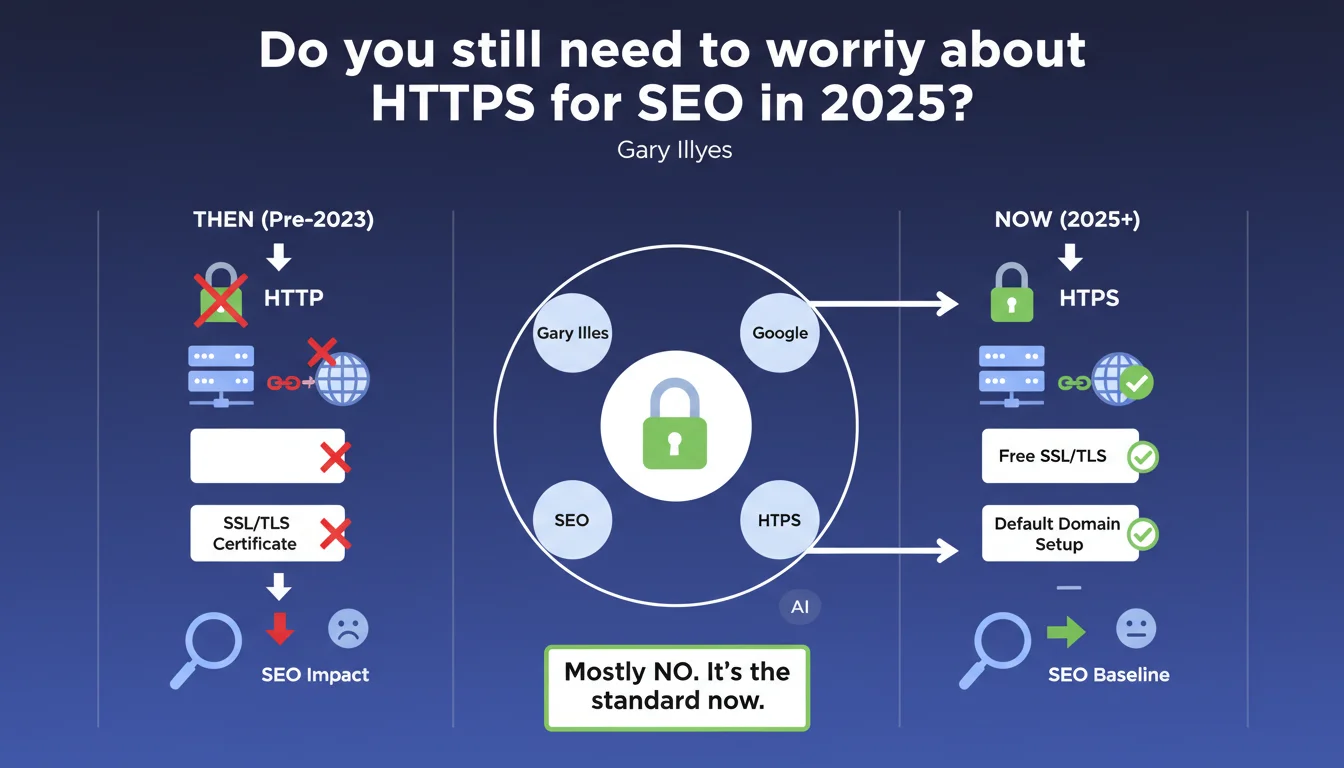
Google has removed HTTPS from its SEO Starter Guide. Their reasoning: most websites now activate HTTPS by default when created, with free certificates easily accessible. For Google, this is no longer a topic for beginners.
What you need to understand
Why is Google removing HTTPS from its SEO beginner's guide?
The stated logic is straightforward: HTTPS has become the standard. Hosting providers automatically configure SSL/TLS certificates when a domain is activated, particularly through Let's Encrypt. Google therefore believes that reminding beginners about the importance of HTTPS no longer makes sense — it should be a given from the start.
This decision reflects the web's evolution since 2014, when Google introduced HTTPS as a lightweight ranking signal. Today, Chrome clearly displays non-HTTPS sites as "not secure," and most CMS platforms and hosting providers handle the switch automatically.
Is HTTPS losing its status as a ranking factor?
No. Google isn't saying that HTTPS no longer has SEO impact. It's saying that it's no longer an educational priority for someone starting out. The signal remains active, but subtle — it has never been a major positioning lever.
The real shift is that HTTPS has transitioned from a technical optimization to a basic requirement. Not having it is now an anomaly, not an advanced optimization technique.
Which sites are still affected by this issue?
Unmigrated legacy sites, custom or legacy environments requiring manual intervention, and certain misconfigured servers. Also sites with mixed content (HTTP resources on HTTPS pages), which generate warnings and degrade user experience.
- HTTPS remains a ranking signal, even if it's minor
- Google removes it from the beginner guide because it should be enabled by default
- Sites without HTTPS are now anomalies, not standard cases
- Mixed content (HTTP/HTTPS) remains a problem to fix
- This announcement doesn't change current technical recommendations
SEO Expert opinion
Does this statement reflect real-world conditions?
Yes and no. On the consumer hosting side, it's true: HTTPS is automatic with most providers (OVH, WP Engine, Shopify, etc.). But in custom infrastructures, multi-domain environments, or legacy sites, HTTPS migration remains a technical project requiring human intervention.
The risk of this communication is downplaying a prerequisite that remains critical. A site without HTTPS in 2025 is a UX handicap (browser warnings), a conversion barrier (trust), and a negative signal for Google — even though the direct ranking impact is low.
Is Google underestimating mixed content problems?
Likely. Removing HTTPS from the guide doesn't solve mixed content errors, which still affect thousands of sites after migration: images, scripts, CSS, or iframes loaded over HTTP on HTTPS pages. These errors break the green lock icon and generate Search Console warnings.
A site can technically have HTTPS enabled but still be poorly configured. [To verify]: Google doesn't specify whether its assessment is based on analysis of implementation quality or simply on gross adoption rates.
What's the real priority behind this announcement?
Google wants to simplify its guide for beginners by removing what should be built-in by default. This aligns with its strategy: focus attention on content and user experience, not foundational technical elements that should be resolved from the start.
But it sends an ambiguous message: HTTPS is no longer presented as an optimization, when it remains a non-negotiable requirement. For an SEO professional, nothing changes — for a beginner, it can create a misleading priority hierarchy.
Practical impact and recommendations
What specifically should you check on your site?
First step: ensure HTTPS is active and the certificate is valid. Second step: verify that no resources are loaded over HTTP (images, CSS, JS, iframes). Mixed content is the most frequent error after migration.
Also check the 301 redirects from old HTTP URLs to HTTPS. Google follows these redirects, but poor configuration can create redirect chains or loops that slow down crawling.
What errors should you avoid after this announcement?
Don't confuse "HTTPS by default" with "HTTPS properly configured." An active certificate isn't enough if the site still loads unsecured resources or if redirects are faulty.
Another trap: neglecting HTTPS under the assumption that "Google no longer highlights it." Browsers penalize directly non-HTTPS sites, regardless of SEO. Chrome, Firefox, and Safari display warnings that drive away visitors.
How do you ensure everything is in order?
Use Search Console to detect mixed content errors. Scan your site with a tool like Screaming Frog or OnCrawl to identify lingering HTTP resources. Manually test key pages across different browsers to verify the absence of warnings.
- Verify that the SSL/TLS certificate is valid and up to date
- Scan the site to detect HTTP resources (mixed content)
- Check HTTP → HTTPS redirects (no chains, no loops)
- Verify the absence of warnings in Search Console
- Test the padlock display in Chrome, Firefox, Safari
- Ensure old HTTP URLs properly redirect with 301s
- Update sitemaps and robots.txt files with HTTPS URLs
❓ Frequently Asked Questions
HTTPS a-t-il encore un impact SEO en 2025 ?
Puis-je laisser mon site en HTTP si Google retire HTTPS du guide ?
Qu'est-ce que le contenu mixte et pourquoi est-ce un problème ?
Comment vérifier que mon site HTTPS est correctement configuré ?
Cette annonce signifie-t-elle que HTTPS ne sera plus un facteur de classement ?
🎥 From the same video 10
Other SEO insights extracted from this same Google Search Central video · published on 25/01/2024
🎥 Watch the full video on YouTube →
💬 Comments (0)
Be the first to comment.