
Official statement
What you need to understand
Google has clarified its position regarding priority technical criteria for rendering and indexing web pages. Contrary to common beliefs, Google's teams indicate that certain technical parameters should not be a major source of concern for SEO professionals.
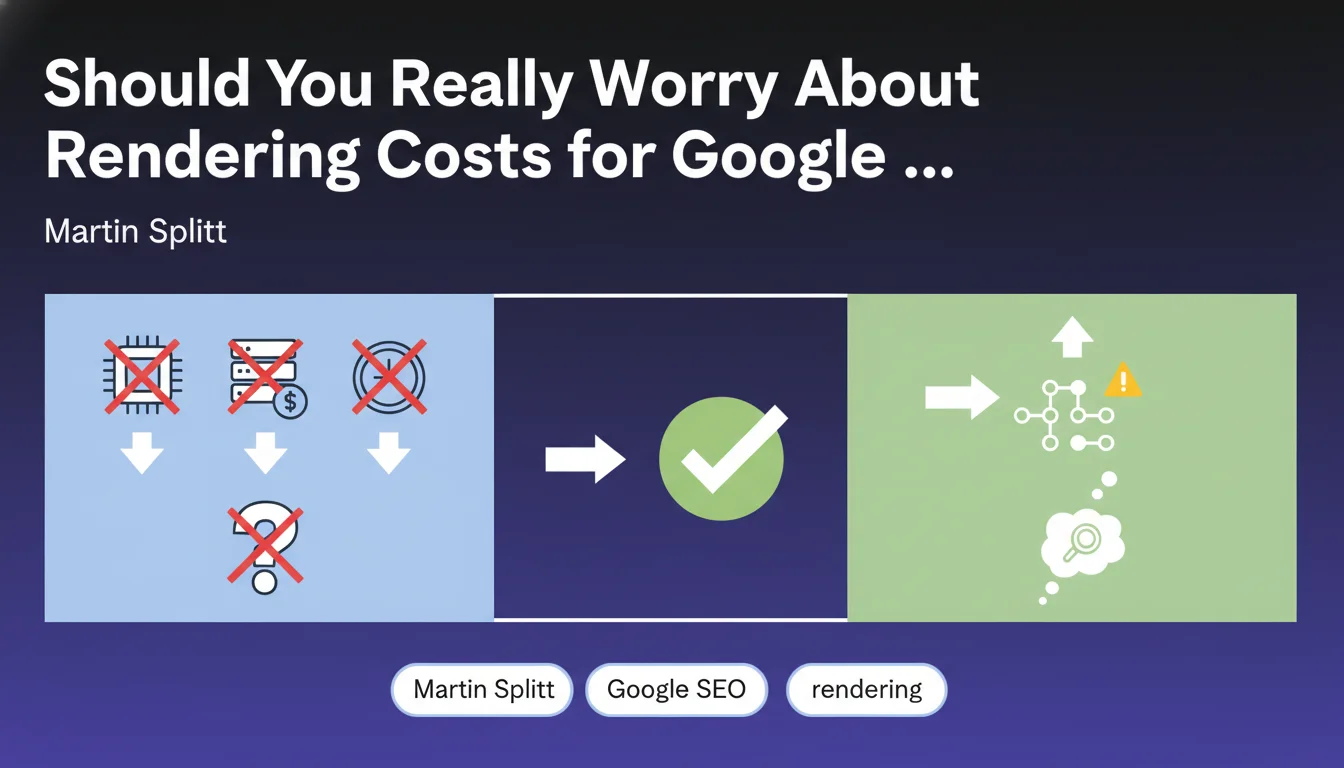
Specifically, rendering costs, CPU usage, or server resources are not limiting factors for Googlebot during crawling and indexing. Google has a sufficiently robust infrastructure to handle these aspects without penalizing websites.
The only element to monitor remains the number of HTTP requests generated by a page during its loading. Even this point should be put into perspective: it's not an absolute constraint, but rather an optimization indicator.
- CPU costs and server resources are not blocking factors for Google
- The number of HTTP requests is the only element deserving particular attention
- This metric should be monitored without falling into excessive optimization
- Google has the technical capabilities to handle complex pages
SEO Expert opinion
This statement fits into a logic of simplifying SEO priorities that Google has been pushing for several years. It is consistent with what we observe in the field: sites with significant rendering times can be perfectly indexed and well-ranked.
However, an important nuance must be made. While Google can technically handle heavy pages, user experience remains a ranking factor. Core Web Vitals, particularly LCP and FID, are directly impacted by a high number of requests and costly rendering. The distinction is subtle: what doesn't block indexing can still affect positioning.
Practical impact and recommendations
Following this clarification, here are the adjustments to make in your technical SEO strategy:
- Stop obsessing over perfect rendering: don't spend weeks optimizing every millisecond of server-side rendering solely for Googlebot
- Prioritize user experience: focus your optimization efforts on Core Web Vitals that actually impact ranking
- Audit the number of HTTP requests: use tools like Chrome DevTools to identify pages generating more than 150-200 requests
- Optimize excessive requests: bundle CSS/JS files, use sprites for images, implement lazy loading
- Monitor without over-optimizing: keep an eye on this metric without making it a paralyzing obsession
- Distinguish indexing from performance: what enables indexing isn't necessarily optimal for positioning
- Maintain a healthy crawl budget for large sites: even though Google downplays the impact, sites with several million pages must remain vigilant
💬 Comments (0)
Be the first to comment.