
Official statement
Other statements from this video 6 ▾
- □ Is Client-Side Rendering really putting your indexation at risk?
- □ Why does content visibility actually determine whether Google will index your pages?
- □ Is hydration really the miracle solution to JavaScript SEO problems?
- □ Is pre-rendering really the ultimate solution for indexing JavaScript sites?
- □ Is hydration really a worthwhile technical tradeoff for your SEO strategy?
- □ How do you choose the right rendering strategy to maximize your SEO performance?
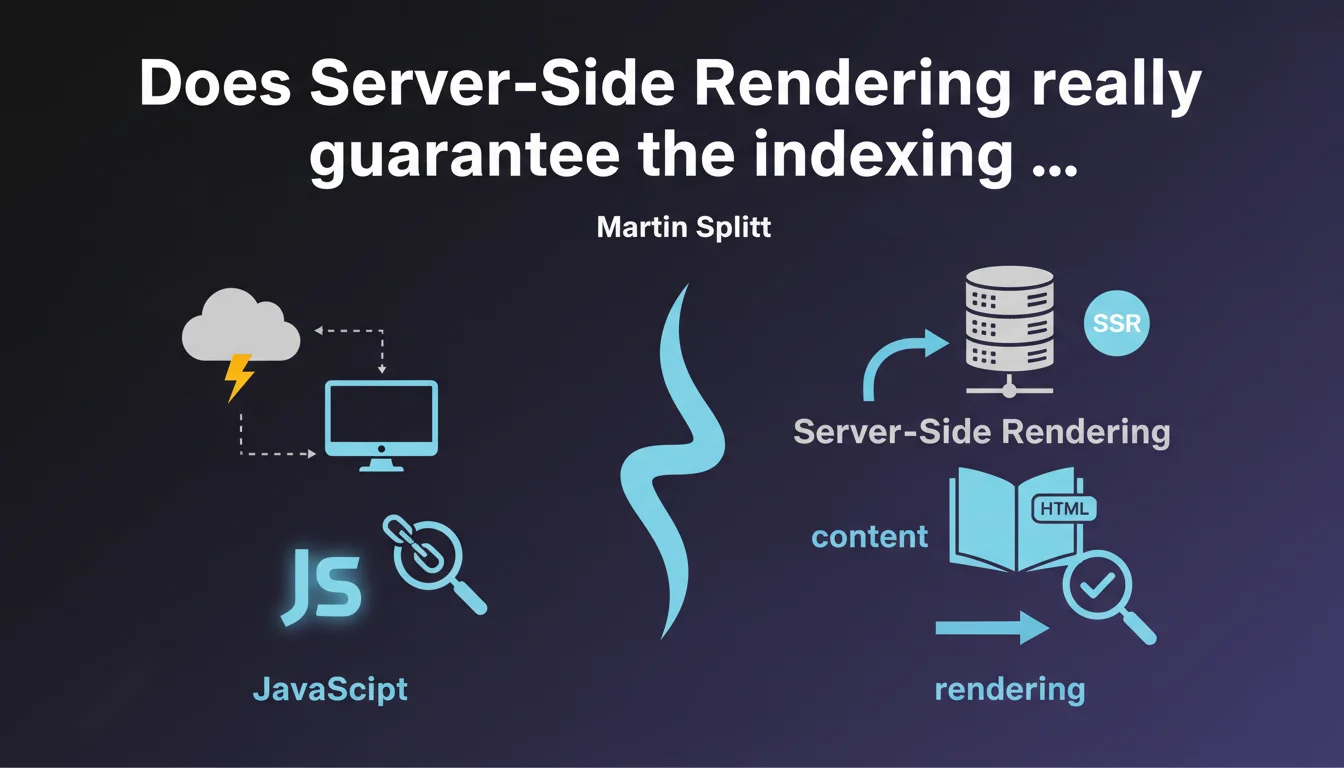
Google confirms that Server-Side Rendering (SSR) eliminates dependency on client-side JavaScript execution for indexing, delivering complete HTML directly from the server. This approach guarantees that content is immediately visible and indexable by search engines, without waiting for JavaScript rendering.
What you need to understand
Why does Google insist on SSR for indexing?
SSR solves a fundamental problem: the latency and unpredictability of client-side JavaScript rendering. When Googlebot crawls a CSR (Client-Side Rendering) page, it must execute JavaScript, wait for the DOM to build, then index the result. This process consumes crawl budget and introduces risks — timeouts, JS errors, blocked resources.
With SSR, the server sends directly complete and ready-to-use HTML. Googlebot only needs to parse the code like any classic static page. No waiting, no unpredictability related to JavaScript execution in a constrained environment.
Concretely, what changes for indexing?
Content becomes immediately accessible on Googlebot's first pass. No need to wait for a second crawl wave for JavaScript rendering. Critical elements — titles, text, internal links, structured metadata — are all present in the initial HTML.
This accelerates the indexing of new pages and reduces the risk of invisible content. E-commerce sites with thousands of product sheets generated in JS, for example, gain in responsiveness and indexing reliability.
Does SSR eliminate all problems related to JavaScript?
No, and this is where nuance matters. SSR guarantees that initial content is indexable, but if your page then loads additional content via client-side JavaScript (lazy loading, infinite scroll, dynamic filters), these elements remain subject to the same constraints as pure CSR.
Google will still need to execute this JavaScript to discover this secondary content. SSR is therefore not a miracle solution — it's a solid foundation, but it doesn't exempt you from well-designed JS architecture.
- Complete HTML from the first pass: no more dependency on deferred rendering
- Reduction of wasted crawl budget: fewer resources consumed to index the same content
- Improved indexing speed: new pages are discovered and indexed more quickly
- Extended compatibility: works for all crawlers, even those that don't execute JavaScript
- Limitation: content loaded after the first render remains subject to the usual JavaScript constraints
SEO Expert opinion
Is this statement consistent with real-world observations?
Yes — and that's even an understatement. For years, SEOs have observed that sites using SSR or pre-rendering index faster and more completely than those using pure CSR. Audits regularly show missing content in the index on poorly configured React or Vue.js sites, whereas their Next.js (SSR) or Nuxt equivalents show indexing rates close to 100%.
Google isn't inventing anything here — it's formalizing a reality that practitioners already know. But saying that SSR "guarantees" indexability remains an oversimplification. It guarantees that initial content will be visible, not that everything will be perfectly indexed if the architecture has flaws elsewhere (poorly managed canonicals, restrictive robots.txt, etc.).
What nuances should be added to this statement?
First nuance: SSR is not binary. Between pure SSR and pure CSR, there's a whole spectrum — SSG (Static Site Generation), ISR (Incremental Static Regeneration), partial hydration, islands architecture. Each of these approaches has different implications for indexing and performance.
Second nuance: Martin Splitt speaks of "guaranteeing" indexability, but he doesn't mention the infrastructure and complexity costs. SSR requires a Node.js server in production, cache management, and server response times to monitor. A poorly optimized SSR site can be slower than a well-executed CSR site with static pre-rendering. [To verify]: Does Google penalize SSR sites with high TTFB the same way it values their indexability?
Third nuance: not all search engines execute JavaScript the same way. SSR guarantees maximum compatibility, but Google itself has executed JS very well for several years. Is this statement intended to simplify developers' lives or to compensate for internal Googlebot limitations that Google doesn't want to publicly admit?
In which cases is SSR not the optimal solution?
On sites with very high traffic and very dynamic content (dashboards, business applications), SSR can create disproportionate server load. CSR with API remains more suitable then, even if it means pre-rendering only public pages intended for indexing.
For light showcase sites or blogs, SSG (static generation) is often preferable: HTML files served directly from a CDN, minimal TTFB, no Node.js server to maintain. SSR makes sense for personalized content or real-time updates, not for everything.
Practical impact and recommendations
What should you concretely do to benefit from SSR?
If your current site runs in pure CSR (React, Vue, Angular without SSR), first evaluate the actual impact on your indexing. Use Google Search Console to identify pages that aren't indexed or are slow to appear in the index. Compare the source HTML (curl or "View page source") with the visible rendered content — if the gap is massive, SSR becomes a priority.
Next, choose the right technical approach. For React, Next.js is the reference SSR framework. For Vue, Nuxt. For Angular, Angular Universal. These tools handle server rendering without rewriting the entire application. But be careful: migration is not trivial and requires backend skills in addition to the usual frontend expertise.
What errors should you avoid when implementing SSR?
Classic mistake: enabling SSR without optimizing server response times. If your HTML takes 2 seconds to generate server-side, you've just degraded your TTFB (Time To First Byte) and your Core Web Vitals. SSR must be accompanied by effective cache strategies — Redis, edge CDN, heavy component caching.
Another pitfall: believing that SSR exempts you from testing JavaScript rendering. Even with SSR, part of the content may be hydrated or loaded after initial rendering. Continue to verify with the "URL Inspection" tool in Search Console that all expected content appears correctly in Googlebot's rendering.
Finally, don't neglect third-party library compatibility. Some JavaScript libraries only work on the client side (access to `window`, `document`, etc.). You'll need to isolate them or replace them to avoid server-side errors.
How can you verify that your SSR implementation is working correctly?
First reflex: disable JavaScript in your browser and reload the page. If essential content (titles, text, links) remains visible, your SSR is working. If the page is empty or broken, rendering still depends on the client.
Second check: use `curl` or `wget` to retrieve raw HTML without JavaScript execution. Critical content must appear directly in the source code. Then compare with the rendered HTML in Google Search Console's inspection tool — the gap should be minimal.
Third verification: monitor your Core Web Vitals after migration. SSR can improve FCP (First Contentful Paint) if well implemented, but degrade TTFB if the server is too slow. Use PageSpeed Insights and Search Console's real-world data to validate the actual impact.
- Audit current indexing with Search Console (discovered vs indexed pages)
- Identify critical pages where content is invisible in the source HTML
- Choose the SSR framework suited to your technical stack (Next.js, Nuxt, Angular Universal)
- Implement a robust cache strategy (Redis, edge CDN, cached components)
- Test rendering without JavaScript enabled in the browser
- Check raw HTML with curl/wget and compare with Googlebot rendering
- Monitor Core Web Vitals (TTFB, FCP, LCP) before and after migration
- Isolate JavaScript libraries incompatible with server rendering
- Document pages remaining in CSR (dashboards, user accounts) and their alternative indexing strategies
❓ Frequently Asked Questions
Le SSR améliore-t-il forcément le classement dans Google ?
Peut-on combiner SSR et CSR sur un même site ?
Le pré-rendu statique (SSG) est-il équivalent au SSR pour le SEO ?
Le SSR ralentit-il le TTFB et les Core Web Vitals ?
Google recommande-t-il officiellement le SSR plutôt que le CSR ?
🎥 From the same video 6
Other SEO insights extracted from this same Google Search Central video · published on 08/01/2025
🎥 Watch the full video on YouTube →
💬 Comments (0)
Be the first to comment.