
Official statement
Other statements from this video 6 ▾
- □ Is Client-Side Rendering really putting your indexation at risk?
- □ Why does content visibility actually determine whether Google will index your pages?
- □ Is hydration really the miracle solution to JavaScript SEO problems?
- □ Does Server-Side Rendering really guarantee the indexing of your JavaScript content?
- □ Is hydration really a worthwhile technical tradeoff for your SEO strategy?
- □ How do you choose the right rendering strategy to maximize your SEO performance?
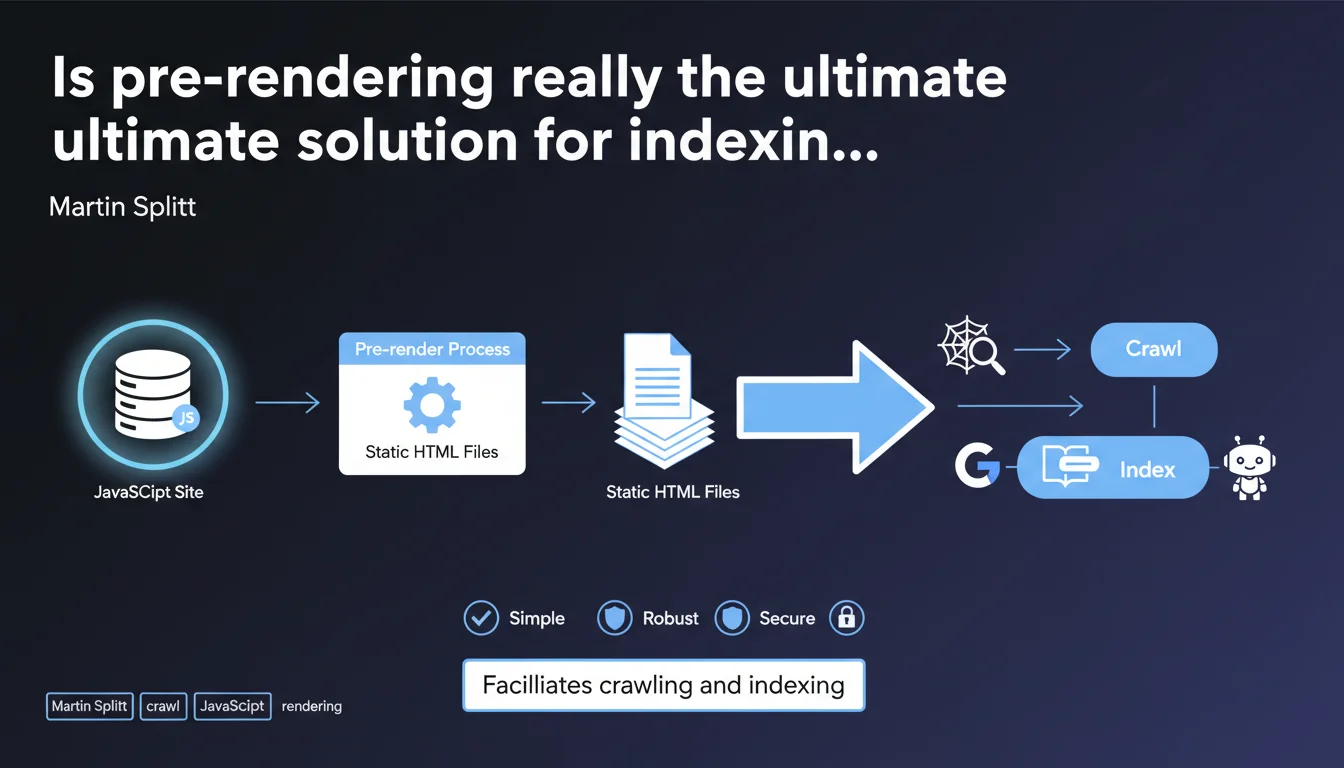
Google confirms that pre-rendering facilitates crawling and indexing by generating static HTML files. This approach eliminates client-side rendering issues, but does it remain relevant given the evolution of JavaScript SEO? Technical simplicity comes at a cost: it's not always suited to complex dynamic sites.
What you need to understand
Why is Google emphasizing pre-rendering now?
Pre-rendering generates static HTML files at build time, before any user or bot requests them. Unlike server-side rendering (SSR), which generates HTML on the fly, pre-rendering creates a frozen version of each page.
Google pushes this approach because it eliminates variables: no JavaScript to execute, no headless browser dependency, no rendering latency. The crawler accesses the complete HTML directly. For Google, this is the ideal scenario — zero friction.
What are the concrete advantages for indexing?
First point: crawl speed. Bots don't have to wait for JavaScript to execute. They fetch the HTML and move to the next page. Your crawl budget is used more efficiently.
Second point: reliability. With pre-rendering, what you see in development is exactly what Googlebot sees. No surprises from JavaScript timeouts, slow external APIs, or client-side rendering errors.
What limitations does this approach impose?
Pre-rendering works for sites whose content changes little or predictably. A blog, a brochure website, documentation — perfect. But as soon as you have personalized content, real-time feeds, or thousands of dynamic pages, it becomes problematic.
Generating thousands of static HTML files with each update becomes a bottleneck. Build time explodes, and you end up with frozen content that no longer reflects reality.
- Static HTML = crawling and indexing without technical friction
- No JavaScript to execute = crawl budget savings and reduced rendering errors
- Suited to low-update-frequency sites, problematic for dynamic or personalized content
- Enhanced security: smaller server-side attack surface, everything is pre-generated
SEO Expert opinion
Is this statement consistent with field observations?
Yes and no. Google intentionally simplifies the message. On static or semi-static sites, pre-rendering works flawlessly — we observe indexation rates close to 100% and reduced crawl times.
But Martin Splitt sidesteps a critical point: most modern sites are not static. E-commerce, SaaS platforms, marketplaces — these environments require fresh, personalized content, often generated based on the user. Pre-rendering becomes a hindrance, not a solution. [To verify]: Google doesn't specify when pre-rendering becomes counterproductive in terms of maintenance and scalability.
In what cases is this approach not recommended?
Let's be honest: pre-rendering isn't a magic wand. If your site generates pages based on user parameters (filters, geolocation, personalized content), you can't pre-render all possible combinations.
Another case: sites with frequent updates. Imagine a news site publishing 50 articles daily. Relaunch a full build with each publication? Unmanageable. SSR or Incremental Static Regeneration (ISR) becomes more relevant.
What are the real implications for modern frameworks?
Next.js, Nuxt, SvelteKit — all offer pre-rendering by default. But they also offer SSR and ISR. The choice depends on your use case, not a generic Google recommendation.
What Google doesn't say: even with pure client-side rendering, if your JavaScript is well optimized (code splitting, lazy loading, no blocking dependencies), indexing works. It's just less predictable. Pre-rendering eliminates uncertainty — but at the cost of flexibility.
Practical impact and recommendations
What should you concretely do if you already use a modern framework?
If you're on Next.js, prioritize Static Site Generation (SSG) for pages whose content rarely changes: category pages, landing pages, editorial content. Reserve SSR for product pages, user profiles, or anything requiring fresh data.
For Nuxt, enable target: 'static' mode and use nuxt generate to pre-render static routes. Complement with revalidation rules for content that evolves periodically.
What errors should you avoid when implementing pre-rendering?
Don't pre-render pages that depend on dynamic parameters or user sessions. You'll generate inconsistent versions or, worse, expose sensitive data in static files.
Another classic mistake: forgetting to update pre-rendered files. A site frozen in time loses relevance. Automate builds via CI/CD so each content modification triggers regeneration.
How do you verify that your pre-rendering works correctly?
Use Search Console to analyze crawl logs. If Googlebot accesses HTML directly without JavaScript rendering, you're good. Also verify via the URL inspection tool: rendered HTML must match source HTML.
Test with curl or wget: fetch the page in bot mode and verify that critical content (titles, text, internal links) is present without JavaScript enabled.
- Identify pages suitable for pre-rendering: static content, low update frequency
- Configure your framework (Next.js SSG, Nuxt generate, etc.) to pre-render these routes
- Automate builds via CI/CD to regenerate files with each modification
- Test generated HTML with curl or Google's inspection tool
- Monitor crawl logs in Search Console to validate absence of rendering errors
- Plan a hybrid strategy (SSG + SSR or ISR) for dynamic content
❓ Frequently Asked Questions
Le pré-rendering remplace-t-il complètement le SSR ?
Google indexe-t-il moins bien les sites en client-side rendering ?
Peut-on combiner pré-rendering et SSR sur un même site ?
Quels frameworks facilitent le pré-rendering ?
Le temps de build devient-il un problème avec des milliers de pages ?
🎥 From the same video 6
Other SEO insights extracted from this same Google Search Central video · published on 08/01/2025
🎥 Watch the full video on YouTube →
💬 Comments (0)
Be the first to comment.