
Official statement
Other statements from this video 6 ▾
- □ Le Client-Side Rendering met-il vraiment votre indexation en danger ?
- □ Pourquoi la visibilité du contenu conditionne-t-elle réellement l'indexation par Google ?
- □ Le pré-rendering est-il la solution ultime pour l'indexation des sites JavaScript ?
- □ Le Server-Side Rendering garantit-il vraiment l'indexation de votre contenu JavaScript ?
- □ L'hydration est-elle vraiment un compromis technique acceptable pour le SEO ?
- □ Comment choisir la bonne stratégie de rendu pour optimiser son référencement naturel ?
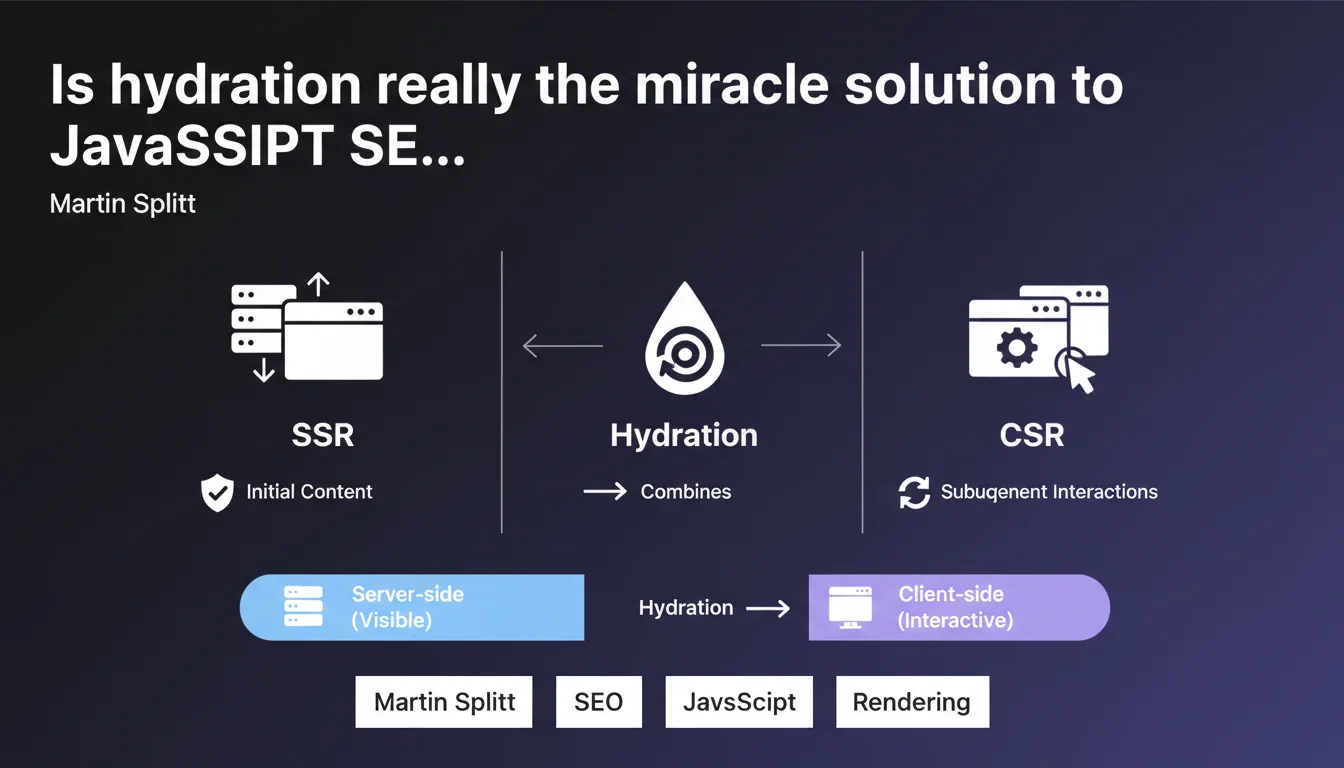
Hydration combines SSR and CSR to work around the SEO limitations of pure JavaScript. Critical content is delivered server-side for crawlers, then JavaScript takes over for interactions. Google presents this as the ideal solution, but in the real world, it's more nuanced.
What you need to understand
Why does Client-Side Rendering pose a problem for SEO?
Pure CSR first loads an empty HTML shell, then JavaScript generates the content. Googlebot must wait for complete JS execution to see your content. This consumes crawl budget, delays indexing, and in some cases — slow sites, JS errors — the content is never seen.
For e-commerce sites or high-volume blogs, this latency can be costly in organic visibility.
What is hydration exactly?
Hydration first sends complete HTML generated server-side. The crawler immediately sees the content without executing JavaScript. Then the JS framework (React, Vue, etc.) "hydrates" this structure: it attaches events and makes the page interactive.
It's a compromise: you keep the dynamic UX of CSR, but you offer search engines immediately accessible content.
Does this approach solve all problems?
In theory, yes. In practice, implementation matters enormously. Poorly configured SSR can generate HTML divergences between server and client — which breaks hydration and produces console errors. Modern frameworks (Next.js, Nuxt) handle this automatically, but you must remain vigilant.
Furthermore, if your content changes frequently after hydration (filters, poorly implemented lazy-loading), crawlers may miss important elements.
- SSR guarantees critical content visibility without relying on JavaScript
- Hydration allows you to maintain rich UX after initial load
- Hydration errors break the experience and can generate SEO inconsistencies
- Modern frameworks simplify but do not eliminate the need for technical monitoring
SEO Expert opinion
Is this statement consistent with what we observe in the field?
Splitt has been preaching for years that Googlebot executes JavaScript "like a modern browser". Hydration is the logical recommendation that follows from this. Except that in reality, JS rendering remains costly for Google. The indexing latency on pure CSR, even when well done, is real — we measure it daily.
Hydration works, but saying that it "solves" CSR SEO problems is a shortcut. It mitigates them. High-traffic sites that migrate from CSR to SSR+hydration observe measurable indexing gains, sometimes spectacular ones. [To verify] conversely: the claim that pure CSR "no longer poses a problem" if the site is fast — field feedback contradicts this narrative.
What nuances must be added?
Hydration introduces technical complexity. If your team isn't familiar with SSR, you'll encounter bugs: server content different from the client, scripts that crash, performance degraded by poor caching. Next.js or Nuxt make things easier, but it's still a heavier architecture than a classic static site.
Another point: server-side SSR consumes resources. For massive traffic sites, this requires infrastructure capable of generating pages on the fly. Caching becomes critical. If every request triggers a full render, your servers will suffer.
In what cases is this approach insufficient?
If your content depends on personalized data (user dashboard, geolocation-specific content to the millisecond), classic SSR cannot anticipate everything. You'll still need CSR in addition — with the same latency risks for elements loaded afterward.
For SPAs with complex navigation, hydrating the first render says nothing about subsequent pages. If you load subsequent routes in pure CSR, Googlebot will still need to execute JS to discover them. Pre-rendering or static generation may be more suitable in these cases.
Practical impact and recommendations
What should you do concretely to implement hydration?
If you're starting from scratch, choose a framework that handles SSR natively: Next.js (React), Nuxt (Vue), SvelteKit. They automatically orchestrate server rendering, client hydration, and routing. No need to reinvent the wheel.
If you already have a pure CSR SPA, migration requires refactoring. You need to identify the critical content that must be rendered server-side (titles, product text, metadata) and what can remain dynamic (filters, secondary widgets).
What errors must you absolutely avoid?
The most frequent: HTML divergences between server and client. If the server generates a DOM different from what JavaScript will produce next, React (or other frameworks) will raise errors and sometimes completely re-render the page. This breaks UX and can create content duplications seen by crawlers.
Second trap: neglecting server caching. Regenerating each page on every visit consumes resources. Use smart caching (Varnish, CDN edge, Next.js ISR) to serve pre-rendered HTML as much as possible.
Third error: loading unnecessary JavaScript after hydration. If your bundle explodes FID or INP, you lose the SEO advantage of SSR. Code splitting and lazy-loading must be systematic.
How do you verify your implementation is working correctly?
Start by disabling JavaScript in your browser. Critical content must remain visible. If the page becomes an empty shell, your SSR isn't working.
Then use Search Console: look at screenshots in the URL inspection tool. Compare the indexed render with what you see in the browser with JS enabled. If elements are missing, your hydration has a problem.
Also test with Screaming Frog with JavaScript rendering enabled/disabled mode. Both scans should show the same titles, headings, main contents. Differences reveal what passes unnoticed by Googlebot.
- Choose a modern SSR framework (Next.js, Nuxt, SvelteKit)
- Identify critical content to render server-side
- Set up high-performance server caching (CDN, ISR)
- Validate absence of HTML divergences between server/client
- Test rendering with JavaScript disabled
- Check Search Console screenshots and compare with browser render
- Optimize JavaScript bundle to limit post-hydration impact
- Monitor Core Web Vitals after migration
❓ Frequently Asked Questions
L'hydration ralentit-elle le chargement initial de la page ?
Peut-on utiliser l'hydration sur un site WordPress ?
L'hydration est-elle nécessaire si mon site est déjà rapide en CSR ?
Quelle différence entre hydration et pre-rendering ?
Les erreurs d'hydration impactent-elles directement le SEO ?
🎥 From the same video 6
Other SEO insights extracted from this same Google Search Central video · published on 08/01/2025
🎥 Watch the full video on YouTube →
💬 Comments (0)
Be the first to comment.