
Official statement
Other statements from this video 6 ▾
- □ Is Client-Side Rendering really putting your indexation at risk?
- □ Why does content visibility actually determine whether Google will index your pages?
- □ Is hydration really the miracle solution to JavaScript SEO problems?
- □ Is pre-rendering really the ultimate solution for indexing JavaScript sites?
- □ Does Server-Side Rendering really guarantee the indexing of your JavaScript content?
- □ Is hydration really a worthwhile technical tradeoff for your SEO strategy?
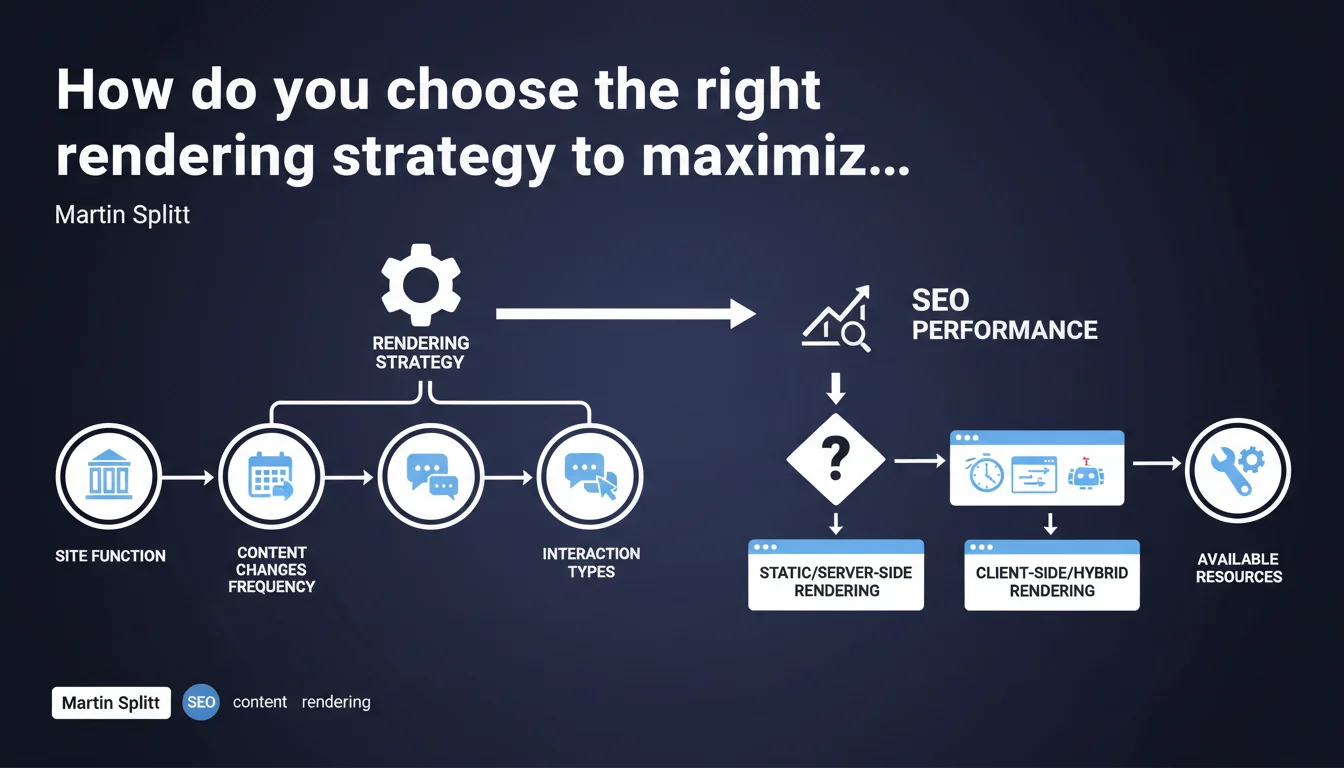
Google states that the choice of rendering strategy (CSR, SSR, SSG, etc.) should depend on the site's function, content update frequency, user interactions, and available technical resources. No universal solution exists — it's the analysis of your specific constraints that should dictate the architecture.
What you need to understand
Why does Google insist on a case-by-case approach?
Martin Splitt reminds us here of a truth that many try to get around: there is no miracle rendering strategy that works for all sites. An e-commerce site with 50,000 product sheets updated daily doesn't have the same needs as a corporate blog with 10 static pages.
Google puts the responsibility back on developers and SEO managers. Understanding business objectives and technical constraints becomes a critical skill — you can no longer simply follow a prefabricated recipe found in a tutorial.
What are the decisive factors mentioned by Google?
Four main criteria emerge: the site's function (e-commerce, media, SaaS), the frequency of content change (static vs dynamic), the types of interactions to support (passive reading vs complex application), and the resources available to maintain the infrastructure.
This last point deserves attention. Google implicitly acknowledges that certain strategies require significant expertise and budget. SSR requires heavier server management than SSG — and if you lack the skills or time, you risk creating more problems than you solve.
What does this concretely change for SEO?
It shifts the debate. Instead of asking « what's the best rendering strategy for SEO, » the real question becomes: which strategy fits my specific context? A static WordPress brochure site has no reason to migrate to complex server-side rendering.
SEO impact flows from the consistency between technical architecture and real needs. A poorly configured site, regardless of the chosen strategy, will always penalize search rankings — degraded load times, unindexed content, catastrophic user experience.
- Analyze the site's actual function before choosing a technical stack
- Evaluate content update frequency to identify if static is sufficient
- Map user interactions required (forms, filters, dynamic search)
- Measure available human and budget resources to maintain the infrastructure
- Favor simplicity when it meets objectives — adding complexity without reason creates SEO risks
SEO Expert opinion
Is this statement a recognition of Googlebot's failure?
No, but it reveals an important nuance. Google can technically crawl and index JavaScript — that's been established for years. But that doesn't mean all JS implementations are equal from an SEO perspective. [To verify] The official discourse remains vague about actual indexation timelines for client-side rendered content in complex configurations.
In practice, we still see significant gaps between raw HTML content and content rendered after JS execution. Sites with pure CSR face longer indexation delays, even though Google claims to handle all renderings equally. This statement implicitly acknowledges these difficulties by encouraging adaptation of strategy rather than forcing an unsuitable architecture.
What nuances should be applied to this advice?
The term « available resources » deserves clarification. Google isn't just talking about money, but sustainable technical expertise. Migrating to SSR without mastering Node.js, Next.js, or Nuxt.js exposes you to major SEO regression risks — incorrect cache configurations, poorly managed metadata, orphaned pages.
Another critical point: content change frequency shouldn't be the sole dictator of strategy. A news site updated every hour can work perfectly well with SSG and incremental regeneration (ISR). Confusing « content dynamism » with « need for dynamic rendering » is a common mistake that costs dearly in infrastructure.
In what cases doesn't this rule apply?
Purely application-based sites (SaaS in connected mode, private dashboards) can completely ignore these SEO considerations. If 100% of your traffic comes from direct connections or paid campaigns, the choice of rendering strategy is purely a matter of user experience and technical performance.
Let's be honest: Google isn't saying anything new here. But the fact that Martin Splitt reiterates these fundamentals in 2025 suggests that many sites continue choosing their technical stack for the wrong reasons — technological hype, CV-driven development, or blind copying of competitors.
Practical impact and recommendations
What should you concretely do before choosing a rendering strategy?
Start by mapping your content. Identify what changes frequently (blog feeds, product sheets) versus what stays stable (institutional pages, FAQs). This distinction already points toward possible hybrid approaches — SSG for static, SSR for dynamic.
Next, audit your internal technical capabilities. Do you have a team capable of maintaining a production Node.js server? Can you manage cache invalidations intelligently? If the answer is no, committing to complex SSR exposes you to outages and SEO regressions.
What errors should you avoid when choosing a strategy?
Classic mistake: choosing the stack because it's « modern » or recommended in a recent article. Pure React CSR remains problematic for SEO if you lack resources to properly implement prerendering or migration to Next.js.
Another trap: underestimating maintenance costs. A site with 10,000 pages in SSG can take 20 minutes to rebuild completely. If you publish 50 articles daily, this strategy becomes unmanageable without ISR — and ISR requires more advanced server configuration.
Never neglect server response times (TTFB). Poorly optimized SSR generates catastrophic TTFB that damages Core Web Vitals. Preferring SSG with CDN remains safer for performance if content allows it.
How do you verify the chosen strategy works for SEO?
Use Search Console's URL inspection tool to compare raw HTML and rendered HTML. If major differences remain (titles, main content missing from raw HTML), you're dependent on JS rendering — and that slows indexation.
Monitor indexation delays via server logs crossed with Search Console. A delay exceeding 48 hours between publication and indexation generally signals a rendering or crawl budget problem. Also test your critical pages with Screaming Frog in JavaScript enabled/disabled mode to identify content invisible without JS.
- Audit actual content update frequency by page type
- Assess available technical expertise to maintain the solution
- Test TTFB and Core Web Vitals on representative pages before migration
- Systematically compare raw HTML vs rendered HTML in Search Console
- Monitor indexation delays post-publication to detect anomalies
- Favor hybrid architectures (SSG + selective SSR) when context allows
- Document cache configuration and purge strategies to prevent errors
❓ Frequently Asked Questions
Le rendu côté serveur (SSR) est-il obligatoire pour bien se référencer en 2025 ?
Comment savoir si mon site dépend trop du JavaScript pour son contenu ?
Peut-on mélanger plusieurs stratégies de rendu sur un même site ?
Quels sont les risques d'une mauvaise stratégie de rendu pour le SEO ?
Les ressources techniques mentionnées par Google incluent-elles uniquement le budget ?
🎥 From the same video 6
Other SEO insights extracted from this same Google Search Central video · published on 08/01/2025
🎥 Watch the full video on YouTube →
💬 Comments (0)
Be the first to comment.