
Official statement
Other statements from this video 10 ▾
- □ Has Google really been respecting robots.txt since day one?
- □ Why do all Google crawlers rely on the same unified crawl infrastructure?
- □ Does Google really slow down its crawl to protect your servers?
- □ Why has Google multiplied its crawlers since the arrival of Mediapartners-Google?
- □ Does Google really ignore robots.txt when users take action?
- □ Does Google's Live Test Tool Actually Crawl Your Site in Real Time?
- □ Is Google Really Crawling Less of the Web, and Should You Worry About It?
- □ Does Google's crawling really consume the most server resources?
- □ Should you really worry about crawl budget before hitting 1 million pages?
- □ Why does Googlebot's server load impact vary so dramatically based on your technical architecture?
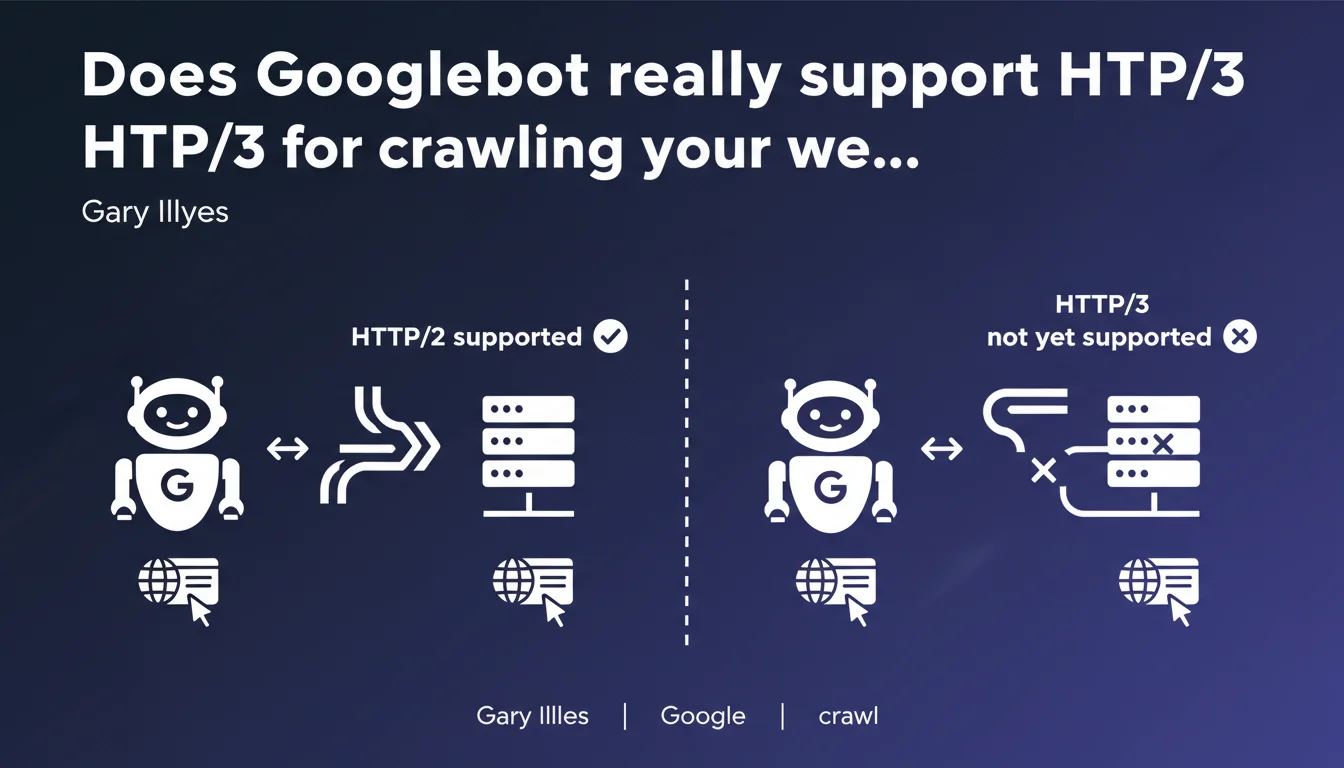
Googlebot currently uses HTTP/2 to optimize crawls through streamed connections, but HTTP/3 is not yet supported. Google hasn't ruled out future adoption, but no timeline has been communicated. For now, HTTP/2 remains the most advanced protocol exploited by the crawler.
What you need to understand
Why does Googlebot favor HTTP/2?
HTTP/2 allows Googlebot to open a single TCP connection and send multiple requests simultaneously over that same connection. This is called multiplexing. Result: less latency, fewer repeated SSL handshakes, faster crawling.
Concretely, Google saves time and network resources. For you, it means reduced server load from crawling — provided your server handles HTTP/2 correctly.
What is HTTP/3 and why isn't Google using it yet?
HTTP/3 is built on QUIC, a UDP protocol originally developed by… Google itself. It promises even better performance: faster connections, better resilience to packet loss, seamless connection migration without interruption.
But here's the thing — Gary Illyes confirms that Googlebot doesn't exploit it yet. No date, no guarantee, just a "could be in the future." In other words: it's not a priority for Google Search right now.
What does this mean for your website?
- HTTP/2 is sufficient to benefit from optimized crawling by Googlebot
- HTTP/3 provides no direct SEO advantage as long as Google doesn't use it
- Implementing HTTP/3 remains relevant for user experience (Core Web Vitals, load times), but not for crawling
- Verify that your server properly supports HTTP/2 and that headers are correctly configured
SEO Expert opinion
Is this statement consistent with what we observe in the field?
Yes, completely. Server logs have shown for several years that Googlebot negotiates HTTP/2 when available. No trace of QUIC or HTTP/3 in crawler requests.
What's interesting is that Google already uses HTTP/3 for its own services (YouTube, Gmail, Search…) but not for Googlebot. This shows that the crawler operates with its own technical stack, likely more conservative to ensure maximum compatibility.
Should you worry about not having HTTP/3 enabled?
No. Let's be honest: as long as Googlebot doesn't exploit it, HTTP/3 is invisible to your SEO. You lose nothing in terms of crawl budget or indexing speed.
On the other hand, for real users, HTTP/3 improves network performance — and that indirectly impacts SEO through Core Web Vitals. But that's another story.
When will HTTP/3 be supported by Googlebot?
[To be verified] — Google provides no timeline. Gary Illyes uses the classic phrase "could be in the future," which means absolutely nothing.
My interpretation: as long as HTTP/2 meets Google's needs (and it does), there's no urgency. HTTP/3 will likely come when server-side adoption is massive and stable. We're talking about years, not months.
Practical impact and recommendations
What should you verify on your infrastructure today?
Start by confirming that your server supports HTTP/2. Use Chrome Developer Tools (Network tab, Protocol column) or online tools like KeyCDN HTTP/2 Test.
If HTTP/2 isn't active, enable it — it's been a standard since 2015. Nginx, Apache, LiteSpeed, all modern servers handle it natively. Also make sure that HTTPS is properly configured, because HTTP/2 requires TLS.
Should HTTP/3 be on your technical roadmap?
Only if you're looking to optimize Core Web Vitals for your users. HTTP/3 reduces latency, especially on mobile and unstable connections. But in pure SEO terms, the impact is zero for now.
If your site is already performing well on HTTP/2, HTTP/3 will only be a marginal gain. Prioritize classic optimizations first: Brotli compression, lazy loading, properly configured CDN.
What mistakes should you avoid in the HTTP/2 migration?
- Don't disable HTTP/1.1 — some third-party bots only support this protocol
- Verify that
Alt-Svcheaders don't force HTTP/3 if your stack isn't ready - Test Googlebot behavior after activation: server logs, Search Console, crawl time
- Don't confuse HTTP/2 Server Push (often counterproductive) with multiplexing
- Monitor CPU load — HTTP/2 can be more resource-intensive on servers
❓ Frequently Asked Questions
Googlebot crawle-t-il mon site en HTTP/3 si je l'ai activé ?
HTTP/2 améliore-t-il mon crawl budget ?
Dois-je désactiver HTTP/1.1 une fois HTTP/2 activé ?
HTTP/3 impacte-t-il les Core Web Vitals ?
Quand Google compte-t-il supporter HTTP/3 dans Googlebot ?
🎥 From the same video 10
Other SEO insights extracted from this same Google Search Central video · published on 29/05/2025
🎥 Watch the full video on YouTube →
💬 Comments (0)
Be the first to comment.