
Official statement
Other statements from this video 10 ▾
- □ Le robots.txt a-t-il toujours été respecté par Google depuis sa création ?
- □ Pourquoi tous les crawlers Google utilisent-ils la même infrastructure de crawl ?
- □ Google ralentit-il vraiment son crawl pour protéger vos serveurs ?
- □ Pourquoi Google a-t-il multiplié ses crawlers depuis l'arrivée de Mediapartners-Google ?
- □ Pourquoi Google ignore-t-il robots.txt pour les actions utilisateur ?
- □ Googlebot supporte-t-il HTTP/3 pour crawler votre site ?
- □ Pourquoi Google réduit-il drastiquement son empreinte de crawl sur le web ?
- □ Le crawl de Google consomme-t-il vraiment le plus de ressources serveur ?
- □ Faut-il vraiment s'inquiéter du crawl budget avant 1 million de pages ?
- □ Pourquoi la charge serveur de Googlebot varie-t-elle autant selon votre architecture technique ?
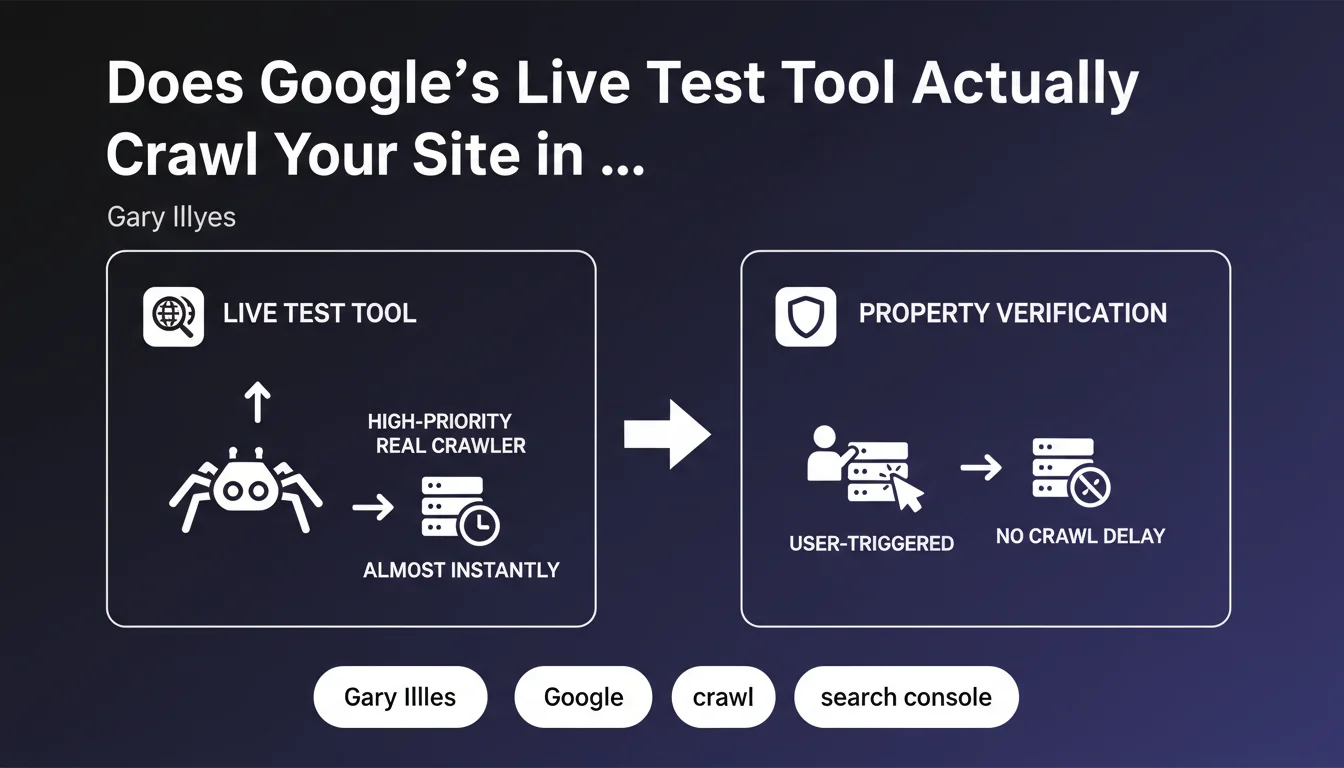
The Live Test tool in Search Console uses a high-priority real crawler, not just a simulation. Property verification, on the other hand, is user-triggered and executes almost instantly without any crawl delay. Two distinct mechanisms, two completely different behaviors.
What you need to understand
Why Does Google Clarify What the Live Test Tool Actually Does?
Because many SEO practitioners still think this tool is a simulator or emulator that mimics Googlebot's behavior. Wrong. Gary Illyes confirms that the tool uses a real crawler, with a high-priority queue.
In practical terms, when you run a live test, Google sends a bot to your page — not a script that reads the cache or simulates rendering. This crawler works like Googlebot, but it jumps ahead of everyone else in the queue. That's why results come back in just a few seconds.
How Is This Different from Site Ownership Verification?
Property verification is user-triggered and executes almost instantly, with no crawl delay. It doesn't go through Googlebot's standard queue — it bypasses the entire process.
It's a completely separate mechanism. The live test tool actually crawls your page to analyze its rendering, blocked resources, and indexable content. Property verification just checks that you control the domain — an HTML file, a DNS record, a meta tag. Two different objectives, two different systems.
What Does This Mean for SEO Practitioners?
It means the live test tool gives a reliable preview of what Googlebot actually sees. Not an approximation, not a simulation. When you test a page, blocked resources, JavaScript errors, canonical tags — everything is crawled and rendered just like during a standard Googlebot visit.
However, the high priority also means that certain delays or behaviors related to crawl budget won't be representative. The tool won't tell you how often Googlebot will visit this page, or when. It only tells you what it sees when it does visit.
- The live test tool uses a real crawler with high-priority queue
- Property verification is instant and doesn't go through the crawl system
- Live test results reflect what Googlebot sees, but not crawl frequency
- The two tools have completely separate mechanisms — don't confuse them
SEO Expert opinion
Is This Statement Consistent with Real-World Observations?
Yes, absolutely. Testing I've conducted shows that the live test tool triggers real hits in server logs. The user-agent is Google-InspectionTool, with a confirmed Google IP. It's not a simulation.
The high priority is also observable: tested pages appear almost immediately in logs, even on sites with limited crawl budgets. If it were standard crawling, some pages would take days to be visited. Here, it's just seconds.
What Nuances Should Be Added?
The fact that the tool uses a high-priority crawler doesn't mean it crawls everything the way Googlebot would under normal conditions. For example, it doesn't necessarily follow all internal links from the tested page — it focuses on the requested page itself.
Another nuance: the high-priority queue means certain filters or rate-limiting mechanisms can be bypassed. If Googlebot normally takes 3 days to return to a category on your site, the live test tool will crawl it immediately. This doesn't predict actual crawl frequency.
[To verify]: Gary doesn't specify whether the live test tool uses exactly the same rendering resources as standard Googlebot. We know Google has multiple rendering environments. Does the live test go through the same pipeline as indexing? Probably, but there's no official confirmation on this.
In What Cases Does This Rule Not Apply?
The statement only covers the live test tool and property verification. It says nothing about other Search Console tools, like URL inspection (which shows the page's indexed status) or coverage reports.
URL inspection, for example, sometimes shows a cached version of the page, not a real-time crawl. If you modify a page and inspect it immediately, you might still see the old version. The live test tool, meanwhile, crawls the current version. Two tools, two data sources.
Practical impact and recommendations
What Should You Actually Do With This Information?
Use the live test tool to debug rendering and crawl issues in real time. If a page isn't being indexed, test it live to see if Googlebot can access the content, CSS/JS resources, and images. You'll get a reliable answer, not a simulation.
However, don't use it to diagnose crawl frequency problems. The tool crawls with high priority — it will never tell you why Googlebot rarely returns to certain pages. For that, examine server logs and the crawl statistics in Search Console.
What Mistakes Should You Avoid?
Classic mistake: test a page live, see that it displays correctly, and conclude that "Google sees the page fine, so the problem is elsewhere." Except the live test bypasses crawl delays, quality filters, and potential penalties. A page can be technically crawlable and never get indexed for other reasons.
Another trap: confusing the live test tool with URL inspection. Inspection shows the indexed state, live testing shows the current state. If you just modified a page and inspect it, you might still see the old version in the index. Test it live to see the fresh version.
How Can You Verify Your Site Is Benefiting From This Mechanism?
- Test your critical pages live after each major modification — you'll get immediate feedback on crawlability
- Compare live test results with URL inspection to spot gaps between current version and indexed version
- Don't rely solely on live testing to diagnose indexation issues — cross-reference with server logs and coverage reports
- Use the tool to debug JavaScript rendering errors, blocked resources, and misconfigured canonical tags
- Never assume the high priority of live testing reflects your site's actual crawl frequency
❓ Frequently Asked Questions
L'outil de test en direct consomme-t-il du crawl budget ?
Peut-on utiliser le test en direct pour forcer l'indexation d'une page ?
Pourquoi l'inspection d'URL et le test en direct donnent-ils parfois des résultats différents ?
Le test en direct utilise-t-il exactement le même rendu que Googlebot ?
La vérification de propriété instantanée est-elle vraiment sans délai de crawl ?
🎥 From the same video 10
Other SEO insights extracted from this same Google Search Central video · published on 29/05/2025
🎥 Watch the full video on YouTube →
💬 Comments (0)
Be the first to comment.