
Official statement
Other statements from this video 7 ▾
- □ Quels encodages HTTP Googlebot accepte-t-il réellement pour crawler vos pages ?
- □ Pourquoi Google convertit-il enfin ses vieux articles de blog en documentation officielle ?
- □ Les AI Overviews indexent-elles vraiment votre contenu ou se contentent-elles de le lire ?
- □ JavaScript convient-il vraiment aux sites hybrides selon Google ?
- □ Comment les white papers de Google sur l'IA peuvent-ils améliorer votre stratégie SEO ?
- □ Le contenu dupliqué est-il vraiment un problème SEO ou un problème juridique ?
- □ Pourquoi Google pointe-t-il des problèmes massifs de création de contenu sur les sites turcs ?
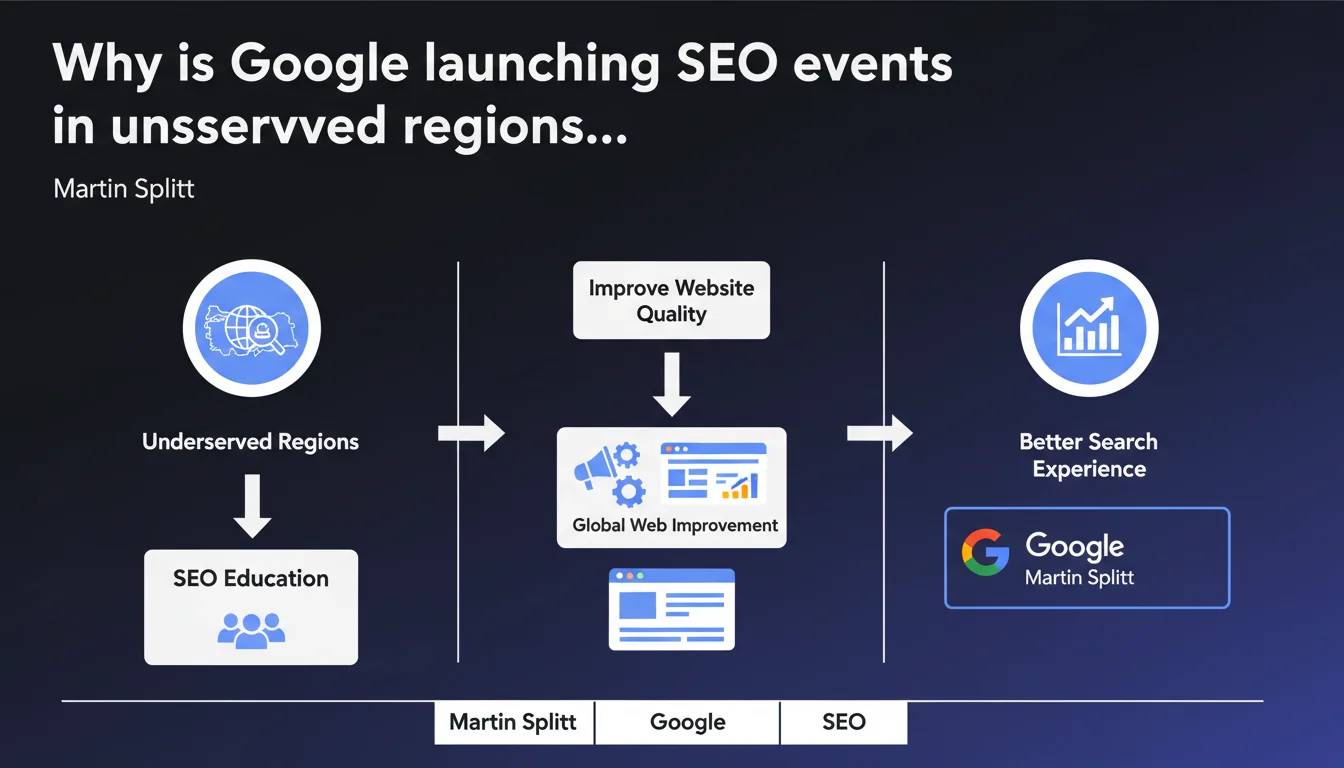
Google is rolling out Search Central Live in regions where it hasn't traditionally had a strong presence — Turkey, Malaysia — to train local professionals in SEO and raise the overall quality of websites. An educational expansion strategy aimed at improving the quality of the global web, but one that also raises questions about the standardization of SEO practices on a global scale.
What you need to understand
Which regions is Google targeting with Search Central Live?
Google is deploying its Search Central Live event series in geographic areas it describes as "underserved". We're talking about countries like Turkey or Malaysia, where the local SEO ecosystem hasn't received as much attention or official educational resources as more mature markets (United States, Western Europe).
The stated objective: close the gap in SEO training and improve the overall quality of websites in these regions. Google wants to ensure that local webmasters understand best practices — indexation, technical performance, quality content — rather than perpetuating common errors that harm user experience.
Why is Google investing in these events now?
The search engine has realized that a higher-quality web serves its interests. Better-optimized sites mean less wasted crawl budget, less spam to filter, and more satisfying user experience — which means more queries and advertising revenue.
By investing in SEO education in emerging regions, Google accelerates the upskilling of local players. It's a win-win strategy: sites improve, Google gains operational efficiency and geographic coverage.
What should an SEO professional understand from this initiative?
That Google is no longer waiting for webmasters to come to it. It's taking the lead, especially in markets where English-language documentation or official resources remain difficult to access. This is a sign that Google sees growth potential in these regions — and that it intends to shape local SEO practices right now.
- Google is extending its educational presence beyond traditional markets
- The goal is to raise the technical and qualitative level of sites in targeted regions
- Better web quality reduces Google's operational costs and improves user experience
- Search Central Live is becoming a tool for standardizing best SEO practices on a global scale
SEO Expert opinion
Is this statement consistent with observed practices?
Yes, and it's quite revealing. Google has long concentrated its efforts — conferences, detailed documentation, video content — on English-speaking and European markets. Search Central Live events in countries like Turkey or Malaysia mark a turning point: Google is internationalizing its educational strategy.
On the ground, we see that sites from these underserved regions often suffer from recurring technical problems — poor crawl management, massive duplicate content, catastrophic loading times. Google's initiative responds to a reality: without local training, webmasters reproduce errors that penalize their visibility.
What nuances should be added to this announcement?
First nuance: Google doesn't specify exactly what it means by "improving the overall quality of websites". Are we talking about technical performance? Editorial richness? Compliance with anti-spam guidelines? [To verify] — without concrete data, it's hard to measure the real impact of these events.
Second nuance: organizing events is good. But if Google doesn't adapt its documentation and tools (Search Console, notably) to local specificities — languages, technical infrastructure, browsing habits — the impact will remain limited. A Turkish or Malaysian SEO professional needs much more than generic translated advice.
In what cases could this initiative fail?
If Google merely repeats the same messages as elsewhere without accounting for local realities. For example: recommending premium cloud hosting in a region with tight budgets and unreliable network infrastructure won't work.
Another risk: that these events remain accessible only to an already-trained elite — those who speak English, who can afford to travel, who already work for large companies. If training doesn't reach small local players, the goal of global quality elevation will remain empty words.
Practical impact and recommendations
What should you do concretely if you operate in a targeted region?
If you're an SEO professional in Turkey, Malaysia, or a region where Google is intensifying its educational presence, take advantage of it. Attend Search Central Live, ask specific questions, gather first-hand insights. Google often shares information at these events that you won't find in official documentation.
Then, audit your sites with a critical eye. Recurring technical problems — indexation, speed, mobile-friendliness — will likely be at the heart of Google's messages. This is the time to fix these flaws before local competition upskills.
What mistakes should you avoid in this context?
Don't fall into the trap of believing Google will solve your problems for you. These events are educational, not miraculous. If your site suffers from structural gaps — poorly designed architecture, poor content, toxic backlinks — a webinar won't change anything.
Another mistake: blindly applying Google's advice without adapting it to your local context. What works for an American site doesn't necessarily work for a Turkish or Malaysian site. Search habits, technical infrastructure, and user behaviors differ.
How do you verify that your site is ready to benefit from this general upskilling?
Start with a complete technical audit. Check the indexability of your pages, server response time, mobile compatibility, and URL structure. Fix obvious errors — 404 pages, redirect chains, missing tags.
Next, analyze the quality of your content. Is it unique? Does it provide real added value? Or does it reproduce generic patterns found everywhere? In an SEO ecosystem that's upskilling, mediocrity will be increasingly penalized.
- Participate in Search Central Live events in your region to capture first-hand insights
- Audit your site on the fundamentals: indexation, speed, mobile, structure
- Fix recurring technical errors before local competition strengthens
- Adapt Google's advice to your local context — don't copy-paste practices from other markets
- Invest in editorial quality: unique content, local expertise, real added value
- Monitor the evolution of local competition post-events — SEO dynamics will accelerate
❓ Frequently Asked Questions
Quels pays sont concernés par les événements Search Central Live ?
Pourquoi Google investit-il dans ces événements maintenant ?
Ces événements sont-ils accessibles aux petits acteurs locaux ?
Faut-il appliquer tous les conseils de Google sans les adapter ?
Quel impact concret sur la concurrence locale ?
🎥 From the same video 7
Other SEO insights extracted from this same Google Search Central video · published on 30/12/2024
🎥 Watch the full video on YouTube →
💬 Comments (0)
Be the first to comment.