
Official statement
Other statements from this video 7 ▾
- □ Quels encodages HTTP Googlebot accepte-t-il réellement pour crawler vos pages ?
- □ Pourquoi Google convertit-il enfin ses vieux articles de blog en documentation officielle ?
- □ Les AI Overviews indexent-elles vraiment votre contenu ou se contentent-elles de le lire ?
- □ JavaScript convient-il vraiment aux sites hybrides selon Google ?
- □ Comment les white papers de Google sur l'IA peuvent-ils améliorer votre stratégie SEO ?
- □ Pourquoi Google organise-t-il des événements SEO dans des régions « sous-desservies » ?
- □ Pourquoi Google pointe-t-il des problèmes massifs de création de contenu sur les sites turcs ?
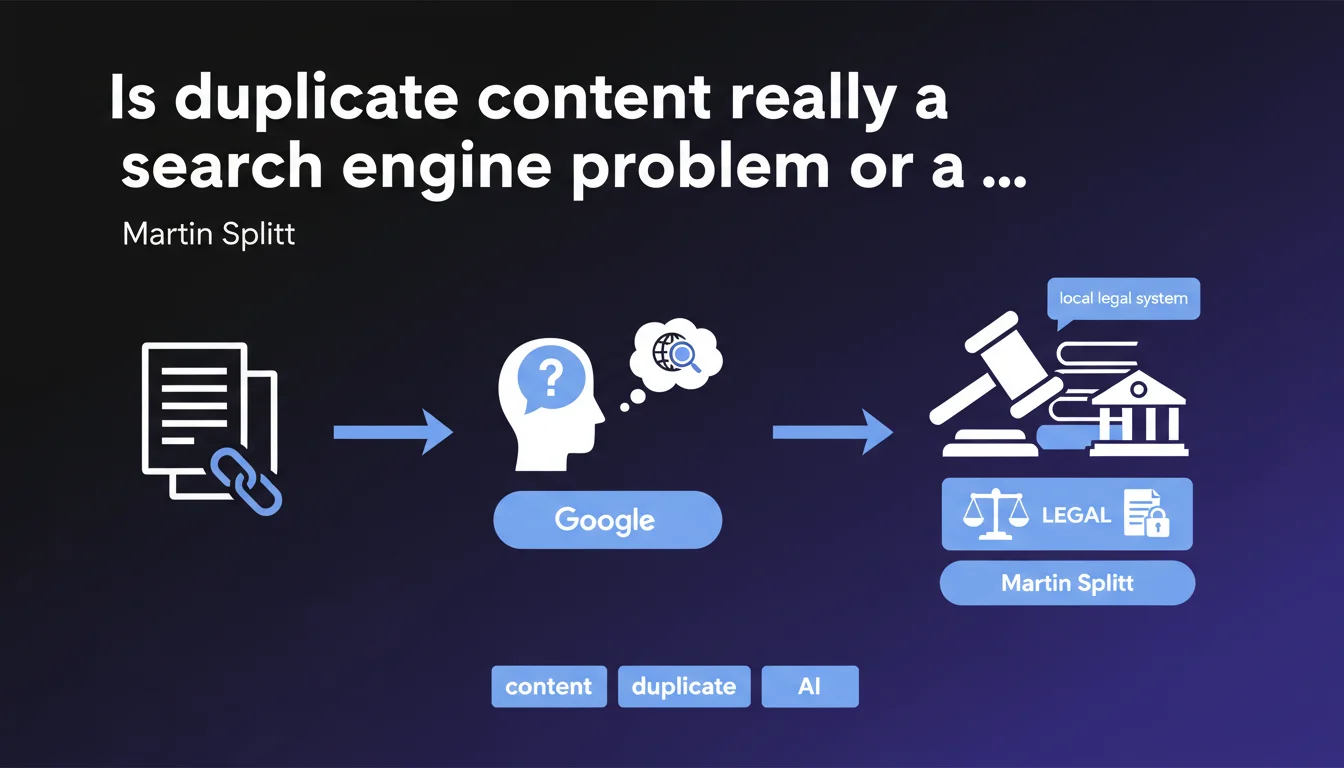
Google states that content theft falls under local legal systems, not its technical mechanisms. According to Martin Splitt, webmasters who are victims of content copying should pursue legal remedies rather than wait for Google algorithmic intervention.
What you need to understand
Why does Google direct victims of content theft toward the legal system?
During events in Turkey, Google observed a recurring pattern of complaints from experienced webmasters regarding full copies of their content. The official response is clear: these situations do not fall under the search engine's technical responsibility.
Google positions itself as an indexing tool, not as an arbiter of copyright. The company believes that local legal mechanisms — DMCA in the United States, European copyright directives, civil courts — are the appropriate avenues for handling these disputes.
What distinction does Google make between technical duplication and content theft?
Two cases must be distinguished: technical duplicate content (pagination, URL parameters, mobile/desktop versions) which Google handles through its algorithms, and outright theft where a third party deliberately copies content to profit from it.
In the first case, Google uses automatic canonicalization and other signals to identify the original version. In the second case, Google waits for the legitimate owner to prove their rights through legal channels before intervening — for example, via the DMCA form.
Does Google really penalize sites that copy content?
Contrary to popular belief, Google does not systematically "penalize" sites with copied content. The search engine attempts to determine the original source through signals like first indexation date, domain authority, and inbound links.
However, this detection is not foolproof. An authoritative site that copies from a small site may sometimes rank better than the original — hence the frustration of webmasters and this clarification from Google.
- Google does not act as a copyright police — it is up to the content owner to take action
- Technical mechanisms (canonicalization, original detection) remain imperfect
- The DMCA form allows you to report stolen content, but requires a solid legal basis
- Webmasters who are victims must document proof of priority (publication date, archives, timestamp)
SEO Expert opinion
Is this position consistent with field observations?
Yes and no. Google is right in principle: copyright is a legal matter, not a technical one. But this response sidesteps a frustrating reality for SEO practitioners.
In practice, we regularly observe cases where a scraper or aggregator site outranks the original in the SERPs. Google's detection of the original source works well when the original site has authority — less well when a small site faces an established media outlet that republishes without permission.
Google's statement shifts responsibility to the webmaster, which makes legal sense but is operationally frustrating. Pursuing legal action is expensive, time-consuming, and is not always proportionate to the damage.
What nuances should be added to this statement?
First point: Google's DMCA form exists and works. It allows you to have stolen content removed from the index without going to court — but requires a formal notice with risk of counter-notice and perjury. So it is not so simple.
Second nuance: Google values freshness and authority. If an authoritative site copies your content a few hours after publication, it may temporarily rank better than you — until Google "understands" who the original is. This delay can be enough to capture traffic from an event or breaking news.
[To verify]: Google claims to effectively detect the original, but provides no public metrics on its detection success rate. Third-party studies (such as those by Moz or Ahrefs) show that in 15-20% of cases, the copied site outranks the original — a non-negligible rate.
In what cases does this rule not apply?
Google intervenes technically in certain specific cases: manifest spam, automatically generated content farms, sites created solely for scraping. These cases fall under anti-spam filters (Panda historically, then integrated into the core algorithm).
Conversely, if a competitor manually copies your articles and slightly rewrites them, Google will not detect it as spam — you will need to go through legal channels or DMCA.
Practical impact and recommendations
What can you do concretely if your content is copied?
First step: document priority of creation. Use tools like the Wayback Machine, Google Cache, or certified timestamp services to prove you published first. This proof is essential for any legal action or DMCA process.
Second step: contact the copying site directly. Send a formal email requesting removal or attribution with a canonical link to your original content. In 30-40% of cases, this is sufficient — especially if the copier is acting in good faith or fears legal action.
If that does not work, use Google's DMCA notification form. You must provide: URL of the original content, URL of the copied content, sworn statement that you are the owner, electronic signature. Google typically processes these requests within 24-48 hours.
What mistakes should you absolutely avoid?
Do not confuse legitimate citation and theft. If a site reproduces a short excerpt with attribution and a link to your source, that is legal and even beneficial for your SEO. An abusive DMCA notice can backfire on you.
Avoid submitting multiple notices for minor duplications or thematic similarities. Google may consider this notification spam and ignore your future legitimate requests.
Do not rely on Google to automatically detect that you are the original if your site lacks authority. Work on your link profile, your E-E-A-T, your indexation speed — these signals help Google identify the primary source.
How can you protect your content upstream?
Set up monitoring alerts. Use Copyscape, Google Alerts for your exact titles, or tools like Ahrefs Content Explorer to quickly detect copies. The faster you respond, the more effective it is.
Integrate internal and external links into your content. A lazy copier will leave them, creating backlinks to your site — which helps Google identify the original. It is also a proof of authorship signal.
Structure your content with Author schema markup and rich metadata. This does not prevent copying, but strengthens the signals Google uses to determine the original source.
- Document proof of priority for your content (Wayback Machine, timestamp)
- Set up automatic copy detection alerts (Copyscape, Ahrefs)
- Contact the copying site first before escalating to DMCA
- Use Google's DMCA form only for proven cases of theft
- Build your site's authority (links, E-E-A-T) to facilitate Google's detection
- Integrate internal links in your content as "authorship markers"
- Do not confuse legitimate citation with theft — risk of abusive notice
❓ Frequently Asked Questions
Google pénalise-t-il mon site si quelqu'un copie mon contenu ?
Le formulaire DMCA de Google suffit-il pour faire retirer un contenu volé ?
Comment Google détermine-t-il quel site a publié en premier ?
Puis-je utiliser la balise canonical pour signaler que je suis l'original ?
Quels outils utiliser pour détecter automatiquement les copies de mon contenu ?
🎥 From the same video 7
Other SEO insights extracted from this same Google Search Central video · published on 30/12/2024
🎥 Watch the full video on YouTube →
💬 Comments (0)
Be the first to comment.