
Official statement
Other statements from this video 7 ▾
- □ Quels encodages HTTP Googlebot accepte-t-il réellement pour crawler vos pages ?
- □ Les AI Overviews indexent-elles vraiment votre contenu ou se contentent-elles de le lire ?
- □ JavaScript convient-il vraiment aux sites hybrides selon Google ?
- □ Comment les white papers de Google sur l'IA peuvent-ils améliorer votre stratégie SEO ?
- □ Le contenu dupliqué est-il vraiment un problème SEO ou un problème juridique ?
- □ Pourquoi Google organise-t-il des événements SEO dans des régions « sous-desservies » ?
- □ Pourquoi Google pointe-t-il des problèmes massifs de création de contenu sur les sites turcs ?
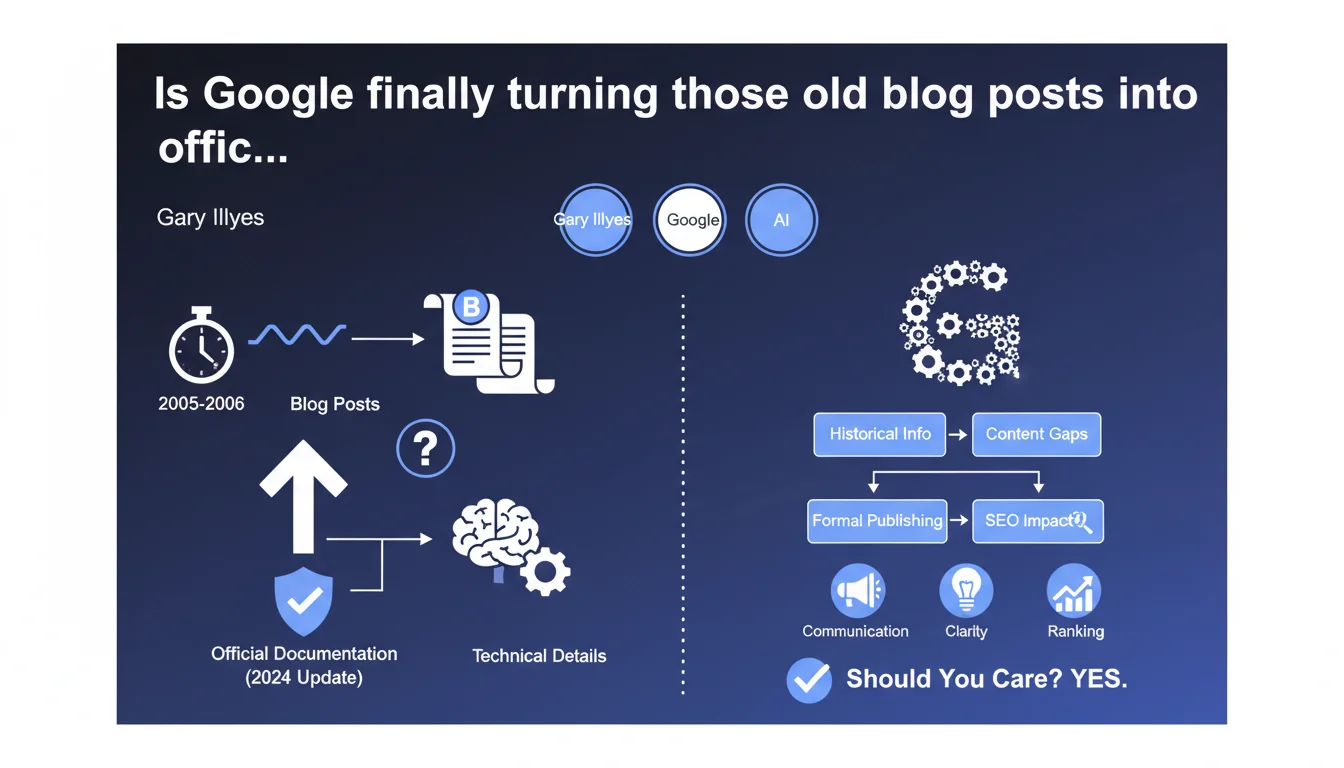
Google is transforming scattered information from blog articles since 2005 into structured official documentation. The goal: fill knowledge gaps and document technical details never formally published before. For SEO practitioners, this means fewer gray areas and more stable reference points.
What you need to understand
What exactly is changing in Google's documentation?
Google has decided to centralize technical knowledge that was scattered across blog articles from 15 to 20 years ago. This information, often cited by SEO professionals but never officially formalized, is finally becoming documented references.
What was the problem until now? Practitioners had to dig through archives, reconcile contradictory statements, and rely on interpretations. Now, Google is structuring this knowledge in its official documentation.
Why is this initiative happening now?
The answer boils down to one word: clarity. With Search evolving and the proliferation of questionable SEO practices, Google needs to establish solid foundations. Formalizing what was once implicit reduces misunderstandings and limits excuses from bad actors.
It's also a way to reduce communication overhead: instead of answering the same questions at conferences, Gary Illyes and his colleagues can now direct people to a single source.
Which technical details are finally being documented?
Google mentions details never formally published. We can imagine clarifications about Googlebot's behavior with certain HTTP codes, nuances on how chained redirects are handled, or clarifications on crawl budget.
However, the exact scope of these additions remains unclear—you'll need to explore the updated documentation to measure the real impact.
- Centralization: dispersed historical information becomes accessible in one place
- Formalization: what was interpretation becomes official reference
- Technical details: undocumented behaviors finally find their place
- Reduced ambiguity: fewer gray areas for practitioners
SEO Expert opinion
Does this initiative really solve Google's communication problems?
Let's be honest: it's a step in the right direction, but Google's official documentation has always been incomplete. Converting old blog articles is good. But if that information remains vague or oversimplified, we're not making much progress.
The real test will be the precision of technical details. If Google just rephrases generalities we already know, the impact will be limited. If they document specific use cases—like URL parameter handling or crawl prioritization rules—then things change.
What gray areas still remain?
Even with this update, entire aspects of how Google works stay opaque. Crawl budget is a glaring example: Google wavers between "it doesn't really exist" and "here's how to optimize it." [To verify]: does this new documentation finally settle these contradictions?
Another question mark—how temporary redirects lasting months are handled. Google says they're followed, but field observations show erratic behavior. If the official docs don't clarify these edge cases, we stay in the dark.
Why is Gary Illyes pushing this update now?
There's probably a strategic dimension. With the rise of generative AI and automated SEO tools, Google wants to regain control of the narrative. By officially documenting what was once oral or informal, they're setting guardrails.
It's also a signal to practitioners: "Stop relying on hazy YouTube conference interpretations—here's the reference." Whether this documentation will be kept current remains to be seen—so far, some Google's official pages have remained frozen for years.
Practical impact and recommendations
What should you do concretely with this new documentation?
First, systematically explore the updated sections. Compare what's written now with the practices you've been applying. Look for discrepancies—that's where adjustments hide.
Next, document your own observations. If the official documentation says X but you observe Y on your sites, write it down. These gaps can reveal nuances or use cases not covered.
What mistakes should you avoid with this documentation?
Don't fall into the blind application trap. Google generalizes to simplify, but your site has its own specifics. An official recommendation can be counterproductive in certain contexts—especially on technical sites or complex platforms.
Another classic mistake: ignoring historical contradictions. If Google said A in 2015 and B today, try to understand why. Sometimes it's algo evolution, sometimes it's just awkward rewording.
- Explore the new sections of Google Search documentation
- Compare official recommendations with your current practices
- Identify gaps between the documentation and your field observations
- Don't apply recommendations without contextual analysis
- Cross-reference this documentation with other reliable sources (forums, case studies)
- Monitor future updates—this initiative could be the start of a cycle of clarifications
How do you integrate these changes into your SEO strategy?
Use this documentation as a baseline reference, but not as the only source of truth. It should integrate into a broader approach: testing, log analysis, SERP monitoring, case studies.
If you manage complex sites or advanced technical architectures, this documentation can reveal overlooked optimization opportunities. However, correctly interpreting these technical details and applying them in a personalized way requires deep expertise and a nuanced understanding of crawling and indexing mechanisms.
Converting historical articles into official documentation is a welcome advance, but it doesn't replace field experience. Use it as a reference, test it against your data, and adjust your practices accordingly. For projects where every detail matters—complex infrastructures, risky migrations, advanced crawl optimizations—support from a specialized SEO agency can make the difference between a generic interpretation and a customized strategy that accounts for the specifics of your ecosystem.
❓ Frequently Asked Questions
Cette documentation remplace-t-elle les déclarations antérieures de Google ?
Où trouver exactement ces nouvelles sections documentées ?
Les détails techniques non documentés concernent-ils aussi le JavaScript et le rendu ?
Cette initiative signifie-t-elle que Google va publier plus d'informations techniques à l'avenir ?
Faut-il revoir toutes mes pratiques SEO à la lumière de cette documentation ?
🎥 From the same video 7
Other SEO insights extracted from this same Google Search Central video · published on 30/12/2024
🎥 Watch the full video on YouTube →
💬 Comments (0)
Be the first to comment.