
Official statement
Other statements from this video 7 ▾
- □ Which HTTP encodings does Googlebot actually accept to crawl your pages effectively?
- □ Is Google finally turning those old blog posts into official documentation—and should you care?
- □ Do AI Overviews really index your content, or do they just read it?
- □ Is JavaScript Really the Right Choice for Hybrid Websites According to Google?
- □ How can Google's AI white papers transform your SEO strategy?
- □ Is duplicate content really a search engine problem or a legal one?
- □ Why is Google launching SEO events in underserved regions like Turkey and Malaysia?
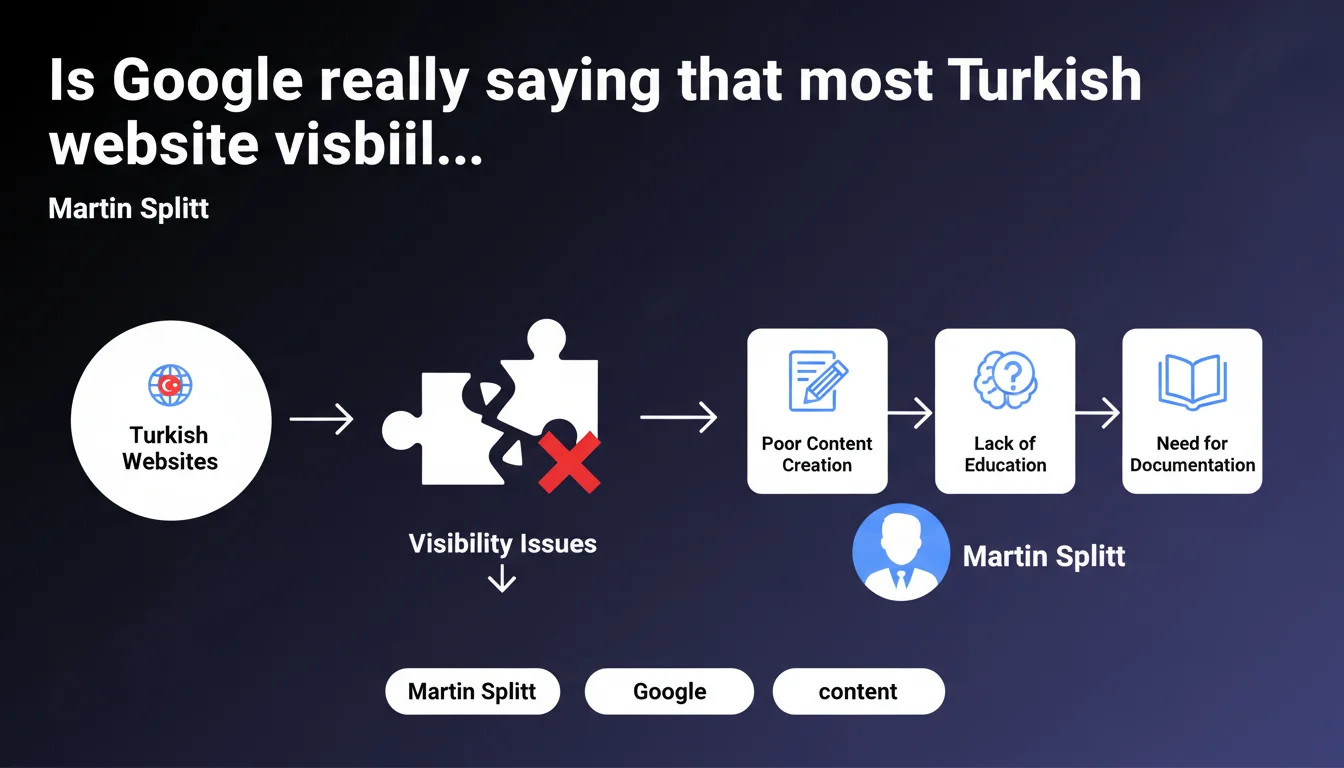
Google identified at a Search Central Live event in Turkey that the majority of organic visibility problems originate from deficient content creation practices on Turkish-language websites. This finding reveals an urgent need for education and documentation specific to this linguistic market.
What you need to understand
What exactly happened at this Search Central Live event?
Martin Splitt made a brutal diagnosis: most ranking problems encountered by Turkish websites don't come from algorithmic bugs or unjustified penalties, but from the intrinsic quality of published content.
This statement comes in the context of a local event, suggesting that Google observes recurring patterns specific to the Turkish ecosystem — likely content creation practices ill-suited to current algorithm standards.
What specific types of problems are being targeted?
Google remains vague on details, but the emphasis on "how content is created" suggests structural and methodological defects: bulk-generated content without added value, unreviewed machine translations, internal or external duplication, lack of verifiable expertise.
The fact that Google mentions a need for "education and documentation" indicates these errors are widespread enough to justify targeted educational action — it's not an isolated problem affecting just a few sites.
Is this situation unique to the Turkish market?
Nothing officially confirms this. Google organizes Search Central Live events across various regions, and each market has its own particularities. Turkish could simply be a case study for issues found elsewhere in different forms.
The Turkish SEO ecosystem likely has its own cultural and commercial practices that clash with E-E-A-T criteria and Helpful Content requirements. What's certain: Google believes the problem warrants specific public communication.
- Ranking problems stem primarily from content creation methods, not technical factors
- Google deems it necessary to produce documentation specific to the Turkish market
- This diagnosis suggests systemic practices ill-adapted to current quality standards
- The statement remains deliberately general without detailing specific errors observed
SEO Expert opinion
Does this statement really provide new insights?
Let's be honest: not really. Google has been repeating for years that content quality is paramount. What's interesting here is the geographic and linguistic angle — the admission that an entire market exhibits systemic failures.
This confirms what we've observed since the massive Helpful Content Update rollout: some local ecosystems, accustomed to practices that worked before, haven't adapted their approach. Turkish appears to be one of them.
Why does Google remain so vague about identified problems?
Classic move. Google always prefers generalities over concrete examples to prevent SEOs from circumventing guidelines by exploiting gray areas. Saying "the way content is created" without specifying whether the problem stems from scraping, poorly supervised AI generation, content farms, or keyword stuffing… it's frustrating but strategic.
[To verify]: Impossible to know whether Google has solid quantitative data or if this comes from qualitative observations based on a few manual audits. The phrasing suggests a general trend, but without published figures or methodology, it's hard to measure the real scope of the phenomenon.
Should we expect specific algorithmic actions?
Nothing in this statement indicates that. Google is betting first on education — creating resources, raising awareness among Turkish webmasters. If that's insufficient, we could imagine targeted algorithmic tightening, but that's mere speculation.
More likely: an intensification of low-value content detection through existing mechanisms (Helpful Content, spam systems), with perhaps adjustments to better capture Turkish linguistic specificities.
Practical impact and recommendations
What should you do if you manage a Turkish-language site (or a similarly situated language)?
First step: ruthless audit of your existing content. Identify bulk-generated pages, machine translations, thin recycled content. Compare against E-E-A-T criteria: expertise, experience, authority, trustworthiness.
Second step: immediately stop any content production not grounded in genuine human expertise. If you use AI generation, it must be supervised, edited, and enriched by domain professionals.
How do you verify your content meets current standards?
Ask yourself the question of real utility: does this content provide a unique, documented, verifiable answer? Or is it merely a restatement of what exists elsewhere? Google seeks originality of perspective, not just semantic reformulation.
Also test consistency with YMYL expectations if applicable. On sensitive topics (health, finance, legal), the absence of identifiable and verifiable expert signatures is disqualifying.
What errors must you absolutely avoid?
Don't settle for reformulating existing text to "optimize" it. Don't delegate creation to generalist writers without detailed brief and editorial validation. Don't multiply near-identical pages to target keyword variants.
And above all: don't rely on machine translation without thorough human review. Linguistic, cultural, and contextual nuances are systematically lost.
- Audit all published content against E-E-A-T criteria
- Identify and improve or remove low-quality content
- Implement rigorous editorial process with expert validation
- Verify each page provides unique and documented value
- Eliminate unsupervised bulk generation practices
- Train editorial teams on current Google standards
- Prioritize depth and originality over quantity
❓ Frequently Asked Questions
Cette problématique concerne-t-elle uniquement les sites en langue turque ?
Quels types de contenu sont principalement visés par cette déclaration ?
Google va-t-il créer des guidelines spécifiques pour le turc ?
Faut-il s'attendre à une pénalité algorithmique spécifique ?
Cette déclaration impacte-t-elle les sites multilingues ?
🎥 From the same video 7
Other SEO insights extracted from this same Google Search Central video · published on 30/12/2024
🎥 Watch the full video on YouTube →
💬 Comments (0)
Be the first to comment.