
Official statement
Other statements from this video 7 ▾
- □ Quels encodages HTTP Googlebot accepte-t-il réellement pour crawler vos pages ?
- □ Pourquoi Google convertit-il enfin ses vieux articles de blog en documentation officielle ?
- □ Les AI Overviews indexent-elles vraiment votre contenu ou se contentent-elles de le lire ?
- □ JavaScript convient-il vraiment aux sites hybrides selon Google ?
- □ Le contenu dupliqué est-il vraiment un problème SEO ou un problème juridique ?
- □ Pourquoi Google organise-t-il des événements SEO dans des régions « sous-desservies » ?
- □ Pourquoi Google pointe-t-il des problèmes massifs de création de contenu sur les sites turcs ?
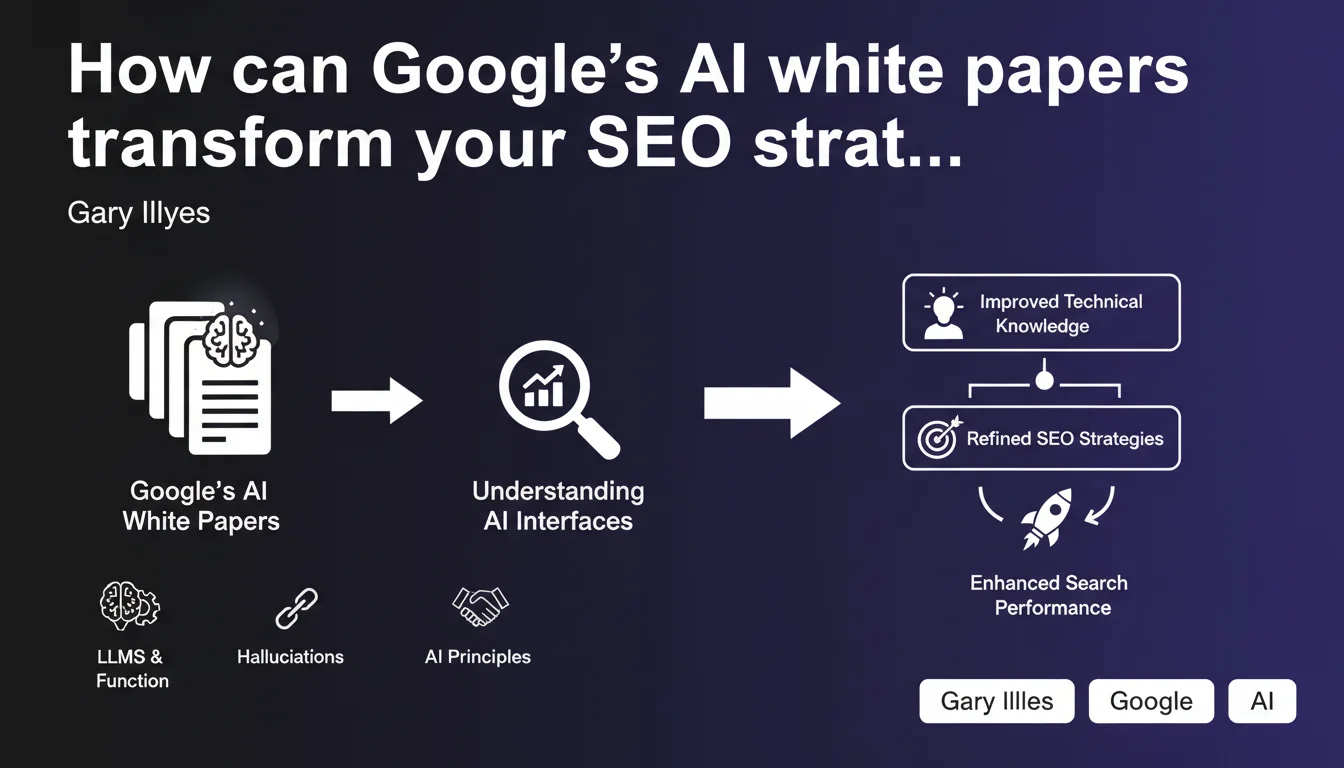
Google releases technical white papers detailing how LLMs work and common issues like hallucinations. These resources help SEO professionals better understand AI interfaces that now influence search results and user experience.
What you need to understand
Why is Google releasing these white papers now?
Google is trying to demystify its AI systems for professionals. The massive arrival of generative AI in SERPs (AI Overviews, Gemini) has created gray areas about how these tools actually work.
These technical documents aim to fill that gap. They explain in particular how LLM hallucinations occur — a critical topic when your content can be distorted in a generated response.
What exactly do these resources contain?
The white papers break down the internal workings of language models: tokenization, attention mechanisms, generation processes. Not watered-down vulgarization, but an intentionally technical approach.
Google also addresses common problems: algorithmic bias, contextual limitations, and especially hallucinations — when the model invents plausible but false information.
What are Google's guiding principles for AI?
The highlighted principles cover algorithmic accountability, system transparency, and deployment ethics. Google emphasizes the need to understand AI's limitations before leveraging it.
For an SEO professional, this means Google officially acknowledges that its own AI systems have weaknesses. A rare admission that changes the game.
- Technical white papers publicly accessible on how LLMs function
- Focus on hallucinations and their structural causes
- Ethical principles governing AI deployment at Google
- Recommended documentation for understanding AI interfaces (AI Overviews, Gemini)
- Technical approach without excessive simplification
SEO Expert opinion
Is this transparency really new?
Let's be honest: Google rarely communicates about the inner workings of its algorithms. This initiative marks a shift in stance. Why? Because generative AI has become too visible to remain opaque.
AI Overviews errors received massive coverage — dangerous food advice, factually false information. Google had to respond to preserve its credibility.
Do LLM hallucinations really impact SEO?
Absolutely. When Google generates an AI Overview response, it can distort or invent content that doesn't exist on your source page. Your site can be cited, but with incorrect information.
The problem: you have no direct control over this generation. [To verify] Google claims to be working on reliability, but the concrete mechanisms for fact-checking remain unclear.
Do you really need to read these white papers for SEO?
It depends on your level of exposure to AI in your SERPs. If your keywords frequently trigger AI Overviews or Gemini responses, understanding LLM limitations becomes strategic.
You'll know when to identify when Google might misinterpret your content. You can also anticipate the types of queries where AI fails — and position your content as a trusted reference in those cases.
Practical impact and recommendations
How do you structure content to limit hallucinations?
LLMs work through pattern recognition. Ambiguous or contradictory content increases the risk of misinterpretation. Structure your pages with clear hierarchies (H1, H2, H3) and explicit answers.
Use numbered or bulleted lists for factual information. LLMs rely heavily on these structures to extract data — might as well make the work easier.
What mistakes should you avoid with AI Overviews?
Don't try to over-optimize for AI like people over-optimized for featured snippets. Google has already adjusted its algorithms several times following abuse. Stick to quality, factual, verifiable content.
Avoid sensational claims without sources. If your content is the only reference on an obscure topic, AI can pick it up without critical context — and generate hallucinations by extrapolating.
How do you verify if your site is impacted?
Enter your main keywords into Google and check if AI Overviews appear. If yes, compare the generated content with what's on your source page. Discrepancies reveal at-risk areas.
Also use Google Search Console to identify pages generating many impressions but few clicks — a possible sign that an AI Overview is capturing traffic.
- Structure content with clear logical H1-H6 hierarchies
- Prioritize lists for factual or procedural information
- Cite verifiable sources for any important factual claims
- Avoid ambiguities in wording — favor clarity
- Monitor AI Overviews on your key queries regularly
- Analyze gaps between your content and what the AI generates
- Track Search Console to detect CTR drops linked to AI
❓ Frequently Asked Questions
Les white papers de Google sur l'IA sont-ils accessibles gratuitement ?
Les hallucinations des LLM peuvent-elles nuire au référencement de mon site ?
Dois-je modifier mon contenu existant pour l'IA de Google ?
Comment savoir si mes pages sont reprises dans les AI Overviews ?
Google corrige-t-il les hallucinations signalées dans les AI Overviews ?
🎥 From the same video 7
Other SEO insights extracted from this same Google Search Central video · published on 30/12/2024
🎥 Watch the full video on YouTube →
💬 Comments (0)
Be the first to comment.