
Official statement
Other statements from this video 11 ▾
- □ Is page experience really enough to guarantee good UX for Google?
- □ Should you really prioritize users over machines in SEO?
- □ Why does Google prefer hyphens over underscores in URLs—and what's the real impact on your rankings?
- □ Do accordions really hurt your SEO, or is it just an old myth?
- □ Does Googlebot really fail to index content hidden behind user clicks?
- □ Is Google really unable to crawl your navigation if it doesn't use proper anchor links?
- □ Are Core Web Vitals really enough to measure user experience?
- □ Why won't Google give you precise criteria on certain UX aspects—and what should you do about it?
- □ Are human-readable and consistent URLs really a ranking factor?
- □ Does web accessibility directly impact your Google rankings?
- □ Is Lighthouse really missing poor quality anchor text on your site?
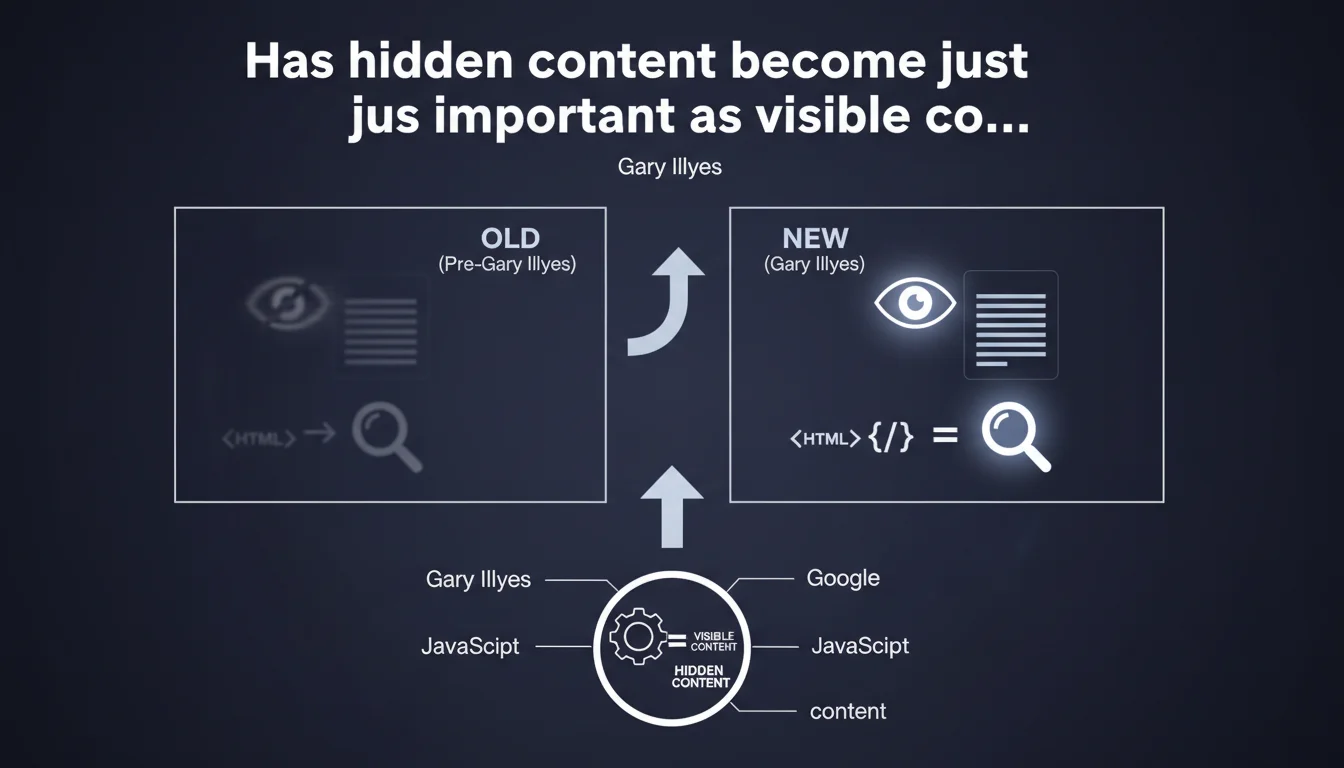
Google no longer penalizes content that isn't immediately visible on screen. The algorithm now treats all content present in HTML or loaded via initial JavaScript equally, whether it's visible or hidden (accordions, tabs, etc.). In practical terms: stop torturing yourself with the 'above the fold' rule.
What you need to understand
What was Google's old stance on hidden content?
For years, Google valued content visible immediately when the page loads. The logic? If a user doesn't see it without scrolling, it's probably less of a priority. This directive pushed SEOs to stuff the top of the page with keywords, sometimes at the expense of user experience.
Content hidden in accordions, tabs, or CSS-masked divs was considered of lesser value — or even suspicious if there was too much of it. This rule dated back to an era when cloaking and concealment techniques were rampant.
What's changed in practice?
Gary Illyes clarifies that this distinction is no longer applied. As long as content is present in the initial DOM (source HTML or immediately executed JavaScript), Google treats it normally. It doesn't matter if it's hidden by CSS, in a Bootstrap collapse, or under a 'See more' button.
The only determining criterion: content must be accessible on first load, not loaded lazily after user interaction (late lazy loading, AJAX triggered by click). If it's in the initial HTML or synchronous JS, you're good.
Why did Google change its approach?
Two main reasons. First, the evolution of web interfaces: accordions, tabs, and dropdown menus have become standard for structuring information without visual overload. Penalizing this content was essentially penalizing good UX practices.
Second, Googlebot now handles JavaScript quasi-natively. The era when the crawler only read raw HTML is long gone. The algorithm can evaluate content relevance even if it only appears after a simple CSS/JS event.
- Content hidden via CSS (display:none, visibility:hidden) is no longer penalized by default
- Accordions, tabs, and dropdown menus are treated normally if they're in the initial DOM
- Content loaded via late lazy loading (after scroll or click) remains lower priority
- This evolution aligns SEO practices with modern UX standards
SEO Expert opinion
Does this statement really change things on the ground?
Let's be honest: most SEOs have observed this behavior for at least 2-3 years. Tests on e-commerce sites with tabbed product sheets show that hidden content ranks perfectly, as long as it's in the source HTML. This statement simply makes official what has been widely observed in practice.
The real change is that Google is publicly owning it. No more gray areas where some people still claimed you had to put everything at the top. Now the official position is clear: structure your content for the user, not for an outdated indexing rule.
What nuances should we add to this claim?
Gary remains deliberately vague about the notion of 'immediate JavaScript'. What does that mean exactly? JS executed before DOMContentLoaded? Before the first paint? Before the onload event? [Needs verification] — Google doesn't provide a precise threshold in milliseconds.
Another gray area: content loaded via intersection observers (lazy loading on scroll). Technically, it's not in the initial DOM, but appears quickly. Google often indexes it, but does it treat it with the same value as content immediately present? The statement doesn't say.
Finally, beware of semantic context. A block of 3000 words hidden in an accordion closed at the bottom of a page might carry less weight than a well-placed paragraph in the main flow, even if technically Google indexes it. Contextual relevance remains a factor.
Should we overhaul all our on-page optimization strategies?
No. If your site already uses accordions or tabs to logically structure content, keep going. If you've been cramming everything at the top to 'make sure Google sees it', yes, ease up.
However, don't confuse this statement with a green light for cloaking or abusive hidden text. If you're hiding content solely to manipulate rankings without providing user value, manual filters and algorithmic penalties remain lying in wait.
Practical impact and recommendations
What should you concretely do with this information?
First, audit your strategic pages. If you have important content tucked away in accordions or tabs, verify it's present in the source HTML (View Source or DOM inspect). No need to unfold everything visually if UX suffers.
Next, test the Googlebot render via Search Console (URL inspection tool). Look at the 'rendered HTML': if your hidden content appears there, you're in the clear. If not, your JS might be loading too late or asynchronously in a blocking way.
What mistakes should you avoid now that this rule has changed?
Don't fall into the opposite excess of putting everything in hidden content under the guise that 'Google doesn't care'. User experience comes first: a visitor should find information quickly without having to unfold 15 accordions. Google also evaluates behavioral signals.
Also avoid loading critical content via aggressive lazy loading triggered by late intersection observer. If an important text block only appears after 2 seconds of scrolling, Google might technically index it, but won't value it as much as immediately available content.
How can you verify your site respects this directive?
- Inspect the raw HTML source code (CTRL+U): hidden content must be present, even if CSS masks it
- Use Search Console's URL inspection tool to verify Googlebot rendering
- Test with a crawler like Screaming Frog in JavaScript mode to see what's detected
- Measure JS execution time: if content takes +3 seconds to appear in the DOM, it's too late
- Compare source HTML and final DOM: anything missing from the source and arriving via late AJAX is at risk
- Verify your accordions/tabs don't load content on-demand when clicked (some frameworks do this by default)
❓ Frequently Asked Questions
Un contenu dans un accordéon fermé a-t-il le même poids SEO qu'un contenu visible ?
Le lazy loading d'images ou de texte est-il pénalisé par Google ?
Faut-il arrêter de mettre du contenu important en haut de page ?
Comment Google différencie-t-il le contenu caché légitime du cloaking ?
Les menus déroulants et modales sont-ils concernés par cette règle ?
🎥 From the same video 11
Other SEO insights extracted from this same Google Search Central video · published on 21/06/2022
🎥 Watch the full video on YouTube →
💬 Comments (0)
Be the first to comment.