
Official statement
Other statements from this video 10 ▾
- □ Is SEO really just about 'showing up in search results'?
- □ Why does Google keep emphasizing 'the right keywords' in SEO?
- □ Why does Google place such strong emphasis on practical information being displayed on websites?
- □ Are descriptive page titles really the game-changer for your SEO visibility?
- □ Does enriching your business information with coordinates and descriptions really impact local SEO rankings?
- □ Is your site losing Google Images traffic because of missing alt text?
- □ Why does Google place so much emphasis on descriptive keywords for product images?
- □ Does Google always penalize hidden text and deceptive content practices?
- □ Is black hat SEO really a waste of time and money?
- □ Is Search Console really enough to manage your site's SEO effectively?
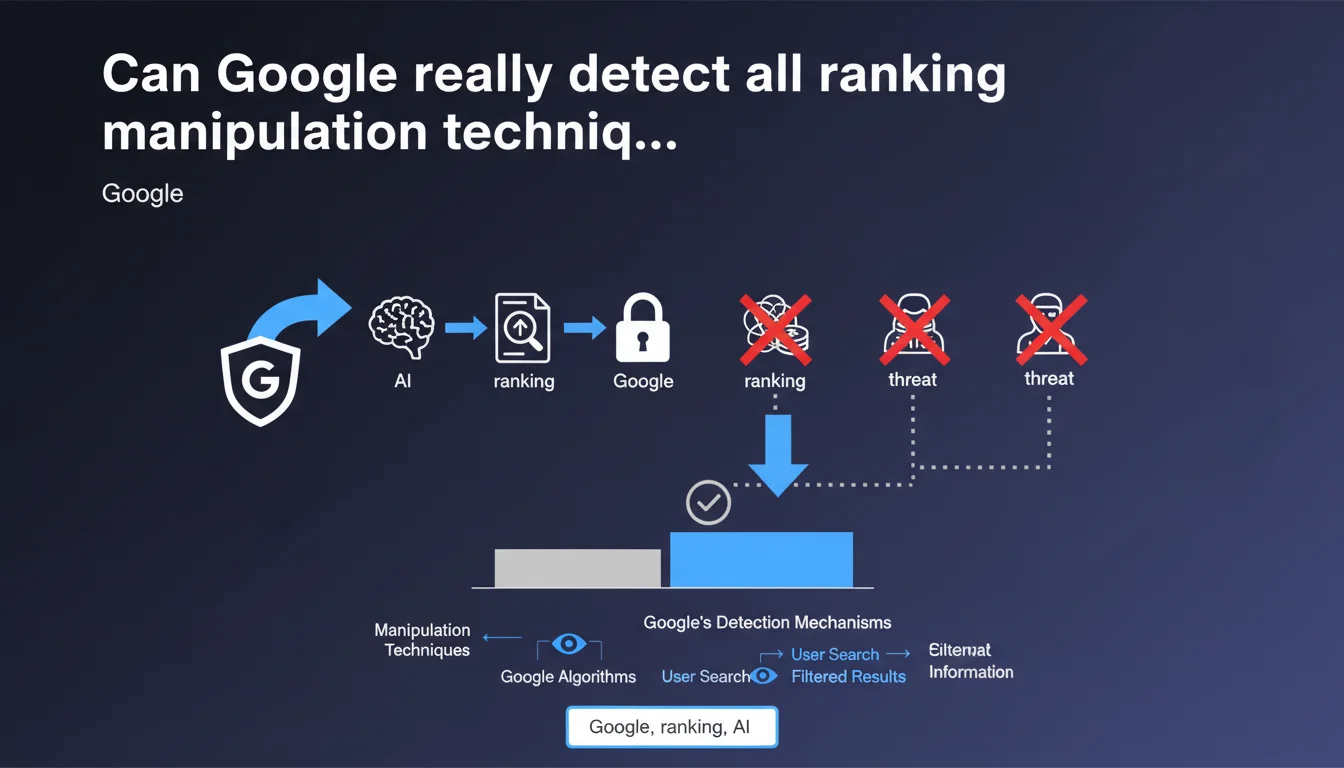
Google claims to have "numerous mechanisms" to detect techniques aimed at artificially manipulating search rankings. A deliberately vague statement that specifies neither the targeted techniques, nor the detection mechanisms, nor their actual effectiveness. The question remains: what counts as manipulation according to Google — and what still flies under the radar?
What you need to understand
What exactly does the term "ranking manipulation" cover?
Google uses intentionally fuzzy language. Manipulating rankings can mean link spam, AI content farms, cloaking, site networks… but also less clear-cut practices.
The problem is that the boundary is often blurry. Is an editorial link exchange between two legitimate sites acceptable or not? Is content optimized for the algorithm rather than for humans a form of manipulation? Google doesn't give a clear answer — deliberately.
What are these "numerous" detection mechanisms?
Again, Google stays vague. We know the algorithm includes anti-spam filters (historically Penguin, now integrated into core), AI detection systems, manual teams handling reports… but no details on thresholds, criteria, or false positives.
[To verify]: the actual effectiveness of these mechanisms varies enormously by sector. Some ultra-competitive niches are still rife with sites clearly artificially boosted — proof that these "numerous mechanisms" have their limitations.
Why does Google communicate so evasively?
It's a classic strategy. By staying vague, Google avoids giving a reverse how-to guide to manipulators. If Google announced tomorrow "we detect all link purchases over 50 backlinks/month," techniques would adapt instantly.
But this opacity has a cost: it creates an anxious gray zone for professionals who never know exactly where to draw the line between legitimate optimization and risky manipulation.
- Manipulation: deliberately broad term encompassing obvious spam and borderline practices
- Detection mechanisms: combination of automated algorithm and manual review, with variable effectiveness
- Fuzzy communication: deliberate strategy to avoid arming manipulators
- Gray zone: many legitimate techniques are close to risky practices without Google providing clear thresholds
SEO Expert opinion
Is this statement consistent with what's observed in the field?
Partially. Yes, Google massively detects obvious spam: link farms, scraped sites, crude cloaking. Manual and algorithmic penalties fall regularly.
But no, Google is far from detecting everything. In certain sectors (finance, casino, pharma, CBD…), sites with manifestly artificial link profiles squat the top 3 for months. The "numerous mechanisms" clearly have blind spots — or priorities that don't cover all verticals equally.
What nuances should be added to this claim?
Google talks about "mechanisms" in plural, but says nothing about their weighting or triggering. A site can accumulate negative signals without ever being penalized — either because it stays below an invisible threshold, or because other positive signals compensate.
[To verify]: the notion of "relevance and accuracy of results for users" is touted as justification, but we regularly observe SERPs polluted by recycled or undisclosed sponsored content. "Relevance" according to Google and relevance according to the user don't always align.
Another point: Google doesn't mention false positives. Some legitimate sites get badly calibrated penalties (unintentional over-optimization, passively received toxic backlinks…). Detection mechanisms aren't infallible — and the reconsideration process is opaque and slow.
In what cases does this rule not really apply?
Let's be honest: large players (major brands, institutional sites, mainstream media) often benefit from implicit leniency. A suspicious backlink on a CAC40 site? No penalty. The same link on a small e-commerce? Filter risk.
Google adjusts its manipulation detection mechanisms based on the perceived authority of the domain. It's never said officially, but it's observable: brand reputation acts as a partial shield against manipulation filters.
Practical impact and recommendations
What should you concretely do to avoid penalties?
First rule: prioritize quality over quantity on all levers (content, backlinks, internal linking). A site with 50 links from real media outlets beats a site with 5,000 links from worthless directories — even if Google doesn't always penalize immediately.
Second rule: document all SEO actions. If a penalty ever hits, you need to justify every link, every optimization. Internal transparency helps spot borderline practices before they become problems.
What mistakes should you avoid absolutely?
Never buy backlinks in bulk from automated platforms. It's the easiest technique to detect — and Google regularly communicates about it (spam updates targeting link schemes).
Never generate AI content without substantial human review. Google's detectors are improving fast — and a whole site of generic content can be deranked overnight.
Avoid excessive optimization (keyword stuffing, over-optimized anchors, satellite pages). Over-SEO is counterproductive: a naturally structured quality page beats a hyper-optimized page that sounds fake.
How can you verify your site stays compliant?
Monitor Search Console: any manual action appears there. But be careful, some algorithmic penalties (automatic filters) generate no notification — only a sudden traffic drop alerts you.
Regularly audit your backlink profile (Ahrefs, Majestic, Semrush): spot toxic links, abnormally concentrated anchors, suspicious link spikes. Use the disavow tool sparingly — Google recommends only as a last resort.
Compare performance before/after each Google update. If traffic systematically drops after every core update, it's a signal that the site is judged "borderline" by the algorithm — even without explicit penalty.
- Prioritize editorial quality and user relevance over all technical optimization
- Avoid any massive purchase of automated or cheap backlinks
- Review all AI content before publication — pure generic content is detectable
- Monitor Search Console for any manual action
- Audit your backlink profile quarterly minimum
- Document every SEO action to justify it if reconsideration becomes necessary
- Never over-optimize: use natural anchors, reasonable keyword density, user experience as priority
❓ Frequently Asked Questions
Google pénalise-t-il toutes les techniques de manipulation ou seulement les plus grossières ?
Comment savoir si mon site a été pénalisé par un mécanisme de détection automatique ?
Est-ce que désavouer des backlinks toxiques suffit à lever une pénalité ?
Les grosses marques sont-elles vraiment mieux protégées contre les sanctions ?
Combien de temps faut-il pour qu'une manipulation soit détectée par Google ?
🎥 From the same video 10
Other SEO insights extracted from this same Google Search Central video · published on 24/02/2022
🎥 Watch the full video on YouTube →
💬 Comments (0)
Be the first to comment.