
Official statement
Other statements from this video 10 ▾
- □ Is SEO really just about 'showing up in search results'?
- □ Why does Google keep emphasizing 'the right keywords' in SEO?
- □ Why does Google place such strong emphasis on practical information being displayed on websites?
- □ Are descriptive page titles really the game-changer for your SEO visibility?
- □ Does enriching your business information with coordinates and descriptions really impact local SEO rankings?
- □ Is your site losing Google Images traffic because of missing alt text?
- □ Does Google always penalize hidden text and deceptive content practices?
- □ Can Google really detect all ranking manipulation techniques?
- □ Is black hat SEO really a waste of time and money?
- □ Is Search Console really enough to manage your site's SEO effectively?
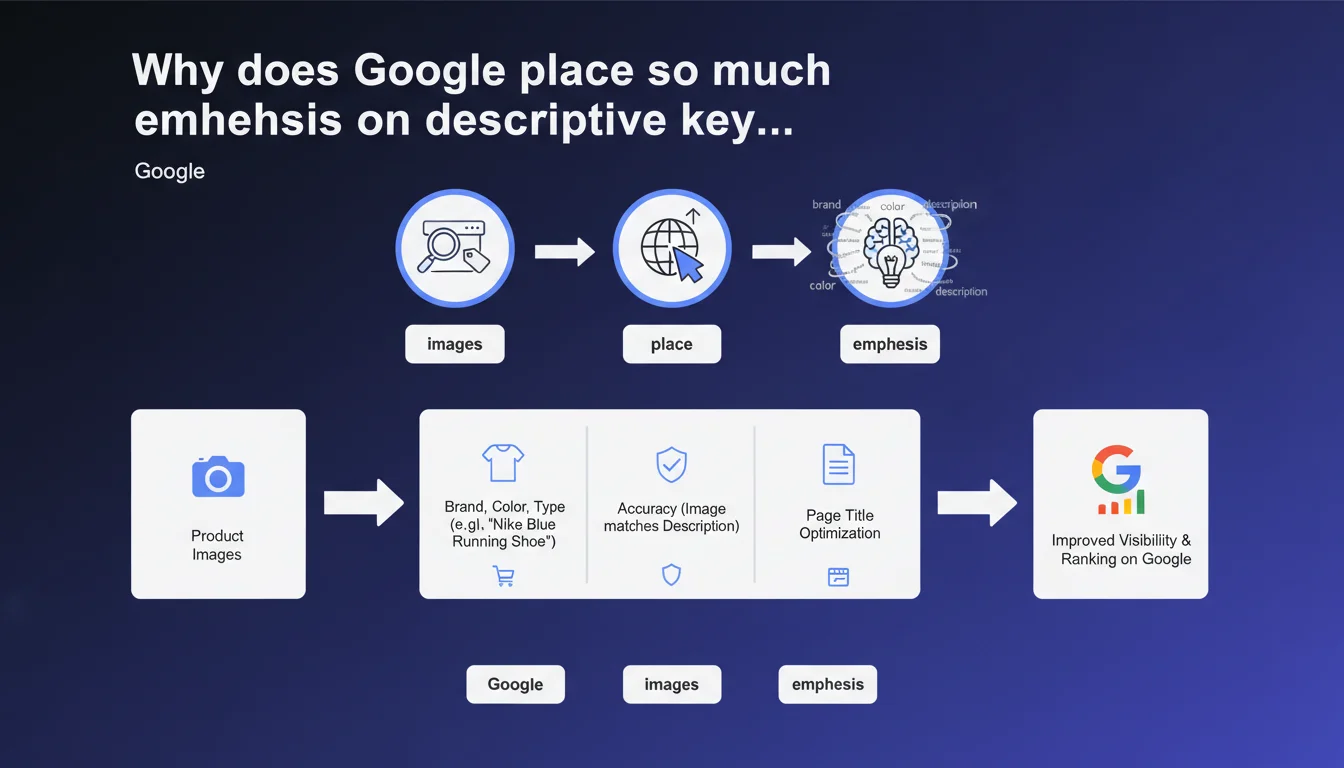
Google is reminding us of an obvious truth that's often overlooked: describe your products with precise attributes (brand, color, features) in titles, descriptions, and images. The focus is on consistency between visuals and metadata—a quality signal for the search engine. This guidance is primarily aimed at e-commerce, where friction between SEO and catalog management creates blind spots.
What you need to understand
Is this recommendation only for e-commerce sites?
Primarily, yes. Google is targeting online stores that manage product catalogs, whether through Google Merchant Center files or standard web pages. The vocabulary—brand, color, product description—reveals an intent to standardize practices for Google Shopping and rich results.
But the underlying principle applies to all visual content: an image should be described using the terms a user would employ to search for it. A media site publishing event photos, a food blog with illustrated recipes... everyone is subject to this principle of lexical relevance.
What does Google mean by "accuracy" of images and descriptions?
Accuracy is the strict correspondence between what the image shows, what the page title says, and what the alt text or product sheet describes. If you're selling a navy blue sofa but the image shows a charcoal gray one, you're creating an inconsistency that Google will detect—and potentially penalize.
Google uses computer vision models to analyze visual content. If your alt tag claims "red running shoe" but the AI identifies a white sneaker, you lose credibility. Accuracy also means avoiding generic descriptions: "Product 1234" or "Image untitled" serves no purpose.
Why emphasize keywords when Google understands natural language?
Because understanding isn't guessing. Google's algorithms, however sophisticated, remain dependent on explicit textual signals to rank and display content. Natural language helps interpret intent, but it doesn't replace the presence of precise terms.
Keywords structure information for the engine. "Corner sofa in navy blue velvet" beats "beautiful furniture for your living room" every time—because the first states indexable and filterable attributes, while the second is hollow marketing speak. Google wants concrete information, not empty storytelling.
- Visual-textual consistency: image, alt, title, and description must tell the same story
- Specific attributes: brand, color, material, model = quality signals
- Computer vision: Google verifies that your claims match the actual image content
- Natural language ≠ absence of keywords: both coexist, one for intent, the other for precision
SEO Expert opinion
Is this statement consistent with real-world observations?
Yes, but it's stating the obvious. Across thousands of e-commerce audits, poorly optimized product sheets remain the norm: images without alt text, titles stuffed with internal SKUs, descriptions copy-pasted from manufacturers. Google is reminding us of basics because too many sites still botch them.
Where it gets tricky is at scale. A catalog of 10,000 products doesn't write itself. CMSs and automated feeds often generate standardized metadata that lacks nuance—and Google knows it. This statement is therefore a signal: if you can't produce unique, precise descriptions at scale, you'll lose to those who can.
What nuances should we add to this recommendation?
First, watch out for hidden keyword stuffing. "Running shoe men Nike Air Zoom Pegasus 40 black white gray 42 43 44" in an alt tag is spam, not optimization. Google wants relevance, not a list of variations. [To verify]: no official guidance specifies the exact over-optimization threshold for product attributes, but experience shows 3-4 attributes suffice.
Second, visual accuracy has limits. Google doesn't always detect color nuances (navy blue vs royal blue), nor fine materials (cotton vs linen). We observe that textual descriptions still take priority over pure image analysis—at least for now. Don't rely solely on Google's AI to compensate for your editorial gaps.
When doesn't this rule apply completely?
For ultra-technical products (industrial components, chemicals, complex B2B), relevant attributes aren't always visually identifiable. An ISO 6203 bearing doesn't describe itself by color but by normative reference. Google understands this: accuracy here comes through structured data (Schema Product) and technical specifications, not classic keywords.
Another case: high-end fashion products where branding and emotion matter as much as attributes. A Dior dress doesn't sell on "red dress size 8" but on brand universe. Here, pure SEO optimization conflicts with editorial strategy—and some sites make the conscious choice to sacrifice some Google visibility for brand image.
Practical impact and recommendations
What should you concretely do to align images and keywords?
Start with an audit of your alt tags. Export your images via Screaming Frog or Oncrawl, identify those without alt text, those with empty or generic alts ("image123.jpg"). Prioritize product pages with high traffic or high conversion potential. The goal: each image must have a descriptive and unique alt, with 2-3 key attributes.
Next, synchronize your page titles, H1s, and product descriptions. If your image shows a "30L hiking backpack in blue," all three elements should mention these attributes. Avoid hollow marketing language in your SEO title: "The backpack that will change your life" tells Google nothing. Prefer "30L Quechua hiking backpack in blue - waterproof and lightweight".
For variant images (color, size variants), create distinct URLs with distinct alts. Don't serve the same image for the red and blue models with just a client-side CSS filter—Google indexes what it crawls, not what users see after interaction.
What mistakes should you avoid when optimizing product descriptions?
First mistake: internal duplicate content. Copy-pasting the manufacturer's description across 50 product variants creates a low-value signal. Google wants uniqueness. If you can't write 50 different descriptions, at least modify the 3-4 variable attributes (color, size, finish) in each title and alt tag.
Second trap: neglecting cross-channel consistency. If your Google Merchant Center feed says "navy blue" but your page says "dark blue," you create friction. Google Shopping and Google Search share signals—an inconsistency can cost you enriched impressions.
Third mistake: blind optimization. Before adding "red" everywhere, check in Google Search Console if that term already generates impressions. Sometimes a synonym or alternative phrasing ("burgundy," "crimson") performs better—don't assume, test.
How do you verify your site meets these recommendations?
Use Google Lens or reverse image search on your own products. If Google correctly identifies your product and its attributes, that's a good sign. If the search returns unrelated results, your image or metadata is insufficiently descriptive.
Check your Google Merchant Center reports (Diagnostics section). Errors like "image doesn't match title" or "missing attribute" are direct red flags. Fix them as a priority, as they block your free and paid Shopping ad displays.
Finally, simulate Google Images crawling: in Search Console, request indexing of a few recently updated product URLs. Check within 48-72 hours if images appear in Google Images with the right attributes in captions. If not, revisit your alt tags and Schema markup.
- Audit all product image alt tags (tools: Screaming Frog, Oncrawl)
- Write unique alts with 2-3 precise attributes (brand, color, feature)
- Align title, H1, description, and alt around the same key terms
- Create distinct URLs and images for each product variant
- Avoid duplicate content: at minimum personalize variable attributes
- Verify consistency between Merchant Center feed and on-site data
- Test with Google Lens and reverse search to validate visual recognition
- Monitor Merchant Center diagnostics and fix attribute errors
- Use Search Console reports to prioritize products to optimize
❓ Frequently Asked Questions
Faut-il vraiment rédiger des alt uniques pour 10 000 produits ?
Google pénalise-t-il les images sans alt ?
Les descriptions générées par IA sont-elles acceptables ?
Doit-on optimiser aussi les images secondaires (vues alternative, zoom) ?
Les données structurées Schema Product remplacent-elles les descriptions textuelles ?
🎥 From the same video 10
Other SEO insights extracted from this same Google Search Central video · published on 24/02/2022
🎥 Watch the full video on YouTube →
💬 Comments (0)
Be the first to comment.