
Official statement
Other statements from this video 10 ▾
- □ Is SEO really just about 'showing up in search results'?
- □ Why does Google keep emphasizing 'the right keywords' in SEO?
- □ Why does Google place such strong emphasis on practical information being displayed on websites?
- □ Are descriptive page titles really the game-changer for your SEO visibility?
- □ Is your site losing Google Images traffic because of missing alt text?
- □ Why does Google place so much emphasis on descriptive keywords for product images?
- □ Does Google always penalize hidden text and deceptive content practices?
- □ Can Google really detect all ranking manipulation techniques?
- □ Is black hat SEO really a waste of time and money?
- □ Is Search Console really enough to manage your site's SEO effectively?
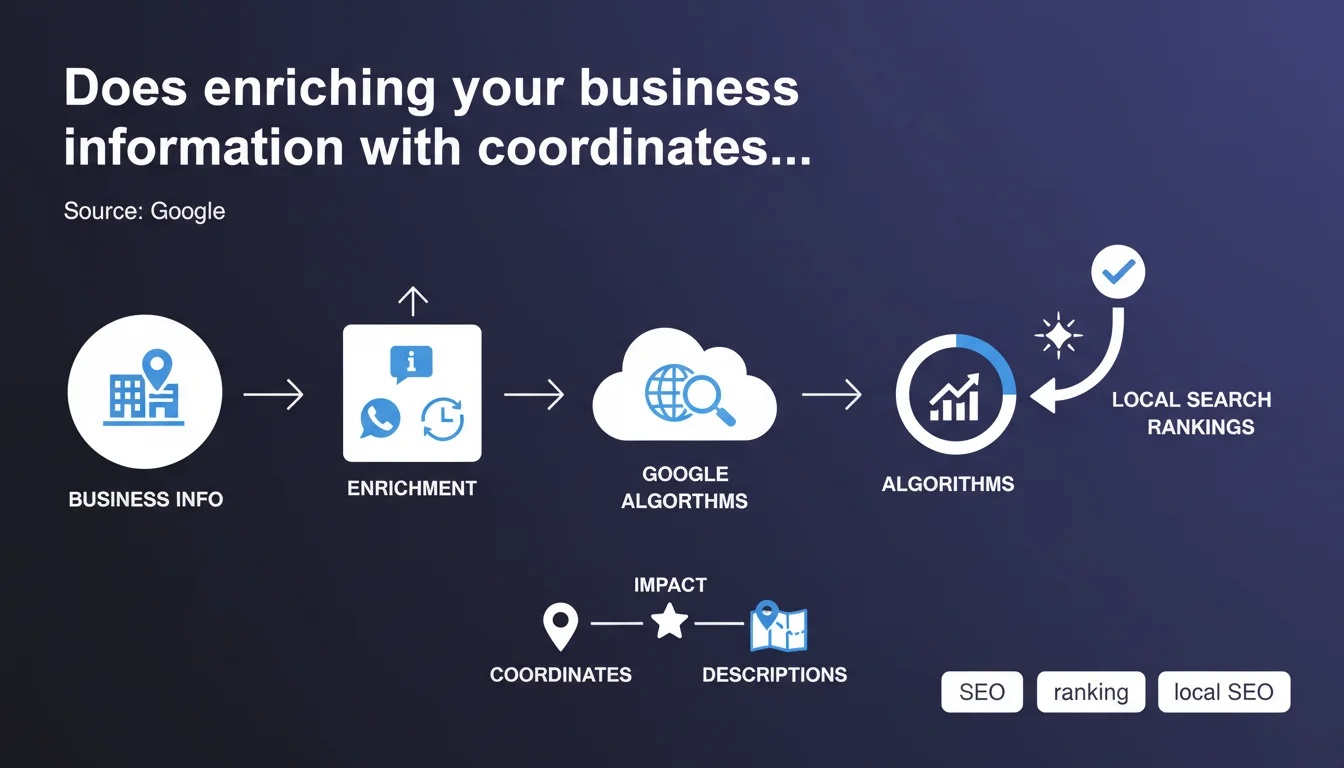
Google recommends enriching your business information with complete contact details, a detailed description of your activity, and for physical stores, locations with opening hours. This structured data directly feeds Google's semantic understanding and geolocation systems, impacting local visibility and click-through rates.
What you need to understand
Why does Google insist on this structured information?
The search engine no longer simply analyzes raw text content. It actively aggregates entity data to build its Knowledge Graph and understand your business within a precise geographic and sectoral context.
Contact details, descriptions, and opening hours directly feed rich results, Google Maps, and information panels displayed in local SERPs. Without these signals, your site remains invisible to queries with local intent.
What sources does Google use for this information?
Google draws from multiple sources: Schema.org LocalBusiness markup, your Google Business Profile, OpenGraph metadata, and even the visible content of your pages if other sources are missing.
Consistency across these channels matters. Discrepancies (different address on your website versus Google Business) create semantic confusion and dilute trust signals.
- Contact details must be marked up using Schema.org (LocalBusiness or Organization)
- Your business description must align with your Google Business Profile categories
- Structured opening hours (openingHours) improve display in SERPs
- NAP consistency (Name, Address, Phone) across all your digital properties remains a strong trust signal
What does Google mean by a "description of your activity"?
Not generic marketing copy. Google seeks a functional characterization: what do you sell, what services do you offer, in which geographic areas do you operate.
This description feeds sector categorization algorithms and matching with search intent. A good description mentions your trade, specialties, and territory — without unnecessary jargon.
SEO Expert opinion
Does this recommendation only apply to local brick-and-mortar businesses?
No, and that's where many get it wrong. Even pure-play e-commerce sites or SaaS publishers benefit from structuring their contact details and business description.
Google uses this information to build your business entity in its knowledge graph. This impacts branded queries, featured snippets in your sector, and even rich display in certain transactional search contexts.
Let's be honest: the impact is amplified for physical retail locations, but completely ignoring this signal when you operate online only means leaving money on the table.
Is Schema markup alone sufficient or should you also optimize visible content?
Both. Schema.org markup gives Google clean structured data that's easy for its systems to ingest. But visible content remains the reference in case of conflict or ambiguity.
I've observed cases where Google ignored properly formatted Schema LocalBusiness because the visible contact details in the footer differed. The engine favors consistency and information recurrence across multiple sources.
[To be verified] Google has never specified the exact weight it assigns to Schema versus visible content in case of divergence. Field tests show that human-visible information often takes priority, but this isn't systematic.
Does this directive hide a commercial logic?
Probably. By pushing companies to enrich their structured data and Google Business Profile, Google centralizes more information in its ecosystem — and reduces the need for users to visit third-party sites.
This is the classic zero-click search strategy: display the answer directly in the SERP. That said, ignoring this directive means cutting yourself off from qualified traffic. The game is worth the candle, even if you're feeding the beast.
Practical impact and recommendations
What should you concretely implement on your website?
Integrate Schema.org LocalBusiness markup (or Organization if no physical storefront) into the source code of your main pages — at minimum your homepage and contact page.
This markup must include: name, address (with streetAddress, addressLocality, postalCode, addressCountry), telephone, url, description, and openingHoursSpecification if applicable. Test validity with Google's Rich Results Test.
Display this same information visibly and legibly: structured footer, dedicated "Find Us" page, geolocated banner on the homepage for local businesses. Consistency between Schema and visible display is non-negotiable.
- Add Schema.org LocalBusiness or Organization with all relevant fields
- Verify NAP consistency across your website, Google Business Profile, directories, and social networks
- Write a factual business description of 150-250 words mentioning your trade and geographic zone
- Structure opening hours as openingHoursSpecification if applicable
- Test your markup in Google Rich Results Test and fix any errors
- Submit your sitemap to Google Search Console to accelerate indexing of changes
What mistakes should you absolutely avoid?
Don't invent a physical address if you don't have one. Google detects fake business domiciliations and can penalize your Business Profile listing, or even your site.
Avoid business descriptions packed with keywords or overly generic ("leading company in the field of…"). Google seeks functional precision, not corporate storytelling.
Don't neglect exceptional hours (holidays, temporary closures). A visitor who travels based on outdated information is a negative signal for Google — and a missed opportunity for you.
How do you verify that your implementation is working?
Use Google Search Console to monitor enhancements related to structured markup. The "Rich Results" section flags critical errors.
Perform branded and geolocalized searches to verify the information panel display. If your Google Business Profile appears with contact details, hours, and a link to your site, the signals are being captured correctly.
Regularly audit NAP consistency using tools like Moz Local or BrightLocal. Inconsistencies slip in quickly during migrations, address changes, or neglected updates.
❓ Frequently Asked Questions
Le balisage Schema LocalBusiness est-il obligatoire pour les sites sans magasin physique ?
Faut-il répéter les coordonnées sur toutes les pages du site ?
Que faire si j'ai plusieurs établissements avec des horaires différents ?
Google utilise-t-il ces données pour le SEO national ou uniquement local ?
Comment gérer les divergences entre Schema et Google Business Profile ?
🎥 From the same video 10
Other SEO insights extracted from this same Google Search Central video · published on 24/02/2022
🎥 Watch the full video on YouTube →
💬 Comments (0)
Be the first to comment.