
Official statement
Other statements from this video 10 ▾
- □ Is SEO really just about 'showing up in search results'?
- □ Why does Google keep emphasizing 'the right keywords' in SEO?
- □ Why does Google place such strong emphasis on practical information being displayed on websites?
- □ Does enriching your business information with coordinates and descriptions really impact local SEO rankings?
- □ Is your site losing Google Images traffic because of missing alt text?
- □ Why does Google place so much emphasis on descriptive keywords for product images?
- □ Does Google always penalize hidden text and deceptive content practices?
- □ Can Google really detect all ranking manipulation techniques?
- □ Is black hat SEO really a waste of time and money?
- □ Is Search Console really enough to manage your site's SEO effectively?
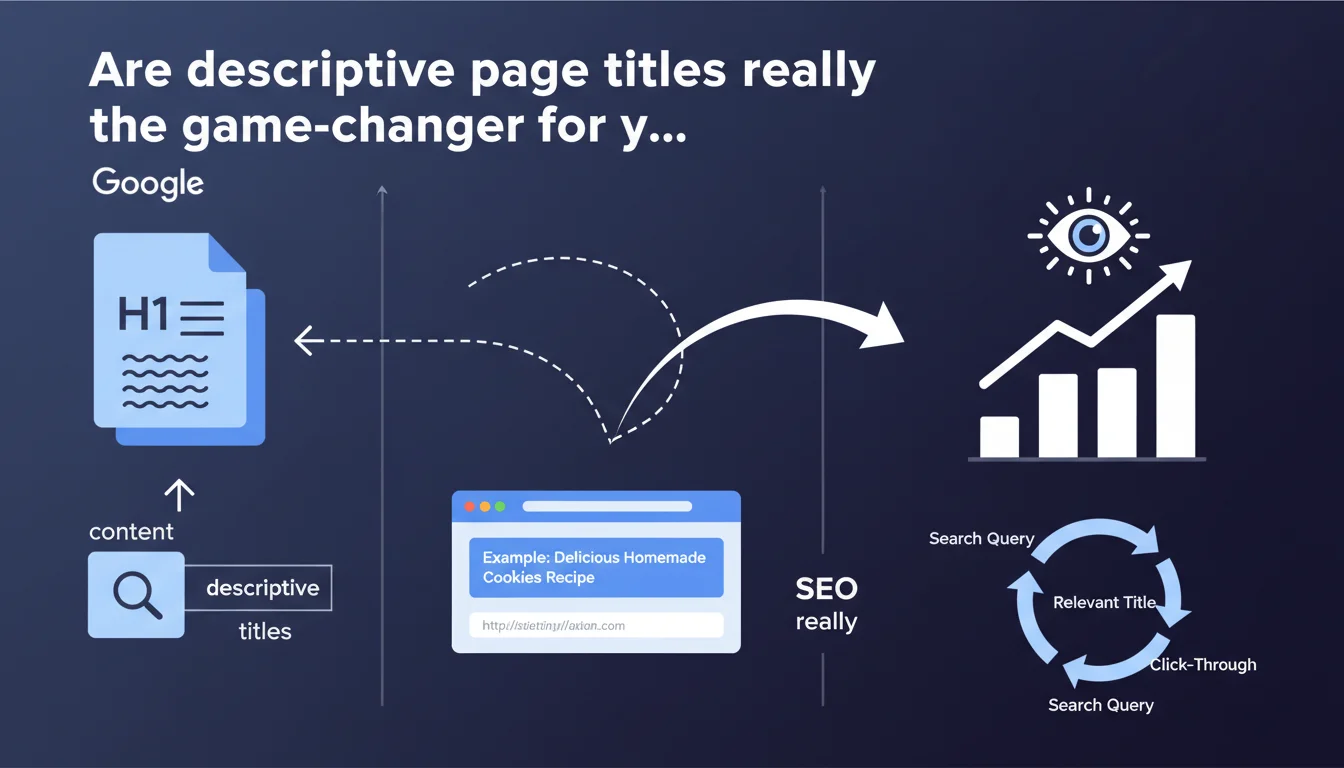
Google recommends creating descriptive page titles that clearly communicate the theme of your content. The title tag remains a major relevance signal, but Google may rewrite it if it doesn't match the user's search query. The challenge: finding the balance between SEO optimization and clarity for actual humans.
What you need to understand
Why does Google insist so much on descriptive titles?
The title tag fulfills two critical functions in Google's ecosystem. First, it serves as a relevance signal to understand the topic covered — a role it has played since the search engine's inception. Second, it becomes the primary interface between your content and the user in the SERPs.
But here's the catch: Google now rewrites over 60% of titles displayed in its search results. This statement therefore takes on a paradoxical dimension — Google asks you to write "useful" titles while reserving the right to modify them at will.
What does "descriptive and useful" actually mean in practice?
A descriptive title communicates the precise theme of the page without ambiguity. "Running shoes" vs. "Nike Air Zoom Pegasus 40: Full Review and Opinions" — the difference jumps out at you. Google is looking for titles that answer the implicit question: "What am I going to find on this page?"
The "useful" aspect goes further. It's about anticipating search intent and answering it in the title itself. A user searching "repair broken iPhone screen" will prefer "How to Repair a Broken iPhone Screen: Step-by-Step Guide" over "iPhone Repair | Professional Service".
What's the difference between the page title and H1 headings?
Google conflates two distinct elements here — the title tag (HTML metadata) and page headings (H1, H2, etc.). The title appears in the SERPs and the browser tab. The H1 structures the visible content of the page.
The algorithm uses both, but differently. The title carries more weight for initial ranking, while headings help understand the semantic structure of the content. Google can even use your H1 to rewrite your title if it deems it more relevant for a given query.
- Relevance signal: the title tag remains an important ranking factor, despite frequent rewrites
- Clarity first: avoid vague, generic, or keyword-stuffed titles without coherence
- Title/H1 consistency: Google uses both to understand and present your content
- User intent: the title should answer the question "Why click here instead of elsewhere?"
SEO Expert opinion
Is this statement consistent with what we observe in the field?
Yes and no. Google preaches descriptive simplicity, but the titles that perform best often incorporate persuasion elements: numbers, years, brackets, modifiers like "best" or "complete." The tension between "descriptive" and "optimized for CTR" definitely exists.
Let's be honest: a perfectly descriptive but bland title will generate mediocre CTR, which will ultimately negatively impact your ranking. Google tells you to be descriptive, but its algorithm rewards pages that get clicks. The paradox is right there.
What nuances should we add to this recommendation?
Google says nothing about the optimal length of a title. Tests show that a title between 50 and 60 characters avoids truncation in most cases, but this metric appears nowhere in their official documentation. [To verify]: no public data confirms that exceeding 60 characters penalizes ranking.
Another evasive point: Google mentions "page headings" without specifying their relative weight. Do H1, H2, and H3 all play the same role? Probably not, but the lack of granularity makes this statement barely actionable beyond basic principles.
Finally, the thorny question of automatic rewrites. Google modifies your titles when it determines they don't match the query, but the exact criteria remain fuzzy. I've seen perfectly descriptive titles rewritten, and mediocre titles left alone. The lack of control is frustrating.
In what cases does this rule become counterproductive?
On hyper-competitive commercial queries, a purely descriptive title condemns you to invisibility. "Car insurance" will never compete with "Car Insurance: Compare 50 Quotes in 2 Minutes (Free)." Google asks you to be descriptive, but the market forces you to be persuasive.
For multilingual sites or large e-commerce platforms, generating descriptive AND unique titles at scale becomes a technical nightmare. Automated patterns ("[Product] | [Category] | [Brand]") are descriptive but produce near-identical titles — something Google discourages anyway.
Practical impact and recommendations
What should you concretely do to optimize your page titles?
Start with an audit of your existing title tags. Use Screaming Frog or your preferred crawler to identify duplicate titles, too short (60 characters), or empty. These basic anomalies kill your visibility before the algorithm even kicks in.
Next, analyze the actual queries generating impressions (Google Search Console). Compare your titles with search intents. If you rank for "repair iPhone" but your title mentions "professional repair service," there's a disconnect — Google is looking for a tutorial, you're offering commercial service.
For each strategic page, build a title that incorporates: the primary keyword (ideally at the beginning of the title), a relevance modifier (guide, review, comparison, etc.), and if possible a differentiation element (year, number, benefit). Example: "SEO Title Tag: Complete Guide 2024 (12 Mistakes to Avoid)" vs. "Title SEO".
What mistakes should you absolutely avoid?
Keyword stuffing remains the number one mistake. "Cheap Car Insurance Car Insurance Quotes Auto Insurance Quote" — that kind of title will be rewritten by Google, and likely penalized. Repeating the same keyword adds nothing; synonymy works very well.
Also avoid identical generic titles on multiple pages. "Home | My Website" on 50 different URLs is a disaster. Each page has a unique topic — your title should reflect that uniqueness.
Watch out for excessive clickbait. "This SEO Trick Will EXPLODE Your Traffic (Experts Hate It)" may generate clicks, but if the content doesn't deliver on the promise, bounce rate skyrockets and Google adjusts your ranking downward. Title-content consistency isn't optional.
How can you verify that your titles meet Google's expectations?
Use Google Search Console to identify pages whose title has been rewritten. If Google systematically modifies your titles, it's a clear signal that they don't meet relevance or clarity criteria. Compare the version displayed in the SERPs with your HTML tag.
Test your titles with SERP simulation tools (Portent, Moz, etc.) to check for truncation. A cut-off title loses its impact and can generate disastrous CTR, even with good ranking.
Monitor CTR in Search Console. A descriptive but unengaging title will produce low CTR for its position. If you're ranking 3rd with a 2% CTR, your title has a problem — the average hovers around 8-10% for that position.
- Audit all title tags: identify duplicates, empty titles, too short or too long
- Incorporate the primary keyword at the beginning of the title, with a relevant modifier (guide, review, comparison)
- Verify consistency between title, H1, and actual page content
- Avoid keyword stuffing and unnecessary keyword repetition
- Test length (50-60 characters max) to prevent truncation in SERPs
- Analyze CTR by position in Search Console to detect underperforming titles
- Monitor automatic Google rewrites — a signal that your titles aren't descriptive enough
- Customize each title according to actual search intent (Search Console > Queries)
❓ Frequently Asked Questions
Quelle est la longueur idéale d'une balise title pour éviter la troncature dans Google ?
Google réécrit-il vraiment plus de 60% des titres de page ?
Faut-il mettre le même texte dans la balise title et le H1 ?
Le keyword stuffing dans les titres pénalise-t-il encore en SEO ?
Comment savoir si Google a réécrit mes titres de page ?
🎥 From the same video 10
Other SEO insights extracted from this same Google Search Central video · published on 24/02/2022
🎥 Watch the full video on YouTube →
💬 Comments (0)
Be the first to comment.