
Official statement
Other statements from this video 10 ▾
- □ Is SEO really just about 'showing up in search results'?
- □ Why does Google keep emphasizing 'the right keywords' in SEO?
- □ Are descriptive page titles really the game-changer for your SEO visibility?
- □ Does enriching your business information with coordinates and descriptions really impact local SEO rankings?
- □ Is your site losing Google Images traffic because of missing alt text?
- □ Why does Google place so much emphasis on descriptive keywords for product images?
- □ Does Google always penalize hidden text and deceptive content practices?
- □ Can Google really detect all ranking manipulation techniques?
- □ Is black hat SEO really a waste of time and money?
- □ Is Search Console really enough to manage your site's SEO effectively?
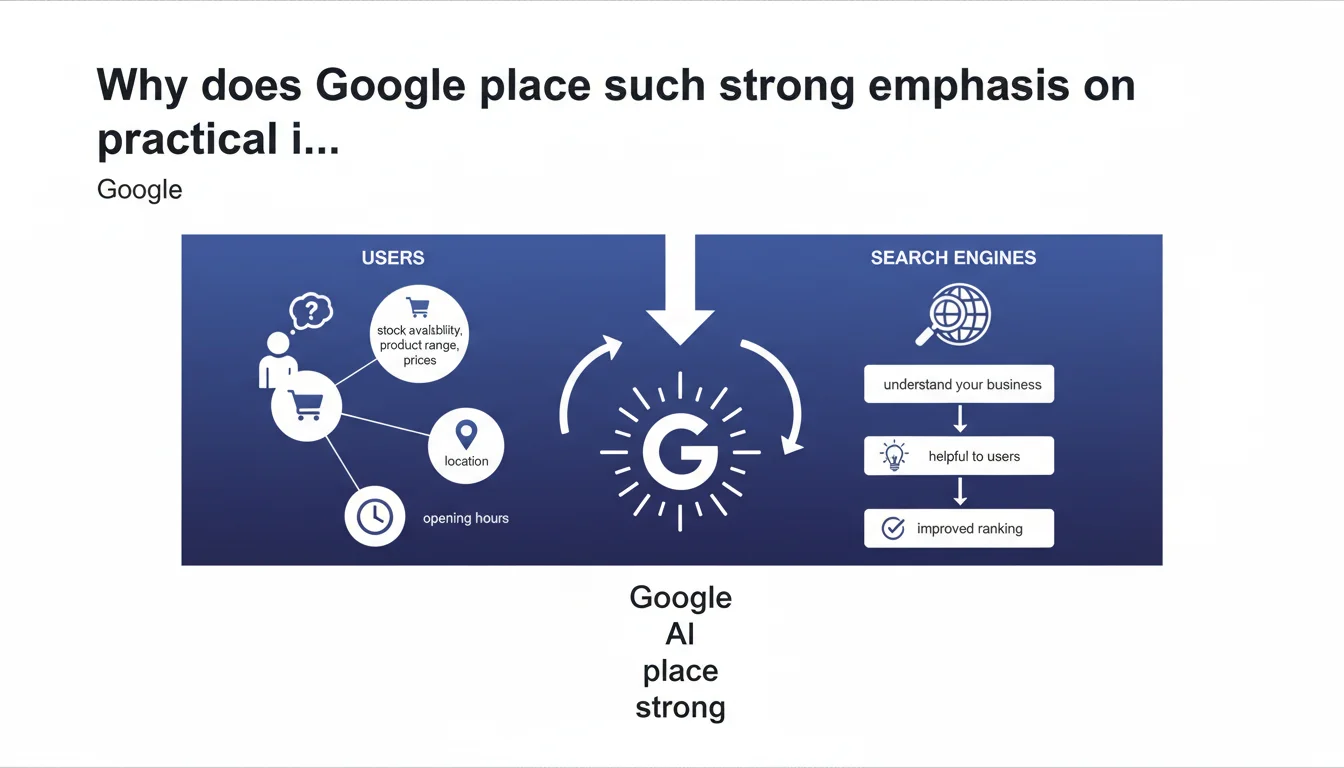
Google states that websites must display concrete information such as prices, inventory levels, opening hours, and locations to help both users and crawlers understand the business. This statement is primarily aimed at e-commerce sites and local businesses, whose visibility depends on the richness of these structured data. The message is clear: the more informative your site is based on factual criteria, the better Google can rank it.
What you need to understand
Does Google really talk about all types of websites?
No. This statement primarily targets e-commerce sites, local businesses, and service companies with a physical presence. A personal blog or online media obviously doesn't need to display opening hours.
Google is trying to push businesses to make their business data accessible, both for the user seeking a quick answer and for its own information extraction systems (Knowledge Graph, Google Shopping, Google Business Profile).
What is the logic behind this recommendation?
The search engine values sites that directly answer informational and transactional search intents. If an internet user searches for "Italian restaurant open Sunday," Google prefers to display a site where this information is clear rather than a competitor that forces users to navigate through multiple pages.
This approach also benefits featured snippets and rich results. The more structured and visible your data is, the more Google can extract it to enrich its own interfaces.
- Stock availability: decisive factor for e-commerce, prevents wasted clicks
- Displayed prices: required transparency, especially for Google Shopping
- Hours and location: essential for local SEO and Google Maps
- Product range: helps Google categorize your business precisely
Should this information simply be present or also be structured?
Both. Displaying "Open Monday to Friday" in a text block is good. Marking it up in Schema.org (LocalBusiness, OpeningHoursSpecification) is better.
Google can understand plain text through NLP, but structured data reduces ambiguity and increases your chances of appearing in rich results. Concretely, a site that combines readable text + Schema markup has a clear advantage.
SEO Expert opinion
Is this statement really applicable everywhere?
Let's be honest: it's common sense wrapped in corporate language. No one is going to argue that an e-commerce site shouldn't display its prices. The problem is that Google presents this as a general recommendation when it really applies mainly to certain sectors.
For a B2B SaaS site, displaying prices can be counterproductive (complex pricing strategy, personalized quotes). For a media outlet, a "product range" makes no sense. This statement lacks contextual nuance. [To be verified]: Does Google actually penalize the absence of this information, or does it simply not boost those who display it?
Do we observe a direct ranking impact from this information?
Yes and no. Field tests show that sites with complete structured data get more rich snippets, thus more clicks, thus indirectly better positioning through behavioral signals.
But correlation is not causation. A site that clearly displays its hours and prices is often also a better-designed site, better maintained, with better UX. It's difficult to isolate the pure effect of "useful information" from everything else. What we know: Google Business Profile clearly favors complete listings. For standard organic SEO, the effect is more diffuse.
What pitfalls should be avoided when applying this guideline?
First pitfall: information overload. Burying users under complex price tables or unnecessary details degrades experience. Google wants useful info, not an indigestible catalog.
Second pitfall: outdated data. Displaying expired hours or incorrect inventory is worse than displaying nothing. Google detects inconsistencies between your site and your other properties (GMB, social media) and may penalize you for lack of reliability.
Practical impact and recommendations
What should you do concretely to comply?
First, audit the main pages of your site (homepage, categories, product pages, service pages) to identify missing information. If you're a local business, verify that each contact page displays address, phone number, and hours.
Next, implement appropriate Schema.org markup: LocalBusiness for physical stores, Product for product pages (with offers including price and availability), Organization for the company page. Use Google's structured data validation tool to check syntax.
- Display price, availability, and delivery times on all product pages
- Add complete address, clickable phone number, and hours on each contact page
- Mark up this information in Schema.org (Product, Offer, LocalBusiness, OpeningHours)
- Synchronize data between your site, Google Business Profile, and social media
- Create product/service FAQ with FAQPage markup to capture featured snippets
- Auto-update inventory if possible (real-time feed for e-commerce)
- Test mobile display: this info must be visible without excessive scrolling
How can you verify that your site properly follows this recommendation?
Use Google Search Console to identify structured data errors. Also check the "Page Experience" report: a slow or poorly mobile-optimized site cancels the benefits of displayed information.
Test your pages with Google's Rich Results Test tool. If your products or services don't appear in rich snippets despite markup, investigate: syntax issue, duplicate content, or simply too much competition for the query.
What errors must be avoided at all costs?
Never display different prices between the Schema markup and visible content. Google considers this cloaking and may penalize you severely.
Also avoid leaving sections as "Coming soon" or "Contact us for pricing" on strategic pages. If you can't display the price (B2B on quote basis), explain why clearly and offer an optimized contact form.
In summary: transparency, structure, consistency. Display the information your users are looking for, mark it up properly, keep it up to date. These optimizations may seem simple in theory, but their technical implementation — especially at scale or on complex CMS — requires pointed expertise. If your team lacks resources or structured data skills, considering support from a specialized SEO agency could save you valuable time and prevent costly mistakes.
❓ Frequently Asked Questions
Est-ce que Google pénalise les sites qui n'affichent pas leurs prix ?
Les données structurées sont-elles obligatoires ou le texte brut suffit-il ?
Comment gérer les informations variables comme les stocks en temps réel ?
Cette recommandation s'applique-t-elle aux sites B2B sans tarif public ?
Quelle différence entre les infos sur le site et celles dans Google Business Profile ?
🎥 From the same video 10
Other SEO insights extracted from this same Google Search Central video · published on 24/02/2022
🎥 Watch the full video on YouTube →
💬 Comments (0)
Be the first to comment.