
Official statement
Other statements from this video 10 ▾
- □ Is SEO really just about 'showing up in search results'?
- □ Why does Google keep emphasizing 'the right keywords' in SEO?
- □ Why does Google place such strong emphasis on practical information being displayed on websites?
- □ Are descriptive page titles really the game-changer for your SEO visibility?
- □ Does enriching your business information with coordinates and descriptions really impact local SEO rankings?
- □ Is your site losing Google Images traffic because of missing alt text?
- □ Why does Google place so much emphasis on descriptive keywords for product images?
- □ Does Google always penalize hidden text and deceptive content practices?
- □ Can Google really detect all ranking manipulation techniques?
- □ Is black hat SEO really a waste of time and money?
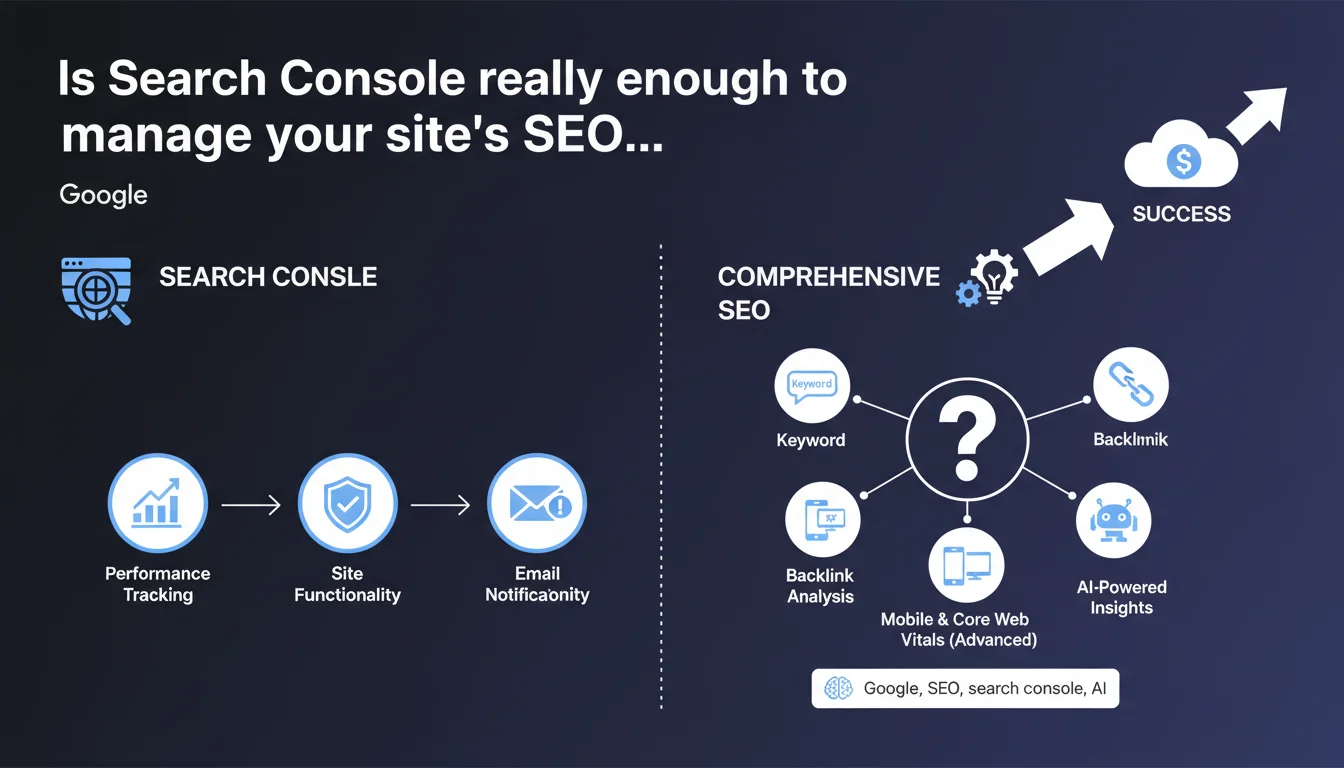
Google presents Search Console as the essential free tool for managing your SEO: performance tracking, technical issue detection, email notifications. A narrative that significantly oversimplifies the reality of the profession and reduces SEO to basic monitoring.
What you need to understand
Google positions Search Console as the central solution for managing a site's search rankings. The tool allows you to track organic performance, verify technical functionality, and receive alerts in case of issues.
This presentation reflects Google's desire to democratize access to search data. But it obscures the true complexity of modern SEO.
What does Search Console really cover?
The tool centralizes crawl, indexation, and organic performance data. You'll find 404 errors, structured data markup issues, mobile usability problems, Core Web Vitals, and queries driving traffic.
Concretely, Search Console diagnoses — it doesn't fix anything. It signals that a page returns a 404, but doesn't tell you why or how to restructure your internal linking to compensate.
Why is this presentation reductive?
Presenting Search Console as sufficient to "manage SEO" is like saying a thermometer is enough to cure a disease. The tool measures symptoms, not root causes.
A site can display zero errors in GSC and still suffer from keyword cannibalization, incoherent architecture, weak content, or a non-existent linking strategy. None of this appears in standard reports.
What are the essential points to remember?
- Search Console is a diagnostic tool, not a complete SEO solution
- It detects technical problems visible to Google, not strategic weaknesses
- Email notifications are useful for quick responses, but don't replace regular audits
- The interface prioritizes Google metrics (impressions, CTR) over business vision
- Many critical SEO issues completely escape the tool
SEO Expert opinion
Does this statement reflect real-world reality?
Partially. Search Console is indeed essential — no serious practitioner does without it. But claiming it "helps manage SEO" is marketing shorthand.
In the field, GSC represents roughly 15-20% of data exploited during a complete SEO audit. The rest comes from third-party tools (Screaming Frog, Ahrefs, Semrush), server log analysis, JavaScript rendering tests, competitor research, and SERP semantic analysis.
What nuances should be clarified?
Google doesn't mention the structural limitations of the tool. Query data is sampled beyond a certain threshold, anonymized clicks disappear from reports, CSV exports cap at 1000 rows.
Coverage reports signal pages "discovered but not crawled" without explaining why — insufficient crawl budget, excessive depth, low authority of parent pages? Impossible to determine via GSC alone. [To verify]: Google suggests that registration alone suffices to "track performance," but without proper property validation and regional parameter configuration, data is biased.
In which cases is this tool insufficient?
As soon as you exceed a 20-page brochure site. On an e-commerce with thousands of URLs, GSC won't tell you which categories suffer from internal duplicate content, or why your product pages are losing positions against Amazon.
For heavy JavaScript sites (React, Vue, Angular), GSC sometimes displays correct rendering while content arrives too late to be valued. Server-side testing and rendering budget analysis become critical.
Practical impact and recommendations
What should you concretely do with Search Console?
Integrate GSC into a monitoring workflow, not as your sole tool. Configure email notifications to be alerted of spikes in 5xx errors, sudden drops in indexation, or manual penalties.
Systematically cross-reference GSC data with your server logs. A page flagged as crawled by Google but absent from logs often reveals a configuration issue (aggressive CDN caching, unintended blocking).
What mistakes should you avoid?
Don't treat all GSC alerts with equal priority. An orphaned page returning 404 that never generated traffic doesn't merit the same treatment as a strategic landing page suddenly deindexed.
Avoid manually submitting URLs via the inspection tool. If Google doesn't naturally crawl your content, your architecture or internal linking has an issue — fix the cause rather than the symptom.
How do you verify your configuration is optimal?
- Validate site ownership via multiple methods (DNS, HTML tag, Google Tag Manager) to prevent loss of access
- Configure regional parameters and geographic targeting if relevant
- Link Search Console to Google Analytics 4 to enrich behavioral analysis
- Segment data by page type (categories, product sheets, blog) to identify friction areas
- Automate export of critical reports (coverage, Core Web Vitals, links) via the API to maintain long-term history
- Compare indexed URLs in GSC with those in your XML sitemap to detect gaps
- Monitor CTR trends by average position: a CTR drop at stable position often reveals a title tag or rich snippet problem
Search Console remains a foundational tool, but it doesn't replace a structured SEO strategy or in-depth technical analysis. High-stakes sites require an ecosystem of tools and expertise that far exceeds GSC's scope.
Faced with growing algorithm complexity and multiplying ranking signals, orchestrating a coherent SEO strategy demands time, cross-functional skills, and constant monitoring. If your team lacks resources or business stakes justify reinforced support, engaging a specialized SEO agency allows you to structure this approach and avoid blind spots that cost dearly long-term.
❓ Frequently Asked Questions
Search Console remplace-t-il les outils SEO payants comme Ahrefs ou Semrush ?
Les données de requêtes dans Search Console sont-elles complètes ?
Faut-il obligatoirement avoir un compte Search Console pour être référencé ?
Les notifications par email de Search Console sont-elles fiables ?
Peut-on se fier aux données de Core Web Vitals dans Search Console ?
🎥 From the same video 10
Other SEO insights extracted from this same Google Search Central video · published on 24/02/2022
🎥 Watch the full video on YouTube →
💬 Comments (0)
Be the first to comment.