
Official statement
Other statements from this video 11 ▾
- □ Should you prioritize low-ranking queries with high CTR to maximize your organic traffic growth?
- □ Should you really focus on improving queries you're already ranking for instead of chasing new keywords?
- □ Should you really ignore traffic-generating queries that don't match your business?
- □ Are structured data really stealing your clicks from the top position?
- □ Why are your competitors stealing clicks from you in the SERPs?
- □ Why does Google emphasize the precision of title tags, meta descriptions, and ALT attributes so much?
- □ Do header tags really help Google understand and rank your content better?
- □ Does structured data really guarantee access to rich results?
- □ Should you really leverage related keywords to expand your keyword strategy?
- □ Can Google Trends really uncover SEO opportunities before your competitors do?
- □ Why is a top ranking with low CTR not necessarily a problem?
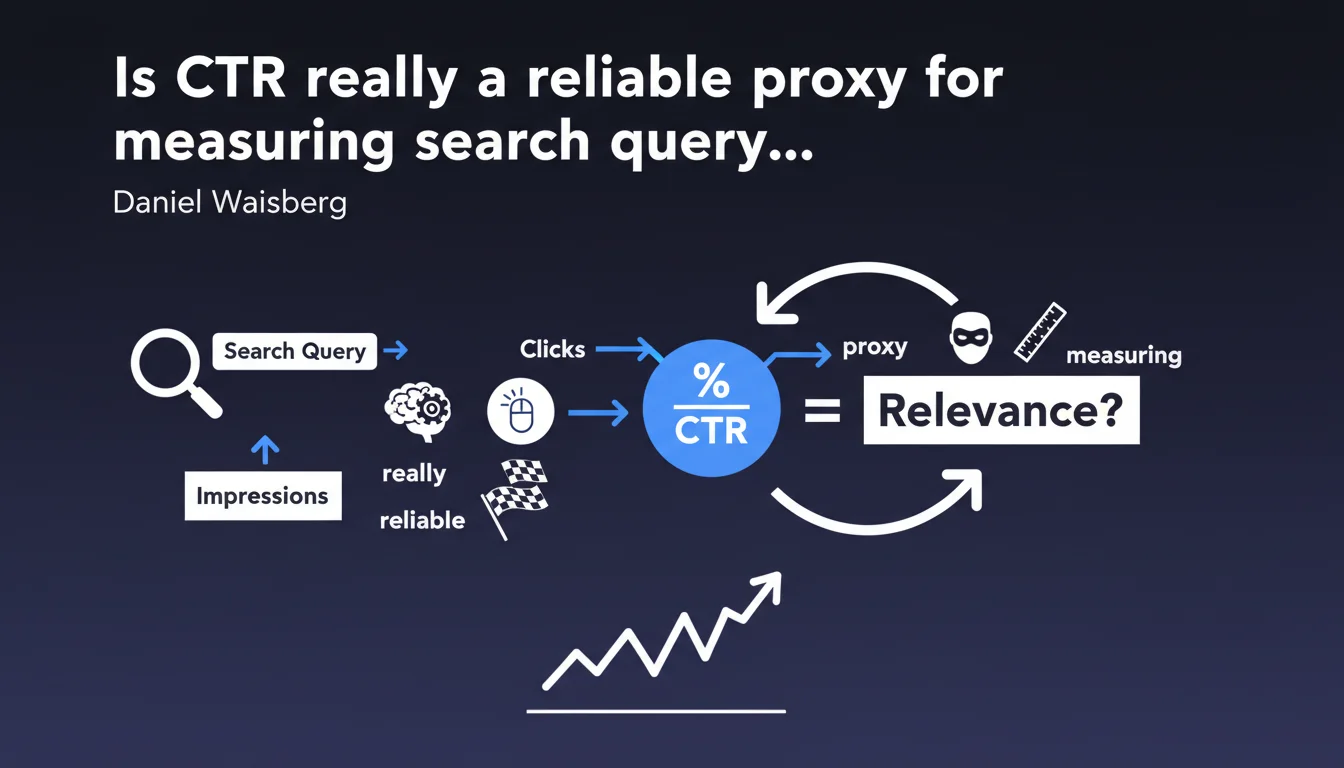
Google states that CTR (clicks/impressions) measures the relevance of a query for users in the SERPs. This official statement confirms that click-through rate serves as an indicator — a "proxy" — to evaluate whether a result effectively answers the search intent. In practical terms, optimizing your snippets to increase CTR isn't just about driving traffic: it's a quality signal that Google takes into account.
What you need to understand
What exactly does "relevance proxy" mean?
A proxy is an indirect indicator. Google can't read users' minds to know if a result is relevant — but it can observe their behavior. If a result displays a high CTR, it means users find it attractive and likely relevant to their search intent.
This statement positions CTR as a behavioral indicator used by Google to refine search results relevance. It's not the only signal, but it's a measurable and actionable signal from the search engine's perspective.
Does CTR directly influence rankings?
The official wording remains cautious: CTR is an indicator, not explicitly a ranking factor. But if Google uses it as a relevance proxy, it would make sense for it to intervene in some way in the algorithm — if only to test result variations.
Systems like Google's continuous A/B testing on SERPs rely on this type of metric. A result that performs better with clicks can be interpreted as more relevant, which influences future adjustments.
Why this official statement now?
Google rarely communicates this directly about behavioral metrics. This official validation of CTR as a relevance proxy legitimizes its use by SEO professionals to evaluate their content performance in the SERPs.
It's also a way for Google to reframe the debate: CTR isn't a manipulation game, it's a reflection of user satisfaction. If your snippet attracts clicks, it means it meets a real user expectation.
- CTR measures the attractiveness of a result in the SERPs for a given query
- Google uses it as an indirect indicator of user relevance
- It's not officially confirmed as a direct ranking factor, but its role in optimizing SERPs is proven
- A good CTR reflects a match between the snippet and search intent
- This metric is accessible via Google Search Console and should be actively monitored
SEO Expert opinion
Is this statement consistent with field observations?
Yes — and that's exactly what makes it interesting. For years, A/B tests on title tags and meta descriptions have shown that improving CTR often leads to ranking gains in the medium term. This official statement confirms what practitioners have been observing empirically.
But be careful: correlation is not causation. A good CTR can be the symptom of relevant content, which in turn generates other positive signals (session duration, low bounce rate, natural backlinks). CTR is a proxy, not an isolated cause.
What nuances should we consider?
CTR only makes sense when contextualized by query and position. A 5% CTR in position 1 is catastrophic; the same CTR in position 8 is excellent. Google Search Console understands this and calculates this data by average position — but Waisberg's statement remains vague about how Google normalizes this signal.
[To be verified]: Does Google use absolute CTR, CTR relative to expected position, or CTR adjusted by vertical/intent? The answer changes everything. High CTR on a transactional query doesn't have the same value as high CTR on a long-tail informational query.
Can CTR be manipulated — and does Google protect against it?
Yes, CTR can be artificially inflated (clickbait, excessive emojis, misleading titles). Google knows this and has anti-manipulation filters: if a result shows an abnormally high CTR but a disastrous bounce rate, the relevance signal reverses.
Tests show that artificial CTR gains are temporary. In the long run, only the actual match between snippet and content generates a lasting advantage. Google continuously adjusts its algorithms to detect behavioral anomalies.
Practical impact and recommendations
What should you concretely optimize to improve your CTR?
The title tag remains the primary lever: it must contain your target query, a clear user benefit, and a differentiating element (number, year, unique angle). The meta description, while not used for ranking, directly influences CTR and should include an explicit call-to-action.
Rich snippets (review stars, price, FAQ, recipes) mechanically increase CTR by occupying more visual space in the SERPs. Implementing Schema.org structured data becomes a prerequisite to stay competitive on high-competition queries.
How to measure and track CTR impact?
Google Search Console provides CTR by query, page, and position. Segment your data: isolate queries in positions 1-3 with CTR below 20% — these are your priority optimization opportunities.
Compare your CTR to observed averages by position (studies from Advanced Web Ranking or Sistrix provide benchmarks). If you're in position 3 with 5% CTR when the average is 10%, your snippet is underperforming.
What mistakes should you avoid when optimizing for CTR?
Never sacrifice snippet truthfulness for CTR. A clickbait title may generate clicks, but if content disappoints, pogo-sticking (rapid return to SERPs) will send a negative signal to Google.
Also avoid optimizing CTR in isolation without considering the complete user journey. High CTR on a page that doesn't convert or retain users is a business failure — and eventually, an ambiguous signal for Google.
- Audit your title tags and meta descriptions via Search Console to identify pages with low CTR despite good positioning
- Implement relevant Schema.org structured data (FAQ, Review, Product, Recipe) to generate rich snippets
- Test title variants with numbers, years, brackets [Complete Guide] or power words (Free, Comparison, Best)
- Segment your GSC data by position to compare your CTR against industry benchmarks
- Monitor bounce rate and session duration: good CTR with poor post-click engagement is a red flag
- Verify that your SERP snippets match the actual intent of the query (informational vs transactional)
- Avoid excessive emojis or misleading titles that artificially boost CTR but degrade user experience
❓ Frequently Asked Questions
Le CTR est-il un facteur de ranking direct dans l'algorithme Google ?
Quel est le CTR moyen attendu par position dans les SERP ?
Comment améliorer le CTR sans tomber dans le clickbait ?
Le CTR a-t-il le même poids sur toutes les requêtes ?
Peut-on mesurer l'impact d'une optimisation CTR sur le ranking ?
🎥 From the same video 11
Other SEO insights extracted from this same Google Search Central video · published on 13/04/2023
🎥 Watch the full video on YouTube →
💬 Comments (0)
Be the first to comment.