
Official statement
Other statements from this video 11 ▾
- □ Is CTR really a reliable proxy for measuring search query relevance?
- □ Should you prioritize low-ranking queries with high CTR to maximize your organic traffic growth?
- □ Should you really focus on improving queries you're already ranking for instead of chasing new keywords?
- □ Should you really ignore traffic-generating queries that don't match your business?
- □ Are structured data really stealing your clicks from the top position?
- □ Why are your competitors stealing clicks from you in the SERPs?
- □ Why does Google emphasize the precision of title tags, meta descriptions, and ALT attributes so much?
- □ Do header tags really help Google understand and rank your content better?
- □ Does structured data really guarantee access to rich results?
- □ Can Google Trends really uncover SEO opportunities before your competitors do?
- □ Why is a top ranking with low CTR not necessarily a problem?
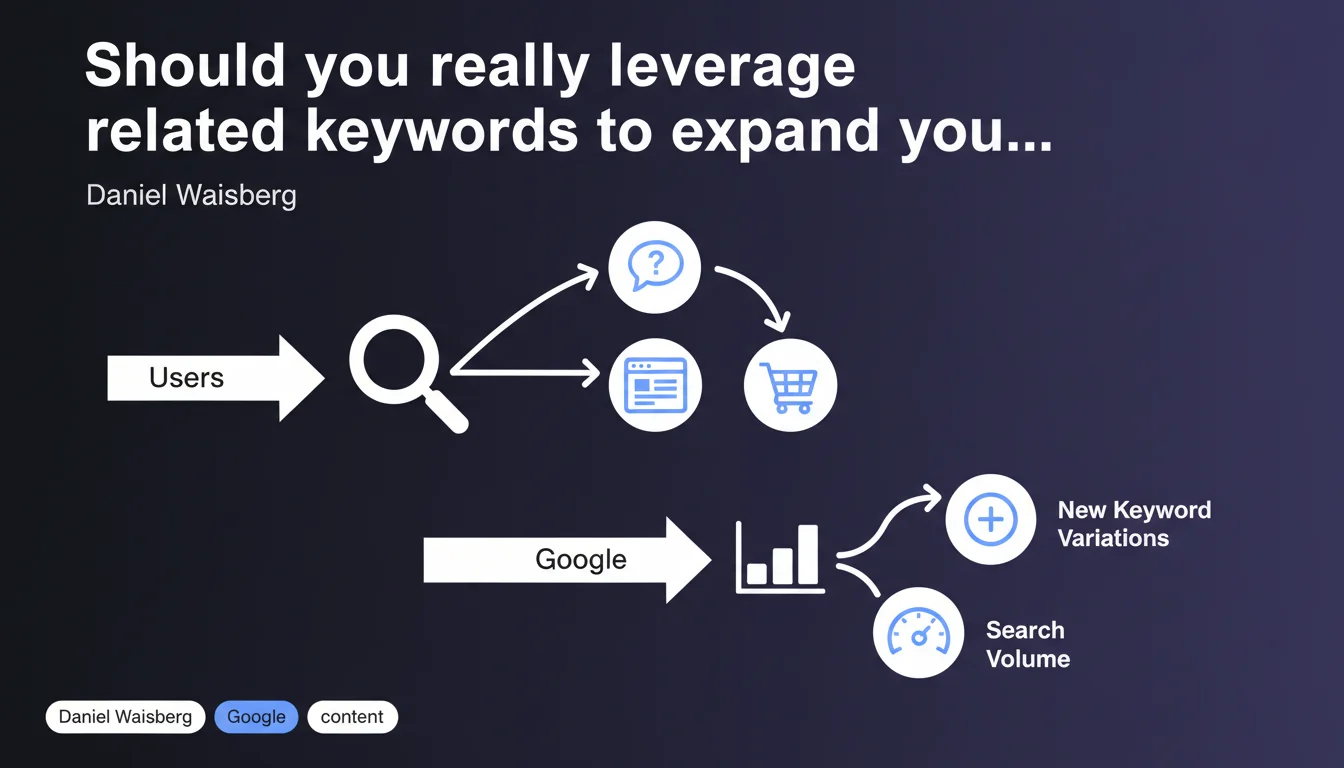
Google recommends exploring related keywords to enrich your keyword strategy. The Keyword Planner tool is suggested to discover variations and estimate search volume. The advice remains generic — nothing new for an experienced SEO professional.
What you need to understand
What does Google mean by "related keywords"?
Google is talking about expanded semantics here: synonyms, associated terms, reformulations that users might use to search for the same content. The idea is not to stick to a single keyword formulation, but to think about the entire lexical field surrounding a topic.
Concretely? If you're targeting "SEO agency," also think about "search engine consultant," "Google expert," "search engine optimization." Google's algorithm — particularly through BERT and MUM — understands these nuances and rewards content that covers a topic comprehensively.
Is Keyword Planner the ideal tool for this?
It's the tool Google promotes, which makes sense. It allows you to see keyword variations and approximate search volume. But — let's be honest — it's not the most sophisticated tool for advanced semantic analysis.
Keyword Planner remains oriented toward Google Ads: the volumes displayed are estimates, often rounded, and the tool favors terms with high advertising volume. For in-depth SEO analysis, other tools (Semrush, Ahrefs, Sistrix) offer more granular data.
Why this recommendation now?
Because Google has been pushing for years toward semantic understanding of content rather than keyword stuffing. This statement is part of that continuity: covering a topic broadly, with lexical richness, rather than endlessly repeating the same exact term.
- Related keywords enrich the semantic field of your page.
- Google rewards depth of topic treatment.
- Keyword Planner is a starting point, not a complete solution.
- Think about varied search intentions around a central theme.
SEO Expert opinion
Is this recommendation really new?
No. It's a basic SEO practice for at least a decade. Any serious practitioner already does semantic research and explores keyword variations. Google is just rephrasing obvious advice.
The statement remains very vague: no concrete examples, no metrics, no indication of how Google evaluates this "semantic richness." It's generic advice, lacking technical depth.
Is Keyword Planner enough to identify the right related keywords?
Frankly, no. The tool provides starting ideas, certainly. But it severely lacks semantic context: it doesn't tell you which terms are truly relevant to your audience, or how they relate to each other.
For a solid semantic strategy, you need to cross-reference multiple sources: SERP analysis, Search Console data, semantic clustering, competitor analysis. Keyword Planner alone is beginner-level.
What nuances should be added?
Google's recommendation implies that more related keywords = better ranking. That's false. What matters is contextual relevance: using related terms that strengthen topic understanding, not forcing them in artificially to "boost volume."
If you're tackling a very niche topic, the number of relevant related keywords will be limited. Forcing lexical diversity can dilute your message and harm clarity. The goal isn't to maximize lexical variety, but to precisely answer the search intent.
Practical impact and recommendations
What should you do concretely?
First, map the semantic field around your primary keywords. Use multiple tools: Keyword Planner for a foundation, specialized SEO tools to refine, Search Console to see what's already working.
Next, analyze the SERPs: what formulations do well-ranking competitors use? Which terms appear in featured snippets, People Also Ask sections? These clues reveal the vocabulary Google associates with your topic.
What mistakes should you avoid?
Don't fall into the semantic stuffing trap: cramming every possible related keyword into a paragraph won't make your content better. On the contrary, it can harm readability and user experience.
Another common mistake: relying solely on Keyword Planner without verifying the actual relevance of suggested terms. The tool sometimes proposes variants that are too broad, off-topic, or advertising-oriented rather than organic SEO focused.
How do you verify your semantic strategy is working?
- Check in Search Console whether your page ranks for keyword variations (long-tail).
- Analyze click-through rates: good semantic alignment attracts varied searches, thus broadens your audience.
- Compare your lexical field to well-ranking competitors (tools like Surfer SEO, Clearscope).
- Test your content's readability: a human reader should find the text natural, not forced.
- Monitor the evolution of your rankings on identified related keywords.
❓ Frequently Asked Questions
Le Keyword Planner de Google Ads est-il gratuit ?
Les mots connexes doivent-ils tous apparaître dans le même paragraphe ?
Faut-il utiliser les mots connexes dans les balises title et meta description ?
Les mots connexes influencent-ils directement le classement ?
Peut-on remplacer le Keyword Planner par d'autres outils SEO ?
🎥 From the same video 11
Other SEO insights extracted from this same Google Search Central video · published on 13/04/2023
🎥 Watch the full video on YouTube →
💬 Comments (0)
Be the first to comment.