
Official statement
Other statements from this video 11 ▾
- □ Le CTR est-il vraiment un proxy fiable de la pertinence d'une requête ?
- □ Faut-il vraiment prioriser les requêtes déjà classées plutôt que de viser de nouveaux mots-clés ?
- □ Faut-il vraiment ignorer les requêtes non pertinentes qui génèrent du trafic ?
- □ Les données structurées volent-elles vraiment vos clics en première position ?
- □ Pourquoi vos concurrents captent-ils plus de clics que vous en SERP ?
- □ Pourquoi Google insiste-t-il autant sur la précision des balises title, meta descriptions et attributs ALT ?
- □ Les balises d'en-tête structurent-elles vraiment mieux le contenu pour Google ?
- □ Les données structurées garantissent-elles vraiment l'accès aux résultats enrichis ?
- □ Faut-il vraiment s'appuyer sur les mots connexes pour élargir sa stratégie de mots-clés ?
- □ Google Trends peut-il vraiment identifier les opportunités SEO avant vos concurrents ?
- □ Pourquoi un bon classement avec un faible CTR n'est-il pas forcément un problème ?
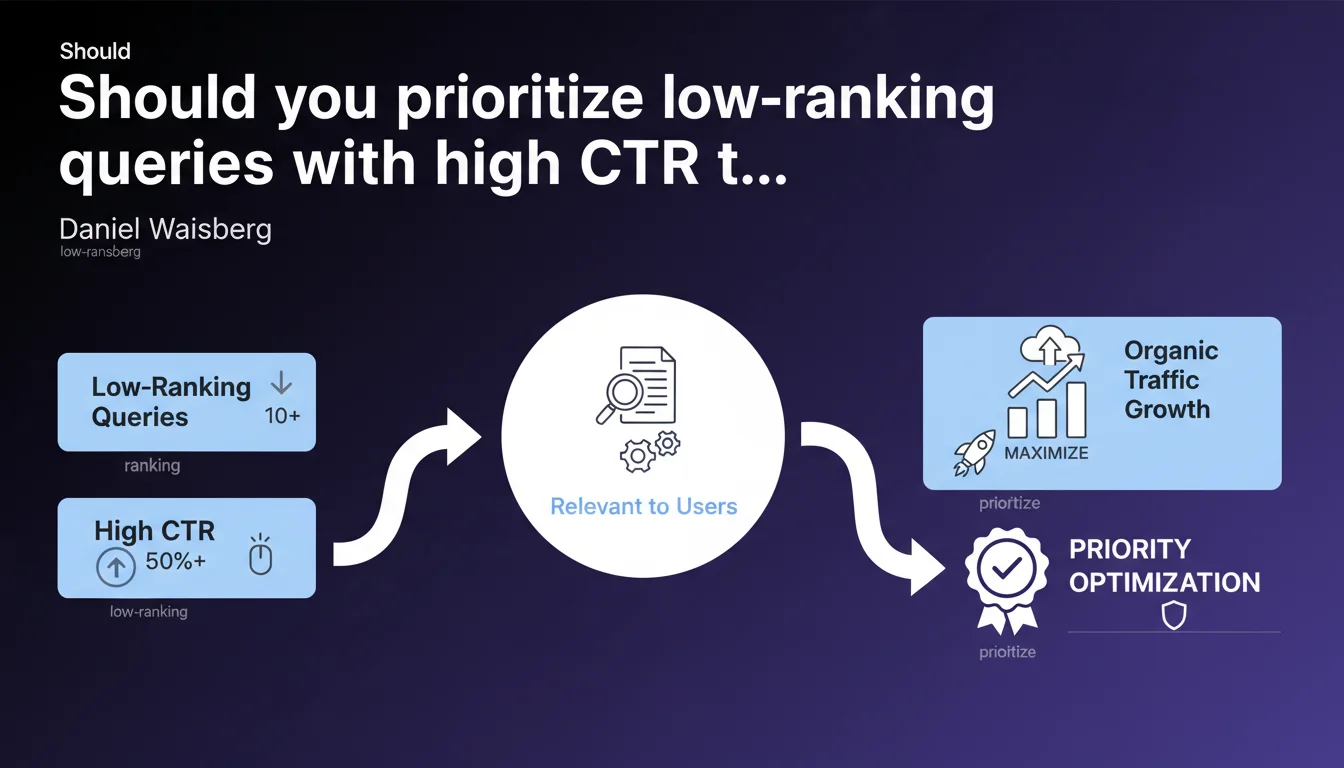
Google confirms that queries displaying high CTR despite low ranking position reveal strong perceived relevance by users. Improving their ranking should generate significant traffic, making them priority optimization opportunities. The challenge is identifying these queries in Search Console and acting on the right levers.
What you need to understand
Why is high CTR in low position such a strong signal?
An unusually high CTR for a position on the second or third page of results indicates that users recognize the relevance of your page in the SERP. They click more than the average expected for that position — which signals that your title and meta description resonate with search intent.
This statistical anomaly reveals a gap between what Google evaluates (current position) and what users are actually searching for. Your content appears to answer an unmet need not satisfied by better-ranked results.
How does Google interpret this signal in its algorithm?
Google has never officially confirmed that CTR is a direct ranking factor. However, Waisberg suggests here that these queries deserve attention — not necessarily because CTR will influence ranking, but because they reveal untapped traffic potential.
Position improvement through classic optimizations (content, links, technical) will transform this high CTR into actual click volume. It's an opportunity arbitrage, not an algorithmic promise.
What is the methodology for identifying these queries?
In Google Search Console, filter queries by average position (e.g., 11-50) then sort by descending CTR. You're looking for outliers — queries ranking 15-20 with 2-5% CTR, where the average would be under 1%.
Always compare observed CTR with CTR curve benchmarks by position (Advanced Web Ranking, Sistrix). A query at position 18 with 3% CTR massively outperforms the norm.
- High CTR in low position signals strong perceived relevance by users
- This is not proof that CTR influences ranking, but an indicator of traffic opportunity
- Identifying these queries requires Search Console filtering combined with CTR benchmark analysis
- The goal is to capitalize on existing demand by improving classic ranking
SEO Expert opinion
Is this statement consistent with field observations?
Yes, completely. We regularly observe long-tail or highly specific queries displaying aberrant CTR at positions 8-15. Often, it's the title that captures attention — a unique phrasing, a different angle, or a precise answer that top 5 results don't offer.
But be careful: [To verify] — Waisberg doesn't specify whether these position improvements should come via on-page optimization, link building, or user experience improvement. The correlation between high CTR and ranking potential is not an established causality. Google might simply be saying "this page interests people, so if it naturally rises, traffic will explode".
In what cases does this rule not apply?
If the high CTR comes from clickbait or misleading titles, improving position will only amplify a bounce rate problem. Google will eventually correct course. Similarly, some queries display high CTR because your brand is well-known — it's not a generic relevance signal, but a notoriety signal.
Another case: queries with near-zero volume. A 10% CTR on 20 monthly impressions remains anecdotal. Prioritizing these queries over opportunities with real volume would be a resource allocation error.
What nuances should be added to this recommendation?
Waisberg talks about optimization, but doesn't say how. Improving a position from page 2-3 often requires quality link building, not just content. If the query is competitive, high CTR alone won't be enough — you'll need to address classic ranking signals.
Second nuance: some SERPs are saturated with featured snippets, People Also Ask boxes, or carousels. High CTR at position 8 may simply reflect that the user scrolled past these elements. The traffic potential at position 3-5 will then be limited by the SERP structure itself.
Practical impact and recommendations
How do you concretely identify these queries in Search Console?
Export query performance data over 12 months (to smooth seasonality). Create a custom filter: average position between 10 and 50, minimum CTR 1.5%. Sort by descending impressions to eliminate ultra-long-tail query noise.
Next, compare each CTR with reference curves (e.g., position 15 should display ~0.6% CTR according to Advanced Web Ranking). Anything exceeding 2x the norm deserves investigation. Note the affected URLs and search intents.
Which optimization actions should you launch first?
Start with on-page analysis: does the page truly answer the intent? If yes, enrich the content — add missing sections, add data and figures, include visuals. Optimize heading tags for better structure.
Next, address link building. A position 12-18 with high CTR often signals a lack of authority. Identify better-ranked competitor pages, analyze their link profile, and target similar backlinks. Prioritize quality over quantity.
Finally, monitor Core Web Vitals and mobile experience. If your page loads slowly or displays poorly on mobile, even good CTR won't compensate for negative UX signals.
What errors should you avoid in this approach?
Don't over-optimize the title to boost CTR further if position doesn't follow — you risk intent/content misalignment and catastrophic bounce rate. Google will then adjust the position downward.
Another error: neglecting SERP context. If positions 1-3 are held by national authority sites (Wikipedia, media outlets, institutions), your high CTR at position 15 won't make you climb without considerable foundational work. Be realistic about ROI.
- Export Search Console data over 12 months, filter position 10-50 and CTR > 1.5%
- Compare each CTR with reference benchmarks (Advanced Web Ranking, Sistrix)
- Analyze search intent and on-page quality before any optimization
- Address link building if the page lacks authority — it's often the main lever
- Monitor Core Web Vitals and mobile experience to avoid technical roadblocks
- Don't over-optimize the title if content doesn't follow — risk of misalignment
- Evaluate SERP context to estimate real ROI of a position increase
❓ Frequently Asked Questions
Le CTR est-il un facteur de ranking direct selon Google ?
À partir de quel seuil de CTR une requête devient-elle prioritaire ?
Comment améliorer la position d'une requête à CTR élevé mais mal classée ?
Ces requêtes à CTR élevé sont-elles toujours rentables à optimiser ?
Un titre clickbait peut-il générer un CTR élevé sans bénéfice SEO ?
🎥 From the same video 11
Other SEO insights extracted from this same Google Search Central video · published on 13/04/2023
🎥 Watch the full video on YouTube →
💬 Comments (0)
Be the first to comment.