
Official statement
Other statements from this video 11 ▾
- □ Le CTR est-il vraiment un proxy fiable de la pertinence d'une requête ?
- □ Faut-il prioriser les requêtes à faible position mais CTR élevé pour maximiser son trafic organique ?
- □ Faut-il vraiment prioriser les requêtes déjà classées plutôt que de viser de nouveaux mots-clés ?
- □ Faut-il vraiment ignorer les requêtes non pertinentes qui génèrent du trafic ?
- □ Les données structurées volent-elles vraiment vos clics en première position ?
- □ Pourquoi Google insiste-t-il autant sur la précision des balises title, meta descriptions et attributs ALT ?
- □ Les balises d'en-tête structurent-elles vraiment mieux le contenu pour Google ?
- □ Les données structurées garantissent-elles vraiment l'accès aux résultats enrichis ?
- □ Faut-il vraiment s'appuyer sur les mots connexes pour élargir sa stratégie de mots-clés ?
- □ Google Trends peut-il vraiment identifier les opportunités SEO avant vos concurrents ?
- □ Pourquoi un bon classement avec un faible CTR n'est-il pas forcément un problème ?
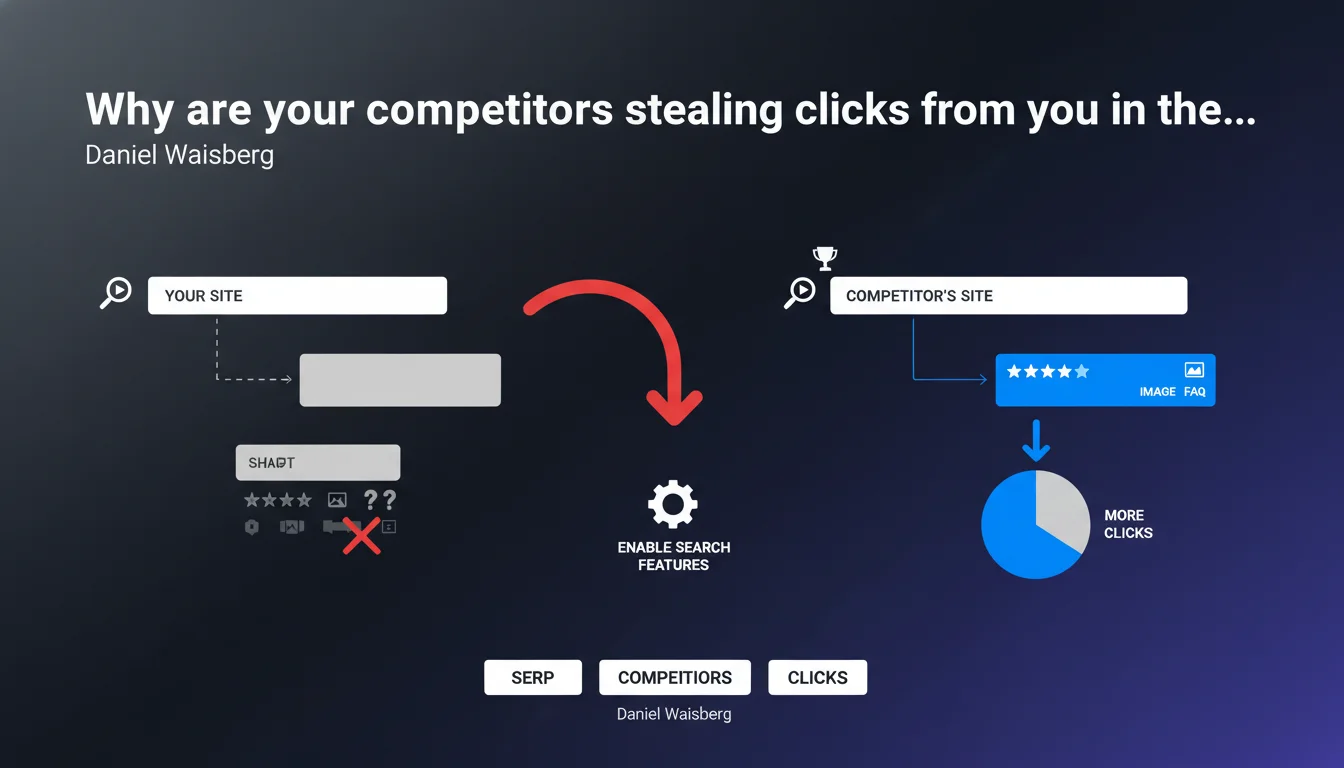
Google recommends enabling more search features (rich results, rich snippets) if your competitors are attracting more clicks than you. The message is clear: the days when simple ranking was enough are over — how your result displays matters just as much as your position.
What you need to understand
What exactly are these "search features" that Google is talking about?
Behind this generic term lies all the enriched formats that allow a result to stand out from the crowd: review stars, product prices, images, structured FAQs, recipes with prep time, video previews, events, breadcrumbs... Everything that transforms a basic blue link into a visually attractive result.
These features primarily rely on structured data (schema.org) that you implement in your code. Google reads these tags, understands your content type, and decides — or doesn't — to display a rich format.
Why does Google emphasize the competitive angle?
The wording is telling: "if your competitors are attracting more clicks". Google is pointing to differential CTR as the trigger for action. No point in optimizing in a vacuum — the issue is taking back ground from competitors who are leveraging these formats better.
It's an indirect admission: at equal ranking position, CTR becomes the deciding factor. A competitor ranked 3rd with review stars can siphon traffic from a 1st-position site without enrichment. Organic ranking is no longer enough — it's how your result displays that converts impressions into clicks.
Which search features have the biggest impact?
- Reviews and ratings (Review/AggregateRating): CTR boost of 15% to 35% depending on industry
- FAQ Schema: takes up more vertical space, pushing competitors lower
- Products (Product schema with price/availability): essential for e-commerce
- Breadcrumb: displays your breadcrumb navigation in the URL, improves readability
- Video (VideoObject): thumbnail preview that catches the eye
- How-to and Recipes: highly visual formats on mobile
SEO Expert opinion
Is this recommendation really new?
No. Google has been harping on this advice for years. What's changing is the more directive tone: "you should consider" sounds like a thinly veiled imperative. Competition for attention in the SERPs has gotten fiercer — users scan in 2 seconds, and an enriched result captures attention instantly.
What's less often mentioned: not all structured data guarantees rich display. Google reserves the right to ignore your tags if they're deemed irrelevant, manipulative, or if content quality doesn't match. I've seen perfectly marked-up sites that never get review stars — and Google never explains why. [Worth checking] case by case via Search Console.
What nuances should we consider?
First nuance: enabling features just for the sake of it makes no sense. If you force a FAQ Schema on every page with artificial questions, Google can detect manipulation and ignore the markup — or even penalize you. Relevance comes first.
Second nuance: CTR isn't everything. A site can spike its CTR with fraudulent review stars (5/5 across the board, fake reviews) and watch traffic collapse if bounce rate explodes afterward. Google observes post-click signals — if users bounce right back to the SERP, you'll lose ground.
When does this strategy fail?
Structured data won't save mediocre content. If your page ranks poorly (page 3+), your markup won't matter — no one will see it. Focus your efforts first on pages already on page 1, positions 4-10, where a CTR gain can shift traffic in your favor.
Another failure case: ultra-competitive sectors where everyone is already marked up. If all results display review stars, the advantage disappears — you're back to square one. Rich markup becomes the standard, not a differentiator.
Practical impact and recommendations
What should you actually do?
Start with a SERP audit of your results. Search your main keywords in Google and compare how your site displays versus competitors. Note who's showing stars, FAQs, images — and on which queries. That's your roadmap.
Next, prioritize high-potential pages: those already on page 1 with improvable CTR. Search Console gives you CTR by page and keyword — identify pages ranking 3-8 with below-average CTR for their position. These are your quick wins.
Implement relevant schemas for your industry. E-commerce? Product + AggregateRating. Local service? LocalBusiness + Review. Editorial content? Article + FAQ or HowTo. Test first with Google's Rich Results Test tool, then deploy.
What mistakes should you absolutely avoid?
- Never mark up hidden content — Google calls this cloaking and may penalize you
- Avoid generic ratings/reviews without verifiable sources — risk of manual action
- Don't lazy-duplicate the same schema across all pages — tailor the markup to actual content
- Don't forget to monitor: rich results can disappear without warning if Google changes its mind
- Don't neglect content quality behind the markup — high CTR with disappointing content works against you long-term
How do you verify your efforts are paying off?
Track two metrics in Search Console: average CTR per page before/after implementation (wait 2-3 weeks to see the effect) and the number of impressions with rich results via the "Enhancements" report. If CTR rises without position changes, you've won.
Regularly verify your rich results actually display in live SERPs — Google can validate your markup in the backend but not show it in production. Use an incognito browser window to see what users actually see.
Enabling search features is no longer optional — it's a competitive requirement. At equal ranking position, the site that displays better wins the click. Start by auditing competitors, prioritize high-ROI pages, and implement relevant schemas with rigor.
The main pitfall? Half-baked implementation. Between identifying the right schemas, validating syntax, avoiding ever-evolving Google guidelines traps, and monitoring actual SERP display, the project can quickly become time-consuming. If your teams lack the time or technical expertise to orchestrate these optimizations properly, guidance from a specialized SEO agency can accelerate compliance and secure deployment — especially if you manage a large catalog or complex content.
❓ Frequently Asked Questions
Les données structurées améliorent-elles directement le classement organique ?
Combien de temps faut-il pour qu'un résultat enrichi s'affiche après implémentation ?
Peut-on perdre ses résultats enrichis sans avoir modifié le code ?
Tous les types de contenu peuvent-ils bénéficier de résultats enrichis ?
Faut-il implémenter JSON-LD, Microdata ou RDFa ?
🎥 From the same video 11
Other SEO insights extracted from this same Google Search Central video · published on 13/04/2023
🎥 Watch the full video on YouTube →
💬 Comments (0)
Be the first to comment.