
Official statement
Other statements from this video 11 ▾
- □ Le CTR est-il vraiment un proxy fiable de la pertinence d'une requête ?
- □ Faut-il prioriser les requêtes à faible position mais CTR élevé pour maximiser son trafic organique ?
- □ Faut-il vraiment prioriser les requêtes déjà classées plutôt que de viser de nouveaux mots-clés ?
- □ Faut-il vraiment ignorer les requêtes non pertinentes qui génèrent du trafic ?
- □ Les données structurées volent-elles vraiment vos clics en première position ?
- □ Pourquoi vos concurrents captent-ils plus de clics que vous en SERP ?
- □ Les balises d'en-tête structurent-elles vraiment mieux le contenu pour Google ?
- □ Les données structurées garantissent-elles vraiment l'accès aux résultats enrichis ?
- □ Faut-il vraiment s'appuyer sur les mots connexes pour élargir sa stratégie de mots-clés ?
- □ Google Trends peut-il vraiment identifier les opportunités SEO avant vos concurrents ?
- □ Pourquoi un bon classement avec un faible CTR n'est-il pas forcément un problème ?
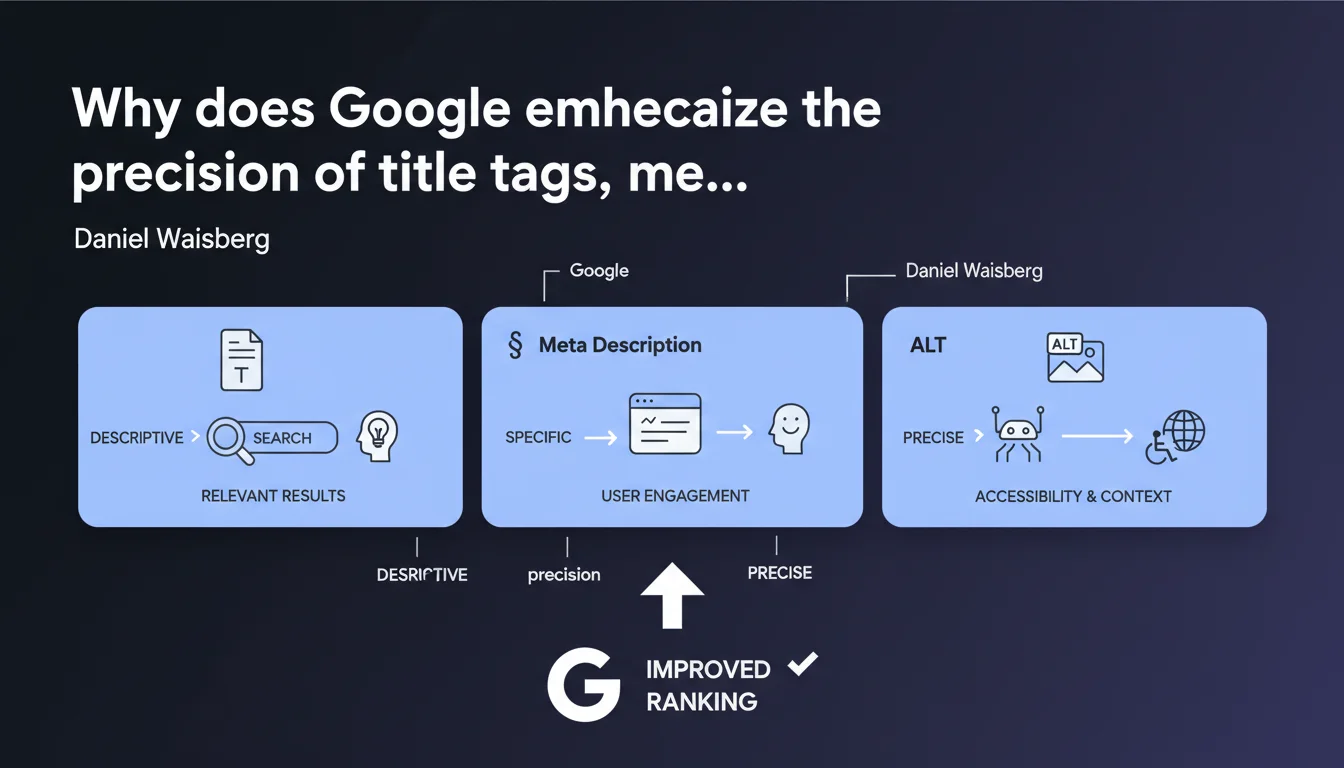
Google emphasizes that title tags, meta descriptions, and ALT attributes must be descriptive, specific, and precise. This generic statement underscores the importance of these elements for SEO, but deliberately remains vague about the exact quality criteria and their respective weight in the algorithm.
What you need to understand
What does "descriptive, specific, and precise" actually mean in practice?
Google uses three adjectives that seem to overlap without defining any measurable guideline. Descriptive implies that the element must accurately describe the content of the page or image. Specific suggests avoiding generic formulations that could apply to any page. Precise refers to the accuracy of the information, without ambiguity or approximation.
In practice, these three criteria boil down to a simple rule: each element must inform both the user and the search engine about what they will find, without any possible confusion. A title like "Home - Welcome" fails on all three counts.
- Title tags must reflect the main subject of the page with relevant keywords
- Meta descriptions serve as a commercial pitch in the SERPs — they must encourage clicks while remaining factual
- ALT attributes describe images for accessibility and image SEO, not just the filename
Why is Google making this statement now?
Daniel Waisberg's statement doesn't announce any algorithmic change — it's a reminder of the fundamentals. Google is likely observing a qualitative decline in these elements, particularly with massive automation and poorly configured templates.
The proliferation of auto-generated or poorly optimized sites is diluting search result quality. Google is therefore refocusing webmasters on these basics, knowing that a large portion of sites still neglect these elementary optimizations.
Do these elements really have an impact on rankings?
The title is a direct relevance signal and has been confirmed as influential forever — it clearly influences positioning. Meta descriptions have never been a direct ranking factor, but they impact CTR, which in turn indirectly influences positioning. ALT attributes count for image SEO and accessibility, two areas that Google values.
The trap here is believing that optimizing these tags is sufficient. They are signals among hundreds of others, and a perfect title tag won't save a page with weak content.
SEO Expert opinion
Does this statement bring anything new to the table?
Let's be honest: nothing new. These recommendations have been in Google's guidelines for fifteen years. What stands out is that Google feels the need to publicly remind everyone, which reveals two things — either the average quality of sites continues to degrade on these basic aspects, or Google is preparing to tighten algorithmic requirements on these criteria.
Without concrete data or specific examples in this statement, it's hard to know whether Google has observed a correlation between poor tags and reduced SERP performance, or if this is simply preventive advice. [To verify] across site samples to measure the real impact of fine-tuning these elements versus standard optimization.
What nuances should be applied to this recommendation?
The notion of "precision" can conflict with CTR optimization. A precise meta description may underperform compared to a persuasive meta description that plays on emotion or urgency. The best SEO professionals know that these tags must strike a balance between algorithmic signal and commercial copywriting.
Another rarely mentioned nuance: Google rewrites titles and descriptions in approximately 60% of cases displayed in the SERPs. So even if your tag is perfect, Google may decide to replace it with a snippet it deems more relevant for the query. This doesn't mean you should neglect these tags — quite the opposite, but it puts the obsession with the "perfect" title into perspective.
In what cases does this rule not apply strictly?
On e-commerce sites with large catalogs (tens of thousands of product pages), automating titles and descriptions remains inevitable. The objective then becomes creating intelligent templates that inject the right variables (brand, model, product attributes) rather than generic formulas.
For pagination pages or low-value filter pages, the investment in ultra-optimized tags isn't always justified — better to concentrate efforts on high-traffic-potential pages. The Pareto principle applies here as elsewhere.
Practical impact and recommendations
What should you concretely do to optimize these tags?
Start with a title tag audit: detect duplicates, titles that are too short (less than 30 characters) or too long (more than 60 characters), and those that don't contain the main keyword for the page. Tools like Screaming Frog or OnCrawl allow you to extract this data in bulk.
For meta descriptions, verify they exist on all strategic pages (no empty or duplicate tags), they are between 140 and 160 characters, and they contain a differentiating element or a light call-to-action. If Google systematically rewrites them, test variations.
Regarding ALT attributes, scan important images (product visuals, infographics, diagrams) and write contextual descriptions. "product-photo-123.jpg" is not an ALT — "Blue waterproof trail shoes model X" is.
What mistakes must you absolutely avoid?
- Identical titles across multiple pages — each page must have its own unique title
- Generic auto-generated meta descriptions without context ("Discover our page")
- ALT attributes stuffed with keywords unrelated to the image
- Titles exceeding 60 characters that get truncated in the SERPs, losing their meaning
- Forgetting to update these tags after content redesigns or positioning changes
How do you verify that your site is compliant?
Run a complete crawl with an SEO technical tool (Screaming Frog, OnCrawl, Botify) and export the title tags, meta descriptions, and ALT attributes. Identify anomalies: duplicates, missing tags, inappropriate length. Prioritize fixes based on traffic and SEO potential of each page.
Then test actual display in the SERPs using tools like SEOmofo or SERP Simulator to verify your tags aren't truncated and remain readable. Compare what you wrote with what Google actually displays — if the gap is systematic, adjust your strategy.
❓ Frequently Asked Questions
Google prend-il vraiment en compte les meta descriptions pour le classement ?
Pourquoi Google réécrit-il mes balises title et descriptions ?
Quelle est la longueur optimale pour un title et une meta description ?
Les attributs ALT améliorent-ils vraiment le SEO hors référencement image ?
Faut-il optimiser ces balises sur toutes les pages ou seulement les pages stratégiques ?
🎥 From the same video 11
Other SEO insights extracted from this same Google Search Central video · published on 13/04/2023
🎥 Watch the full video on YouTube →
💬 Comments (0)
Be the first to comment.